Beyond the Classroom

Beyond the Classroom

Theatre Arts Program

Students participate in a myriad of co-curricular activities, including plays, concerts, art exhibits, workshops, presentations, competitions, tournaments, field trips, and conferences.

Student Collaborations

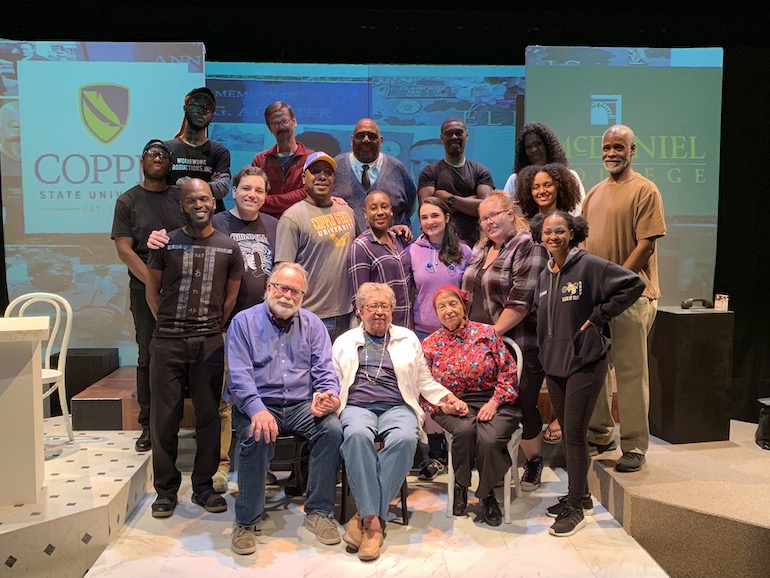
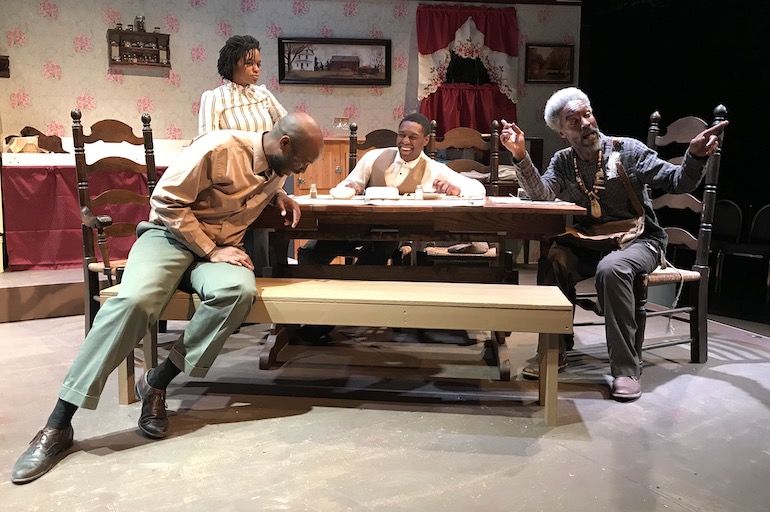
BestofEnemies8404 theatre performance

Our theatre students participate in a range of collaborative and community service projects with other student organizations and with other colleges and universities.

Recent collaborations include participation in Bowie State University’s annual Ten Minute Play Festival and a co-production on the show, Best of Enemies with McDaniel College.

Students also work with professional theatre practitioners as guest directors, actors, designers and playwrights (One Night Only, Harlem Song, Brother’s Keeper).


Internships


Our students have participated in various internship opportunities, such as:

  • Daniel Carter, Ensemble Theatre of Houston, TX
  • Louis Williams, III, Baltimore Shakespeare Factory
  • Dorrian Wilson, Chesapeake Shakespeare Theatre
  • Anthony Murcia-Santos, The Juilliard School
  • Juan Ogando, Upright Citizens Brigade in NYC
  • Kai Crosby-Singleton, Baltimore Center Stage
  • Anthony Murcia-Santos, Baltimore Center Stage

Advanced Study Opportunities

Coppin State theatre students go on to advanced study, such as:

  • Dorrian Wilson, MFA Acting Program, University of North Carolina at Chapel Hill
  • Mama Rashida Foreman-Bey, MFA Community Arts Program, Mrayland Institute College of Art (MICA)
  • Dorrian Wilson and Ryan Pratcher-Bey, the Kennedy Center

Broadway Field Trips

Students are encouraged to participate in our trips to professional productions. Past activities have included:

  • The Color Purple. Students interviewed Natasha Williams, who played Sofia.
  • Cat on A Hot Tin Roof. Students participated in a talk-back with cast member Anika Noni Rose, who played Maggie the Cat.
  • Porgy and Bess. Students participated in a talk-back with cast members Natasha Williams (Mariah) and Norm Lewis (Porgy).
  • Chicago. Students participated in a talk-back with cast members Brandy Norwood (Roxie), Natasha Williams and full cast.
  • The Lion King. Students interviewed L. Steven Taylor who plays Mufasa.
  • A Soldier’s Play

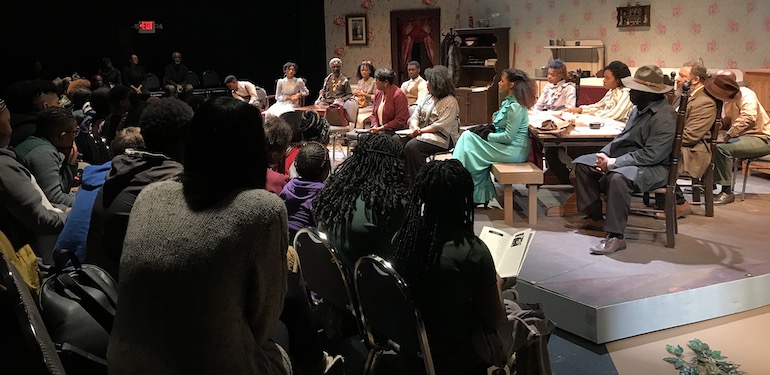
TalkbackJoeTurnersF19 theatre performance

Engaging the Community

Our theatre students participate in a range of community activities, including:

  • Summer theatre program
  • Performances at Churches
  • Audience talk-backs after all theatre performances

Regional and National Competitions

Coppin State theatre students participate in regional and national competitions, such as:

  • NADSA
  • KCACTF, one of the few HBCUs participating
  • Forensics Tournaments

School Matinee Performances

  • Middle and high school students

Participating in Public Showcases

  • Acting I
  • Acting II
  • Acting III
  • Unscripted: Improvisation for the Actor
  • Oral Interpretation
  • Directing
  • We Heart Art Festival

Our Programs

Theatre

Undergraduate

Dance

Undergraduate

Urban Arts

Undergraduate

African American Studies

Undergraduate

Contact Us

The faculty provides nurturance through instruction, leadership, mentorship, advice, and interactive learning methods to engage students in theory, scholarship, practice, and community service.  In addition to the staff and faculty listed below, we'd like to thank the following Adjunct Faculty team members too:

Auditorium Technical Liaison

staff

Assistant Professor

faculty

Assistant Professor

faculty

Can Help With
Theatrical Design, especially Lighting Design
Theatre History
Theatre Safety
College

The Theatre Program is within the Department of Humanities in the College of Arts & Sciences, and Education. 
Theatre Arts Program

Theatre Arts Program

Department of Humanities

We Nurture. We Engage. We Transform.

The arts are essential to our lives!  Theatre art is an avenue to intellectual, social, personal, professional development, and enrichment. The theatre concentration in the Urban Arts major prepares students for careers in theatre and related disciplines through character, leadership, and service for building relationships and community. The program supports the following fundamental beliefs and values:

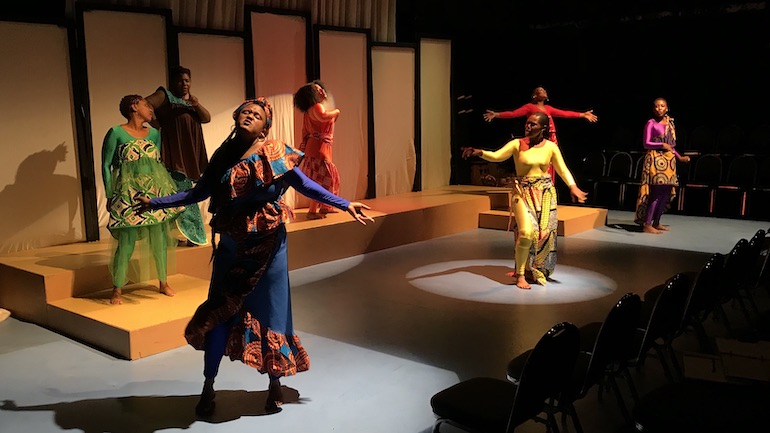
theatre perofrmance

Excellence, the highest artistic quality

Integrity, the highest standards of honesty and fairness in the pursuit of equitable, ethical, and professional practice. 

Lifelong Learning the best continuous training for artistry, knowledge, and skills

Service is our noble and worthy responsibility to our community

Diversity of opinion, freedom of expression and each person’s individuality. 

Creativity in all endeavors. 

Commitment to the arts and to the mission of the University its role in supporting the highest quality of life 

Intellectual Freedom for the ethical and scholarly inquiry in an environment that fully respects the rights of all in their pursuit of knowledge

Stewardship of Resources dedicated to the efficient and effective use as we accept the responsibility of public trust and accountability for our actions 

SoldiersPlay5769 interior theatre

The Theatre concentration focuses on the student as the center of the educational enterprise. We place a high premium on nurturing, engaging, and transforming the individual so that creativity is expressed with honor and value. Learn about theater-related jobs.

Our academic program is ably supported by Coppin Repertory Theatre, the producing arm and Coppin Players, a student run organization where our students collaborate, invest, and own the work they do.

Apply Now

Learn about the Theatre Scholarship

Our Programs

Dance

Undergraduate

Urban Arts

Undergraduate
5 brown-skin young women each wearing a brightly colored shirt sitting closely grouped together with their arms outstretched and open

Current Theatre Season

Coppin State University Hosts the 84th Annual Conference National Association of Dramatic and Speech Arts (NADSA) - April 6-9, 2022

Coppin Repertory Theatre will host the 84th Annual Conference of NADSA, an association of students, faculty, staff, alumni, and other arts/entertainment professionals from historically black colleges and universities across the country. Founded in 1936, NADSA is the nation’s oldest surviving educational theatre association. The annual conference features workshops, competitions, performances, and plenaries. Attendees use NADSA as an opportunity to network, build skillsets, and share best practices in the field.

Contact Us

The faculty provides nurturance through instruction, leadership, mentorship, advice, and interactive learning methods to engage students in theory, scholarship, practice, and community service.  In addition to the staff and faculty listed below, we'd like to thank the following Adjunct Faculty team members too:

Auditorium Technical Liaison

staff

Assistant Professor

faculty

Assistant Professor

faculty

Can Help With
Theatrical Design, especially Lighting Design
Theatre History
Theatre Safety
College

The Theatre Program is within the Department of Humanities in the College of Arts & Sciences, and Education. 
Application Process

Application Process

Maxie Collier Scholars Program

Speak to
Julie Manley
Health & Human Services Building, Room #339

Thank you for your interest in the Maxie Collier Scholars Program at Coppin State University. The Program has a strong legacy of preparing undergraduate Scholars for professional careers in the field of public behavioral health services.

Application Packet

Please complete and include the following documents in your application packet: 

  • Application 
  • Personal Statement: Responses to three questions on application 
  • Signed applicants’ agreement included in application 
  • Proof of Maryland residency 
  • Three submissions addressing your strengths and why you should be selected as a Scholar. Two submissions from CSU professors and one submission from a community person (examples: supervisor, clergy member, volunteer coordinator ). Submissions are due by March 17, 2021 and may be submitted to Maxie Collier Scholars Program Recommendation Form.

Submit Your Application Packet 

Applications may be submitted in person or by email. Please submit the complete application packet to: 

Important Dates 

Please be reminded of the following important dates: 

  • January 20, 2021 - Applications available 
  • March 17, 2021 - Deadline to submit completed Applications and Recommendations
  • April 7, 2021 - Interviews for Applicants 

Please feel free to reach out if you have additional questions.

Sincerely,

Julie Manley, MCSP Program Coordinator

Faculty and Staff

Please don't hesitate to reach out with questions. Your future starts now!

Julie Manley
Lecturer

staff

Can Help With
SheCare Wellness Pods

Criteria for Scholars

Criteria for Scholars

Maxie Collier Scholars Program

  • From the State of Maryland 
  • Officially enrolled as a Coppin State University undergraduate student
  • Have a minimum of 1 year remaining as an undergraduate student at CSU
  • 3.0 minimum GPA preferred
  • Declared major in criminal justice, natural sciences, nursing, psychology, or social work
  • Commitment to pursue a behavioral health career in the State of Maryland
  • Completed Application to include a required personal statement
  • High rating in a required personal interview
  • Three letters of support from recommended sources
  • Official college transcript

Completed applications should be returned to:

Maxie Collier Scholars Program Coordinator
Coppin State University
2500 W. North Avenue, HHSB Room #523 or 339
Baltimore, MD 21216

Graduation Requirements

The Mental Health Seminar HEED 105 is a graduation requirement for Maxie Collier Scholars.

Participating Departments

In order to participate in the Maxie Collier program students must declare a major in the following departments/schools:

  • Helene Fuld School of Nursing
  • Psychology, Counseling & Behavioral Health
  • Department of Criminal Justice
  • Department of Natural Sciences
  • Department of Social Work

Faculty and Staff

Please don't hesitate to reach out with questions. Your future starts now!

Julie Manley
Lecturer

staff

Can Help With
SheCare Wellness Pods

About Dr. Collier

About Dr. Collier

Maxie Collier Scholars Program

Speak to
Julie Manley
Health & Human Services Building, Room #339

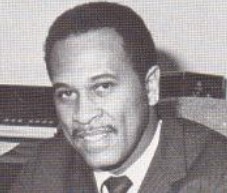
Honoring the name of a prominent practitioner, Dr. Maxie T. Collier, lends prestige and honor to a scholars program designed to increase the number of minority professionals in the field of Mental Health.

Maxie Collier graduated from Vanderbilt University in Nashville, Tennessee with a degree in psychology in 1967. He graduated from the University of Maryland School of Medicine in 1977. Dr. Collier began his private practice in 1980 where he offered his expertise in the areas of family therapy, individual psychodynamic therapy, and forensic psychiatry. In 1987, Dr. Collier became the Chief of Psychiatry for the Johns Hopkins Health Plan where he was responsible for the management and supervision of mental health services including outpatient treatment, inpatient admission, and rehabilitative services.

Dr. Collier sat on numerous boards and committees, including the Baltimore City Medical Society Board of Directors, Baltimore Urban League Executive Board, Congressman Benjamin Cardin's Health Advisory Committee, and the University of Maryland School of Medicine Admissions Committee.

In addition to his many professional activities, Dr. Collier was an Assistant Professor of Psychiatry at the Johns Hopkins Hospital and an Assistant Professor at the University of Maryland School of Medicine.

Dr. Collier created "The Baltimore Project," a novel prenatal care project aimed at reducing infant mortality and future unwanted pregnancies. He established the Baltimore City Health Consortium, which acts as a resource for health care partnerships, and the Health Expo intended to recruit high school juniors and seniors into the field of health. Dr. Collier also created an office of Minority Health to conduct research and education and to orient Baltimore Health Department services to better serve minorities. From 1987 to 1990, Dr. Collier served as the Commissioner of Health for Baltimore City, a cabinet level appointee of the Mayor.

Prior to his unexpected death in April of 1994, Dr. Maxie T. Collier was President of Spectrum Development Services, Inc. and in addition provided consultative services for the Green Spring Mental Health Services, Inc.

Faculty and Staff

Please don't hesitate to reach out with questions. Your future starts now!

Julie Manley
Lecturer

staff

Can Help With
SheCare Wellness Pods

Maxie Collier Scholars Program

Maxie Collier Scholars Program

Purpose of the Maxie Collier Program

The Maxie Collier Scholars Program is a behavioral health workforce development program for Coppin State University undergraduate students who reside in the State of Maryland. The purpose of the Maxie Collier Scholars Program is to prepare promising undergraduate students at Coppin State University for completion of undergraduate school requirements and placement in professional behavioral health career positions in the State of Maryland.

More specifically, the charge is to prepare Coppin State University students from the fields of Criminal Justice, Elementary Education, Health Sciences, Natural Sciences, Nursing, Psychology, and Social Work, with a recommended minimum of two years remaining for completion of undergraduate work, who will be well trained and available to serve children, adolescents and their families in the Baltimore Metropolitan area.

The Program is funded by the Behavioral Health Administration and the Maryland Department of Health. Partners of the Program include the University of Maryland at Baltimore, University of Maryland Baltimore County, Behavioral Health Systems, Baltimore, and the Black Mental Health Alliance.

Criteria for Scholars

Program Goals

The goal of the Maxie Collier Scholars Program is to educate and recruit more African-American professionals into professional behavioral health career positions in the State of Maryland.

Maxie Collier Scholars receive an enriched, career focused, academic background; financial support; graduate school preparation; internship experience; access to a network of career placement resources; and financial resources which encourage and support their educational advancement.

Program Elements

  • Behavioral Health Seminar (Emerging Issues in Behavioral Health and Well Being)
  • Internships
  • Stipends
  • Graduate School Mentors
  • Individual Advisement
  • Coppin Undergraduate Faculty Advisors
  • Enrichment Activities
Dr. Maxie T. Collier

The program is expected to promote college-wide interest in behavioral health issues at CSU. It is also expected to increase community awareness of resources to assist people who are interested in a career in the field of behavioral health.

The project is named for the late Dr. Maxie T. Collier, former Baltimore City Commissioner of Health and practicing psychiatrist.

How to Apply

Please complete no later than February 27, 2026, 5:00pm:

  • Program application *Please refrain from using Artificial Intelligence (AI) to complete your application.
  • Online Recommendation Form: TWO SUBMISSIONS: One submission from a CSU professor addressing your strengths and why you should be selected as a Scholar; Second submission from a community leader, supervisor, mentor.

Eligible Applicants will be invited for interviews.

Application Process

Faculty and Staff

Please reach out with questions. Your future starts now!

Julie Manley
Lecturer

staff

Can Help With
SheCare Wellness Pods
Administrative Assistant

staff

Can Help With
SheCare Wellness Pods

Social Work Resources

Social Work Resources

Department of Social Work

The Social Work Student Experience

The Social Work program is much more than the curriculum. We educate, advocate, and continuously create opportunities for our students to shine.

Social Work Association

20 years ago, the Department Chair, Eloise Bridges founded the Coppin State University Social Work Association. She established this student organization to:

  • help students learn about the field of Social Work.
  • assist students in planning social work career goals.
  • provide a mutual support system for students' educational and personal needs.
  • provide services that support campus, neighborhood, and  community well-being.
  • increase awareness on the Coppin campus of the Social Work program.

Social Work Honor Society

Phi Alpha Honor Society is the national honor society for students studying social work. Coppin State University is home to the Theta Rho chapter which was chartered in 1999. A primary goal of Phi Alpha is to nurture closer bonds among students of social work as well as promote humanitarian goals and ideals. It continues to foster high standards of education for social workers and invites into membership those who have attained excellence in scholarship and achievement in social work.

Theta Rho inducts new members annually, and also conducts 2 meetings every year. The first meeting hosts a speaker, and the second one is a business meeting. Students run the business of the Theta Rho chapter under faculty advisement.

Admissions Eligibility

Any student who meets the eligibility criteria automatically gets an invitation to join. Once a student receives the invitation, they may submit an application. To be eligible for Phi Alpha admission, a student must have:

  • Declared social work as a major
  • Achieved sophomore status
  • Completed 9 semester hours of required social work courses
  • Achieved top 35% of the social work major

Social Work Alumni Association

The Social Work Alumni Association commits to support, mentor, and advocate the needs of students, social work faculty, and the University. It also exists to:

  • maintain a close relationship between alumni and the University
  • support the social work program
  • promote the University's growth and development

Membership

Any graduate of the Coppin State University's Social Work Program may join the Social Work Alumni Association. Membership dues cost $40.00 per year.

Maxie Collier Scholars Program

The goal of the Maxie Collier Scholars Program is to educate and recruit more African-American professionals into public mental health and to address the shortage of trained clinicians available to serve seriously emotionally disturbed children, adolescents, and their families.

Influencing State Policy

Influencing State Policy (ISP) is an open group of policy-minded people who are interested in informing, creating, and evaluating state-level policy. Founded in Chicago in 1997 by social workers and educators, ISP works to help increase the efficacy of those in the social work profession in influencing policy and legislation.

Department of Social Work Student Handbook

The Department of Social Work Student Handbook is the catalog for the social work degree program at Coppin State University. The Handbook includes:

  • a description of the social work profession.
  • social work course descriptions and requirements.
  • faculty profiles.
  • admissions policies and procedures.

Several appendices include important documents for social work majors, including a degree check sheet that enables each student to track progress through the social work curriculum.

Dorothy I. Height Center for the Advancement of Social Justice

The Dorothy I. Height Center for the Advancement of Social Justice is a community-based resource that focuses on community engagement through social justice-related education, advocacy, research and referrals. The Center honors Dr. Height’s name and contributions by actualizing her visions, applying her strategies, and emulating her determination to affect positive social change locally and beyond. Our mission is to heighten awareness regarding national and international human rights and social justice issues that impact marginalized populations and communities.

Faculty and Staff

Our faculty and staff represent diverse professional, academic, and ethnic backgrounds. We work tirelessly to ensure we carry out our tradition of professionalism, high industry standards, and student success.

Melissa Buckley
Chair and Associate Professor

faculty

Professor

faculty

Dr. Jeronda Burley
Associate Professor

faculty

Can Help With
Advising
Social Work Association (SWA)
Administrative Assistant

staff

Can Help With
SheCare Wellness Pods
Assistant Professor

faculty

Can Help With
Qualitative Research Methods
Aging, Dementia
Student Advising, Honor Society
College

The Department of Social Work is within the College of Behavioral and Social Sciences. 

Institutional Review Board

Institutional Review Board

Academic Affairs


irb logo

The Coppin State University Institutional Review Board (IRB) reviews all human research conducted under the auspices of Coppin State University.

The protection of human Subjects is of utmost importance. As such, we believe it is important to provide a “user friendly” environment by which you can seek approval to conduct research using human subjects at Coppin State University.

The IRB will not review applications for projects that are already completed. If a project is already underway, research should be immediately suspended until the application has been reviewed.

Function

The function of the IRB is to ensure adherence to all federal, state, local, and institutional regulations concerning the protection of human subjects in research. All human research conducted at CSU or associated with the university must receive IRB review and approval prior to conducting the research.

Application to Use Human Subjects in Research

The Application to Use Human Subjects in Research and appropriate forms should be completed and submitted to irb@coppin.edu. You will receive a response within 14 business days after the IRB has met.

The CSU Human Subjects Handbook provides guidance for applicants.

Should you have questions, please do not hesitate to contact the IRB Chair at irb@coppin.edu.

Begin Your Application

CITI (Collaborative Institutional Training Initiative) Program

Effective January 1, 2025 Principal Investigators, Faculty Advisors (for students serving as PIs), Co-PIs and research team members who will interact with human subjects and/or their identifiable data for the purposes of research must complete CITI Training before the Initial Application, Amendment Application, Continuing Review Application can be fully approved, or they must be temporarily removed from the research team until the training has been completed.

Register for training

CITI Program, Collaborative Institutional Training Initiative

CITI Program

The CITI Program (Collaborative Institutional Training Initiative) is a professional development educational program designed to train researchers and administrators in research.

Meeting Schedule

IRB monthly meetings are held on the 4th Wednesday of each month from August to May.

  • August 27, 2025
  • September 24, 2025
  • October 22, 2025
  • November 19, 2025
  • December 17, 2025  
  • January 28, 2026
  • February 25, 2026
  • March 25, 2026
  • April 22, 2026
  • May 27, 2026

Contact us

In addition to the names you see below of the people in our Coppin community who are serving on the Institutional Review Board, we are grateful for our Community Member's service, Ms. Sharon Dow.

Chairperson and Professor/Coordinator World Literature Program

faculty

Can Help With
Advising
Teaching
Schedule Classes
Professor

faculty

Can Help With
Courses in the Clinical Mental Health Counseling Rehabilitation Master's Program
Professor

faculty

Can Help With
Advisement
Jennifer Pope
Assistant Professor

faculty

Graduate Program Coordinator & Associate Professor

faculty

Assistant Professor

faculty

Can Help With
Qualitative Research Methods
Aging, Dementia
Student Advising, Honor Society
Professor of Chemistry

faculty

Can Help With
Solar Cell Fabrication and Characterization
Nanomaterial Synthesis, Characterization and Application
Electrospinning and its applications

Field Education

Field Education

Department of Social Work

Mon-Fri 8:30 am - 5:00 pm
Henrietta Lacks Health & Human Services Building, Room 527
(410) 951-3536

Through fieldwork, students get to put their skills, commitment, and knowledge directly to practice, while seeing how interventions can make an impact in clients' lives.

The Value of Fieldwork

Fieldwork is an important part of the social work curriculum because it allows students to the opportunity to apply theories, and concepts learned in the classroom to experiences in the field through a supervised placement.

The goal of field instruction is to engage students in supervised direct and indirect service activities and provide practical experience in all the foundation competency areas as guided by the Council on Social Work Education (CSWE). This effort is accomplished through partnerships with a variety of agencies that meet the required learning outcomes as outlined in the Social Work Field Education Manual.

Through fieldwork, students identify professional strengths and growth areas, while also gaining the skills, knowledge, and values needed to succeed as a social work practitioner and leader.

Fieldwork Eligibility

Each student is responsible for becoming familiar with the social work requirements for the major as outlined in the University Catalog. To qualify for a field placement, a student must:

  • Be accepted as a full social work major (no pre-social work majors)
  • Complete the following courses with a grade of C or better by the end of the spring semester before field work begins:
    • SOWK 210
    • SOWK 260
    • SOWK 379
    • SOWK 388
  • Have a minimum cumulative 2.5 grade point average by the end of the semester before your placement begins
  • Be able to graduate within 3 semesters of starting field work
  • Submit all application materials by the appropriate deadline:
    • March 31st for fall placement
  • Regularly demonstrate responsible and professional student conduct as outlined in the Social Work Field Education Manual.

Frequently Asked Questions (FAQs)

Field Placement provides students with the opportunity to apply the knowledge, skills, and values learned in the classroom setting in practical experiences within social service agencies.

The department notifies all social work students by email about a field interest meeting. During the field interest meeting, students learn about the field process and have an opportunity to ask questions. Field experience may provide opportunities for students to match with specific agencies or client populations, if available.

To start the field placement process, students must electronically apply for field placement. The department does not accept any applications faxed or emailed to the Field Education Office. Students may be matched with agencies and/or particular client populations they would like to work with (provided such an agency is available).

Field placement process infographic

Day and evening students must spend 14-16 hours per week in an internship over two academic semesters for a minimum of 400 hours of field placement. Students and Field Instructors/Field Coordinators have the ability to determine the students’ field schedule. However, most students are at the agencies during the day between Monday-Friday. Students requiring evening and/or weekend hours must coordinate a workable schedule with the agency during operating hours and other staff members are present onsite (if the placement is onsite). For most students, field starts in the fall and continues through the spring semester. If necessary, placements can be arranged to extend through the summer months.

The University cannot guarantee field placement on either weekend or evening hours because most agencies don't have available supervision after 5:00 p.m. The University has a limited number of student placements with non-traditional hours. You will need to plan ahead and save leave time with current employers.

Students are permitted the opportunity to have a place of employment placement with their employer. The employer will be required to enter an affiliation with the university and be able to provide the student with a learning experience for you to obtain competence in the 9 Core Competencies. Students are also required to submit a place of employment proposal.

A field instructor must have a MSW and at least 2 years of postgraduate professional social work experience. The Field Instructor will supervise, monitor, and evaluate interns in their fieldwork, overseeing the entire range of field experience.

The field liaison is an employee of the Department of Social Work who provides a link between the student and the agency. This person also teaches your field seminar courses.

The task supervisor is not required to hold an MSW degree, although they are expected to have experience with the agency. Their role is to work with the student directly on a daily basis regarding specific tasks, client services, and agency operations.

Contact Us

Contact the Office of Field Education at socialworkfieldeducation@coppin.edu or by phone at (410) 951-3537.

Director of Field Education

faculty

Office of Sponsored Programs and Research

Office of Sponsored Programs and Research

Office of Planning & Assessment

Project Proposal with stack of documents and keyboard

The Office of Sponsored Programs and Research (OSPR) is institutionally responsible for all pre-award and non-financial post-award functions, including proposal submissions, the negotiation and acceptance of all sponsored agreements on behalf of Coppin State University, award modifications, subrecipient monitoring and non-financial closeout of awards.

Our office works with the unit administrators to provide assistance to administration/faculty/staff with proposal preparation, applicable sponsor guidelines, as well as sponsored programs training, education and communication. OSPR works closely with the Institutional Review Board (IRB) to safeguard and protect human research subjects and in conducting responsible research and the Office of Grants and Contracts in managing all extramural awards and campus outreach initiatives for sponsored projects.

Contact us

Administrative Assistant II

staff