Social Work Resources

Social Work Resources

Department of Social Work

The Social Work Student Experience

The Social Work program is much more than the curriculum. We educate, advocate, and continuously create opportunities for our students to shine.

Social Work Association

20 years ago, the Department Chair, Eloise Bridges founded the Coppin State University Social Work Association. She established this student organization to:

  • help students learn about the field of Social Work.
  • assist students in planning social work career goals.
  • provide a mutual support system for students' educational and personal needs.
  • provide services that support campus, neighborhood, and  community well-being.
  • increase awareness on the Coppin campus of the Social Work program.

Social Work Honor Society

Phi Alpha Honor Society is the national honor society for students studying social work. Coppin State University is home to the Theta Rho chapter which was chartered in 1999. A primary goal of Phi Alpha is to nurture closer bonds among students of social work as well as promote humanitarian goals and ideals. It continues to foster high standards of education for social workers and invites into membership those who have attained excellence in scholarship and achievement in social work.

Theta Rho inducts new members annually, and also conducts 2 meetings every year. The first meeting hosts a speaker, and the second one is a business meeting. Students run the business of the Theta Rho chapter under faculty advisement.

Admissions Eligibility

Any student who meets the eligibility criteria automatically gets an invitation to join. Once a student receives the invitation, they may submit an application. To be eligible for Phi Alpha admission, a student must have:

  • Declared social work as a major
  • Achieved sophomore status
  • Completed 9 semester hours of required social work courses
  • Achieved top 35% of the social work major

Social Work Alumni Association

The Social Work Alumni Association commits to support, mentor, and advocate the needs of students, social work faculty, and the University. It also exists to:

  • maintain a close relationship between alumni and the University
  • support the social work program
  • promote the University's growth and development

Membership

Any graduate of the Coppin State University's Social Work Program may join the Social Work Alumni Association. Membership dues cost $40.00 per year.

Maxie Collier Scholars Program

The goal of the Maxie Collier Scholars Program is to educate and recruit more African-American professionals into public mental health and to address the shortage of trained clinicians available to serve seriously emotionally disturbed children, adolescents, and their families.

Influencing State Policy

Influencing State Policy (ISP) is an open group of policy-minded people who are interested in informing, creating, and evaluating state-level policy. Founded in Chicago in 1997 by social workers and educators, ISP works to help increase the efficacy of those in the social work profession in influencing policy and legislation.

Department of Social Work Student Handbook

The Department of Social Work Student Handbook is the catalog for the social work degree program at Coppin State University. The Handbook includes:

  • a description of the social work profession.
  • social work course descriptions and requirements.
  • faculty profiles.
  • admissions policies and procedures.

Several appendices include important documents for social work majors, including a degree check sheet that enables each student to track progress through the social work curriculum.

Dorothy I. Height Center for the Advancement of Social Justice

The Dorothy I. Height Center for the Advancement of Social Justice is a community-based resource that focuses on community engagement through social justice-related education, advocacy, research and referrals. The Center honors Dr. Height’s name and contributions by actualizing her visions, applying her strategies, and emulating her determination to affect positive social change locally and beyond. Our mission is to heighten awareness regarding national and international human rights and social justice issues that impact marginalized populations and communities.

Faculty and Staff

Our faculty and staff represent diverse professional, academic, and ethnic backgrounds. We work tirelessly to ensure we carry out our tradition of professionalism, high industry standards, and student success.

Melissa Buckley
Chair and Associate Professor

faculty

Professor

faculty

Dr. Jeronda Burley
Associate Professor

faculty

Can Help With
Advising
Social Work Association (SWA)
Administrative Assistant

staff

Can Help With
SheCare Wellness Pods
Assistant Professor

faculty

Can Help With
Qualitative Research Methods
Aging, Dementia
Student Advising, Honor Society
College

The Department of Social Work is within the College of Behavioral and Social Sciences. 
Institutional Review Board

Institutional Review Board

Academic Affairs


irb logo

The Coppin State University Institutional Review Board (IRB) reviews all human research conducted under the auspices of Coppin State University.

The protection of human Subjects is of utmost importance. As such, we believe it is important to provide a “user friendly” environment by which you can seek approval to conduct research using human subjects at Coppin State University.

The IRB will not review applications for projects that are already completed. If a project is already underway, research should be immediately suspended until the application has been reviewed.

Function

The function of the IRB is to ensure adherence to all federal, state, local, and institutional regulations concerning the protection of human subjects in research. All human research conducted at CSU or associated with the university must receive IRB review and approval prior to conducting the research.

Application to Use Human Subjects in Research

The Application to Use Human Subjects in Research and appropriate forms should be completed and submitted to irb@coppin.edu. You will receive a response within 14 business days after the IRB has met.

The CSU Human Subjects Handbook provides guidance for applicants.

Should you have questions, please do not hesitate to contact the IRB Chair at irb@coppin.edu.

Begin Your Application

CITI (Collaborative Institutional Training Initiative) Program

Effective January 1, 2025 Principal Investigators, Faculty Advisors (for students serving as PIs), Co-PIs and research team members who will interact with human subjects and/or their identifiable data for the purposes of research must complete CITI Training before the Initial Application, Amendment Application, Continuing Review Application can be fully approved, or they must be temporarily removed from the research team until the training has been completed.

Register for training

CITI Program, Collaborative Institutional Training Initiative

CITI Program

The CITI Program (Collaborative Institutional Training Initiative) is a professional development educational program designed to train researchers and administrators in research.

Meeting Schedule

IRB monthly meetings are held on the 4th Wednesday of each month from August to May.

  • August 27, 2025
  • September 24, 2025
  • October 22, 2025
  • November 19, 2025
  • December 17, 2025  
  • January 28, 2026
  • February 25, 2026
  • March 25, 2026
  • April 22, 2026
  • May 27, 2026

Contact us

In addition to the names you see below of the people in our Coppin community who are serving on the Institutional Review Board, we are grateful for our Community Member's service, Ms. Sharon Dow.

Chairperson and Professor/Coordinator World Literature Program

faculty

Can Help With
Advising
Teaching
Schedule Classes
Professor

faculty

Can Help With
Courses in the Clinical Mental Health Counseling Rehabilitation Master's Program
Professor

faculty

Can Help With
Advisement
Jennifer Pope
Assistant Professor

faculty

Graduate Program Coordinator & Associate Professor

faculty

Assistant Professor

faculty

Can Help With
Qualitative Research Methods
Aging, Dementia
Student Advising, Honor Society
Professor of Chemistry

faculty

Can Help With
Solar Cell Fabrication and Characterization
Nanomaterial Synthesis, Characterization and Application
Electrospinning and its applications

Field Education

Field Education

Department of Social Work

Mon-Fri 8:30 am - 5:00 pm
Henrietta Lacks Health & Human Services Building, Room 527
(410) 951-3536

Through fieldwork, students get to put their skills, commitment, and knowledge directly to practice, while seeing how interventions can make an impact in clients' lives.

The Value of Fieldwork

Fieldwork is an important part of the social work curriculum because it allows students to the opportunity to apply theories, and concepts learned in the classroom to experiences in the field through a supervised placement.

The goal of field instruction is to engage students in supervised direct and indirect service activities and provide practical experience in all the foundation competency areas as guided by the Council on Social Work Education (CSWE). This effort is accomplished through partnerships with a variety of agencies that meet the required learning outcomes as outlined in the Social Work Field Education Manual.

Through fieldwork, students identify professional strengths and growth areas, while also gaining the skills, knowledge, and values needed to succeed as a social work practitioner and leader.


Learn · Lead · Liberate in Field Education

The theme Learn · Lead · Liberate is woven throughout every stage of the BSW student experience, especially in field education. Students learn by applying classroom theories to supervised practice, developing core social work skills, and identifying strengths through reflective supervision and real‑world engagement. They lead by demonstrating professionalism, initiative, and ethical responsibility as they collaborate with agencies, support client needs, and grow into emerging practitioners. They liberate by promoting empowerment, equity, and social justice—advocating for individuals, families, and communities while advancing the mission and values of the social work profession.

Together, these themes illustrate the developmental journey students undertake in field—building competence, strengthening leadership capacity, and contributing to meaningful change—while mirroring the purpose of fieldwork itself: transforming students into thoughtful, effective, socially conscious practitioners.

Fieldwork Eligibility

Each student is responsible for becoming familiar with the social work requirements for the major as outlined in the University Catalog. To qualify for a field placement, a student must:

  • Be accepted as a full social work major (no pre-social work majors)
  • Complete the following courses with a grade of C or better by the end of the spring semester before field work begins:
    • SOWK 379
    • SOWK 388
    • SOWK 265
    • SOWK 210
  • Have a minimum cumulative 2.5 grade point average by the end of the semester before your placement begins
  • Be able to graduate within 3 semesters of starting field work
  • Submit all application materials by the appropriate deadline:
    • March 31st for fall placement
  • Regularly demonstrate responsible and professional student conduct as outlined in the Social Work Field Education Manual.

Frequently Asked Questions (FAQs)

The department notifies all social work students by email about a field interest meeting. During the field interest meeting, students learn about the field process and have an opportunity to ask questions. Field experience may provide opportunities for students to match with specific agencies or client populations, if available.

To start the field placement process, students must electronically apply for field placement. The department does not accept any applications faxed or emailed to the Field Education Office. Students may be matched with agencies / and or particular client populations they would like to work with (provided such an agency is available).

The department notifies all social work students by email about a field interest meeting. During the field interest meeting, students learn about the field process and have an opportunity to ask questions. Field experience may provide opportunities for students to match with specific agencies or client populations, if available.

To start the field placement process, students must electronically apply for field placement. The department does not accept any applications faxed or emailed to the Field Education Office. Students may be matched with agencies and/or particular client populations they would like to work with (provided such an agency is available).

Field placement process infographic

Day and evening students must spend 14-16 hours per week in an internship over two academic semesters for a minimum of 400 hours of field placement. Students and Field Instructors/Field Coordinators have the ability to determine the students’ field schedule. However, most students are at the agencies during the day between Monday-Friday. Students requiring evening and/or weekend hours must coordinate a workable schedule with the agency during operating hours and other staff members are present onsite (if the placement is onsite). For most students, field starts in the fall and continues through the spring semester. If necessary, placements can be arranged to extend through the summer months.

The Department of Social Work cannot guarantee field placement on either weekend or evening hours because most agencies don't have available supervision after 5:00 p.m. The Department of Social Work has a limited number of student placements with non-traditional hours. You will need to plan ahead and save leave time with current employers.

Students are permitted the opportunity to have a place of employment placement with their employer. The employer will be required to enter an affiliation with the university and be able to provide the student with a learning experience for you to obtain competence in the 9 Core Competencies. Students are also required to submit a place of employment proposal.

A field instructor must have a MSW and at least 2 years of postgraduate professional social work experience. The Field Instructor will supervise, monitor, and evaluate interns in their fieldwork, overseeing the entire range of field experience.

The field liaison is an employee of the Department of Social Work who provides a link between the student and the agency. This person also teaches your field seminar courses.

The task supervisor is not required to hold an MSW degree, although they are expected to have experience with the agency. Their role is to work with the student directly on a daily basis regarding specific tasks, client services, and agency operations.

LEARN — Building Knowledge, Skills, and Professional Identity 
Aligns with: 

  • Competency 1: Demonstrate Ethical and Professional Behavior 
  • Competency 4: Engage in Practice-Informed Research & Research-Informed Practice 
  • Competency 7: Assess Individuals, Families, Groups, Organizations, and Communities 

How it shows up: Students gain foundational knowledge, understand systems, apply classroom concepts in field, and develop self-reflection and professional growth. 

LEAD — Practicing Initiative, Professionalism, and Collaboration 
Aligns with: 

  • Competency 2: Engage Diversity and Difference in Practice 
  • Competency 6: Engage with Individuals, Families, Groups, Organizations, and Communities 
  • Competency 8: Intervene with Individuals, Families, Groups, Organizations, and Communities 

How it shows up: Students demonstrate professionalism, manage responsibilities, communicate effectively, take initiative, collaborate with agency partners, and support client services. 

LIBERATE — Advancing Advocacy, Equity, and Justice 
Aligns with: 

  • Competency 3: Advance Human Rights and Social, Racial, Economic, and Environmental Justice 
  • Competency 5: Engage in Policy Practice 
  • Competency 9: Evaluate Practice with Individuals, Families, Groups, Organizations, and Communities 

How it shows up: Students practice empowerment-focused interventions, advocate for client needs, address barriers, work with marginalized communities, and support equitable access to resources.

Contact Us

Contact the Office of Field Education at socialworkfieldeducation@coppin.edu or by phone at (410) 951-3537.

Director of Field Education

faculty

Office of Sponsored Programs and Research

Office of Sponsored Programs and Research

Office of Planning & Assessment

Project Proposal with stack of documents and keyboard

The Office of Sponsored Programs and Research (OSPR) is institutionally responsible for all pre-award and non-financial post-award functions, including proposal submissions, the negotiation and acceptance of all sponsored agreements on behalf of Coppin State University, award modifications, subrecipient monitoring and non-financial closeout of awards.

Our office works with the unit administrators to provide assistance to administration/faculty/staff with proposal preparation, applicable sponsor guidelines, as well as sponsored programs training, education and communication. OSPR works closely with the Institutional Review Board (IRB) to safeguard and protect human research subjects and in conducting responsible research and the Office of Grants and Contracts in managing all extramural awards and campus outreach initiatives for sponsored projects.

Contact us

Administrative Assistant II

staff

Office of Sponsored Programs and Research

Office of Sponsored Programs and Research

Office of Planning & Assessment

Project Proposal with stack of documents and keyboard

The Office of Sponsored Programs and Research (OSPR) is institutionally responsible for all pre-award and non-financial post-award functions, including proposal submissions, the negotiation and acceptance of all sponsored agreements on behalf of Coppin State University, award modifications, subrecipient monitoring and non-financial closeout of awards.

Our office works with the unit administrators to provide assistance to administration/faculty/staff with proposal preparation, applicable sponsor guidelines, as well as sponsored programs training, education and communication. OSPR works closely with the Institutional Review Board (IRB) to safeguard and protect human research subjects and in conducting responsible research and the Office of Grants and Contracts in managing all extramural awards and campus outreach initiatives for sponsored projects.

Contact us

Administrative Assistant II

staff

Social Work

Social Work

Degree Type

Bachelor of Social Work

About

Improve the social-emotional wellbeing of individuals by understanding the communities and institutions that make us who we are.

Introduction

Social work is one of the best and most sought-after helping professions! Because of its eclectic knowledgebase, commitment to values and ethics, and high skill requirements, those who complete a degree in social work are able to impact the paths of individuals, families, groups, organizations and communities. Simply stated, social workers are those who have been trained to help others and make positive contributions to the lives of men, women, and children. Social workers help people solve personal, family, as well as community problems so they can lead better lives. Social workers are actively involved in the prevention and treatment of the Grand Challenges facing society today:

Individual Well-Being

  • Ensuring healthy development for youth
  • Closing the health gap
  • Building healthy relationships to end violence
  • Advancing long and productive lives

Stronger Social Fabric

  • Eradicating social isolation
  • Ending homelessness
  • Creating social responses to a changing environment
  • Harnessing technology for social good

Just Society

  • Eliminate racism
  • Promoting smart decarceration
  • Reducing extreme economic inequality
  • Building financial capability and assets for all
  • Achieving equal opportunity and justice
Students studying

750+ Course Options

The Coppin State University Academic Catalog has a wide variety of skill-building courses designed to inspire and prepare you to be in-demand professionals and transformational leaders.

Program Requirements

To graduate with a Bachelor of Social Work (BSW), students must complete 120 credit hours. These credit hours split among:

  • General Education Requirements (GERs),
  • Core courses
  • Electives 

Core Courses 

Course Credits Name
SOWK 205 3 Writing in Social Work
SOWK 210 3 Introduction to Social Work
SOWK 260 3 Social Welfare, Social Policy and Social Work I
SOWK 360 3 Social Welfare, Social Policy and Social Work II
SOWK 379 3

Social Work Methods I: Introduction to Practice

SOWK 388 3 Human Behavior and the Social Environment I
SOWK 389 3 Human Behavior and the Social Environment II
SOWK 390 6 Special Topics in Social Work (Students are required to take two SOWK 390 courses totaling 6 credits.)

SOWK 460

3

Technology in Human Services

SOWK 461 3 Social Work Research
SOWK 480 6 Beginning Field Experience in Social Work
SOWK 481 3 Social Work Methods II: A Generalist's Approach to Practice
SOWK 482 3 Advanced Field Experience in Social Work
SOWK 483 3 Social Work Methods III: Selected Intervention Strategies, Research, and Evaluation
SOWK 490 3 Professional Issues Seminar

Sample Degree Plan

This plan is only for example purposes. Your academic journey may be slightly different from another student’s journey, so be sure to always communicate with your academic advisor before finalizing your course schedule.

Fall Semester (16 credits)

Course credits name
ENGL 101 3 English Composition I
SOCI 201 3 Introduction to Sociology
BIOL 101 4 Introduction to Biology with Lab
HIST 20x 3 World History I or US History I or African American History I

IDIS 103

or

THEA 211

3

Music and Dance

or 

Visual Arts and Theatre

Spring Semester (15 credits)

course credits name
ENGL 102 3 English Composition II
PHSC 103 3 Technology and Human Affairs

PHIL 102

or

PHIL 103

3

Introduction to Logic

or

Introduction to Philosophy

MISY 150 3 Technology Fluency
HIST 20x 3 World History II or US History II or African American History II

Fall Semester (15 credits)

Course credits name
SOWK 210 3 Introduction to Social Work
PSYC 201 3 General Psychology
WLIT 207 3 World Literature
POSC 301 3 US Government

SPCH 204

or

HEED 105 

3

Critical Listening

or

Emerging Issues and Mental Health (Recommended)


Spring Semester (15 credits)

Course credits name
MATH 203 3 Basic Statistics
SOWK 205 3 Writing in Social Work Practice
SOWK 260 3 Social Welfare, Policy, and Social Work I
XXXX xxx 3 Minor or Elective Cluster Option

Fall Semester (15 credits)

Course credits name
SOWK 360 3 Social Welfare, Social Work Policy II
SOWK 388 3 Human Behavior and the Social Environment I
SOWK 460 3 Technology in Human Services
XXXX xxx 3 Minor or Cluster Elective Option
XXXX xxx 3 General Elective

Spring Semester (15 credits)

Course credits name
SOWK 379 3 Social Work MethodsI
SOWK 389 3 Human Behavior and the Social Environment II
SOWK 461 3 Social Work Research
XXXX xxx 3 Minor or Cluster Elective Option

Fall Semester (15 credits)

Course credits name
SOWK 480 6 Beginning Field Experience in Social Work
SOWK 481 3 Social Work Methods II
SOWK 390 3 Special Topics Option
XXXX xxx 3 Minor or Elective Cluster Option

Spring Semester (15 credits)

Course Credits Name
SOWK 482 6 Advanced Field Experience in Social Work
SOWK 483 3 Social Work Methods III
SOWK 490 3 Professional Issues Seminar
SOWK 390 3 Special Topics Option

Admission Requirements

We invite pre-social work students to apply to the social work major while enrolled in the following classes:

  • SOWK 205, Writing for Social Work
  • SOWK 210, Introduction to Social Work
  • SOWK 260, Social Work Welfare Policy I

To be considered for fall admission, students must submit their complete application by March 31.

Application Requirements

A minimum cumulative GPA of 2.5 is required for admission and must be maintained throughout the program. Students who wish to pursue the Bachelor of Social Work degree must apply for admission into the program while enrolled in SOWK 210.

Incomplete applications will not be reviewed and/or may be denied admission to the social work major.

Prepare to submit the following documentation as part of your admissions packet to the Social Work major:

  • Social Work application
  • 1 letter of recommendation
  • Personal statement
  • National Association of Social Work (NASW) policy summary statement
  • Transcripts
  • Course descriptions (for course substitutions, if requested. Transfer students only)
  • Signed Social Work Memorandum of Understanding (MOU)
  • Signed Ethical Standards Form
  • Signed Social Work Code of Conduct

Related Behavioral Health Programs

Applied Psychology

Undergraduate

Psychology

Undergraduate

Rehabilitation Services

Undergraduate

Addictions Counseling

Graduate
College

Social Work is in the Department of Social Work in the College of Behavioral and Social Sciences.
Contemporary Educational Leadership

Contemporary Educational Leadership

Degree Type

Master of Education

About

Lead the change you wish to see in schools and communities. 

Introduction

Schools are only as great as the people who come together to lead them. School improvement is a collaborative process requiring leadership practices that build and maintain partnerships, as well as “nuts and bolts” operational management. To create strong schools and communities, you have to believe people can work together to achieve something greater. Learn from a variety of proven leaders in business and academia, and get the skills to connect schools, families, and community organizations. 

Learn how to: 

  • Demonstrate ability to use leadership approaches that promote, build, and maintain partnerships and relationships
  • Apply research, theory, and best practices to challenges around partnerships, family engagement, and specific school needs
  • Build and maintain relationships that connect school communities through effective communication and leadership skills
  • Design partnership interventions to address singular aspects of school improvement

Community-Building Starts in Schools

This Maryland State Department of Education (MSDE)-approved program works to realize the vision of MSDE’s Office of Leadership Development and School Improvement to provide “leadership, support, and technical assistance to local school systems to improve school performance and foster the development, growth, and retention of effective leaders.” Our curriculum prepares students to be those effective educational leaders, and realize change at the school and community level.

Coursework examines theory, research, and best practices along with challenges and opportunities that support building a variety of school, family, and community partnerships. You’ll develop leadership skills, as well as create communication and community organizational skills that promote healthy organizational relationships. You’ll also apply theory to practice, using learned program knowledge to design partnership interventions to address a singular school improvement opportunity. 

Program Requirements

The program assigns each candidate an advisor to help plan the course schedule throughout your program journey. To graduate with an M.Ed. in Contemporary Educational Leadership, you must complete at least 36 credits:

  • Core courses (18 credits)
  • Leadership courses (15 credits)
  • Research methods course (3 credits)
  • Statistics course*

*It's possible to waive this course if you've recently taken a statistics course and earned a grade of B or better.

Core Courses (18 credits)

Course credits Name
EDUC 646 3 Human Relations and Interpersonal Skills
EDUC 655 3 Supervision of Instruction
EDUC 701 3 School Law
EDUC 705 3 Strategies for Curriculum Development
EDUC 707 3 Administration of Education Programs
EDUC 667 3 Internship in Education Administration**

**This internship must be completed under the supervision of a school principal.

Leadership Courses (15 credits)

Course credits Name
EDUC 660 3 Seminar I - Critical Issues in Contemporary Educational Leadership
EDUC 681 3 Building Effective School-Family-Community Relations for Effective Schools
EDUC 661 3 Seminar II - Critical Issues in Contemporary Educational Leadership
EDUC 583 3 Masters Degree Thesis I
EDUC 584 3 Masters Degree Thesis II
Students studying

750+ Course Options

The Coppin State University Academic Catalog has a wide variety of skill-building courses designed to inspire and prepare you to be in-demand professionals and transformational leaders.

Graduate Education Programs

School Administration

Graduate

Contemporary Educational Leadership

Graduate
College

Adult and Continuing Education lives in the Department of Instructional Leadership and Instructional Development in the School of Education within the College of Arts & Sciences, and Education

Community Engagement

Community Engagement

Ophthalmic Research Laboratory

Speak to
Kavita Hegde
Science and Technology Center Room 244/244A

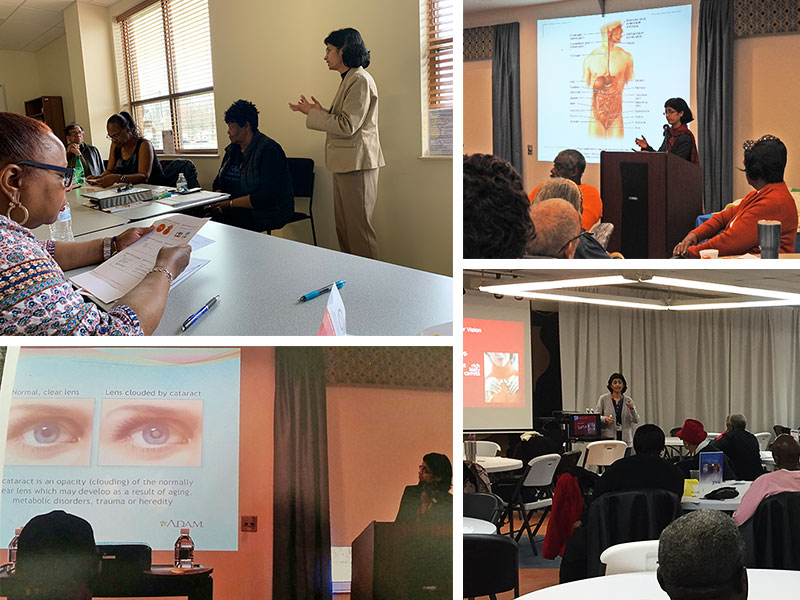
Dr. Hegde is available to participate in events within the community that focus on vision health or other health education topics. To request Dr. Hegde present at an organization or community event, please email khegde@coppin.edu.

collage

Contact Us

Thank you for your interest in the Ophthalmic Research Laboratory at Coppin State University. We welcome any questions and feedback you have. If you would like more information on anything you have read about our lab, please reach out!

Hegde
Interim Chairperson and Professor of Biology & Biochemistry

faculty

Community Engagement

Community Engagement

Ophthalmic Research Laboratory

Speak to
Kavita Hegde
Science and Technology Center Room 244/244A

Dr. Hegde is available to participate in events within the community that focus on vision health or other health education topics. To request Dr. Hegde present at an organization or community event, please email khegde@coppin.edu.

collage

Contact Us

Thank you for your interest in the Ophthalmic Research Laboratory at Coppin State University. We welcome any questions and feedback you have. If you would like more information on anything you have read about our lab, please reach out!

Hegde
Interim Chairperson and Professor of Biology & Biochemistry

faculty

Collaborative Research

Collaborative Research

Ophthalmic Research Laboratory

Speak to
Kavita Hegde
Science and Technology Center Room 244/244A

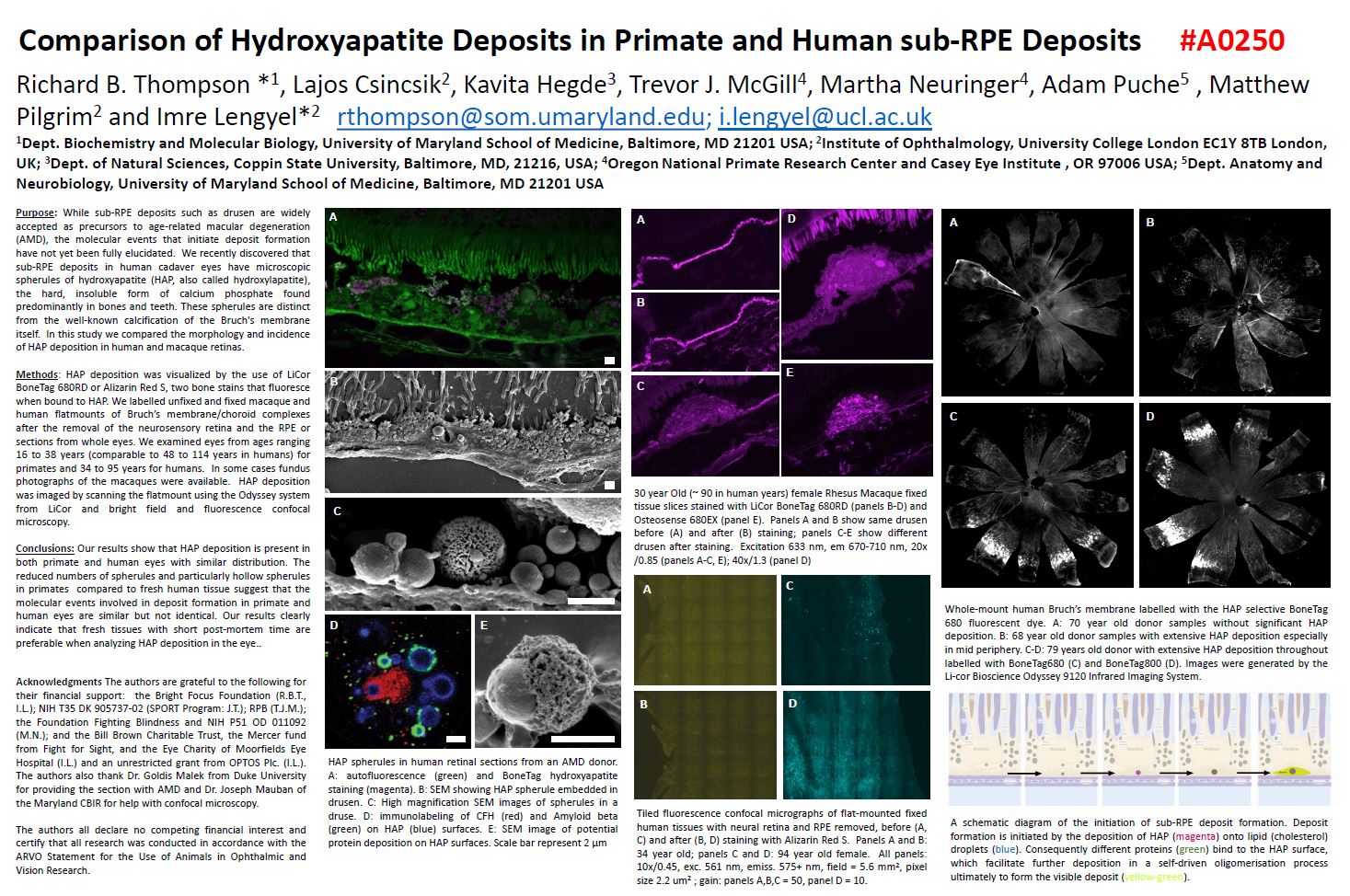
Comparison of Hydroxyapaptite Deposits in Primate and Human sub-RPE Deposits

Research Collaboration with University of Maryland School of Medicine

Dr. Kavita Hegde is working on a collaborative research project with Dr. Richard Thompson, Department of Biochemistry and Molecular Biology, University of Maryland School of Medicine. The project involves detection of sub-RPE hydroxyapatite deposits, the putative early markers of age-related macular degeneration, using fluorescence techniques.

Download Poster

Comparison_Hydroxyapaptite_Deposits

Imaging Hydroxyapaptite in sub-RPE Deposits by Fluorescence Lifetime Imaging Microscopy (FLIM)

Download Poster

Imaging_Hydroxyapaptite

Infusion labeling and FLIM imaging of hydroxyapaptite spherules in human sub-RPE deposits

Download Poster

infusion_labeling_and_flim_imaging_of_hydroxyapaptite_spherules_in_human_sub-rpe_deposits

Contact Us

Thank you for your interest in the Ophthalmic Research Laboratory at Coppin State University. We welcome any questions and feedback you have. If you would like more information on anything you have read about our lab, please reach out!

Hegde
Interim Chairperson and Professor of Biology & Biochemistry

faculty