Major in Accounting

Major in Accounting

Degree Type

Bachelor of Science

About

There’s more to an accounting degree besides being an accountant—but you can be that too.

Introduction

Accounting is everywhere, because money is everywhere. Regardless of field or industry, every company and organization needs a bookkeeping and money management strategy. The field can be especially lucrative because of constantly changing policies around taxes and regulations. Even if you have no desire to become a Certified Public Accountant (CPA), you can leverage the analytical, quantitative, and critical thinking skills learned while studying accounting across completely different industries or job roles.

You can choose to major or minor in accounting.

Learn how to:

  • Apply Generally Accepted Accounting Principles (GAAP)
  • Solve accounting and business problems with technological skills
  • Adhere to standards of Ethical Behavior for Accountants
  • Analyze and use Tax Code

Where can an Accounting degree take you?

Apply your skills and passion to accounting-related jobs on the rise, and see how an Accounting degree can open doors to specific careers across almost any industry. 

Human Resource Specialist
Billing, Cost, and Rate Clerk
First-Line Supervisor

Program Requirements

To graduate with a Bachelor of Science in Accounting, students must complete 120 credit hours. These credit hours split among:

  • General Education Requirements, or GERs (40 credits)
  • College of Business courses (42 credits)
  • Core courses (24 credits)
  • Electives (13 credits)
  • Coppin-specific requirements (1 credit)

Each section describes the range of course requirements and offerings.

General Education Requirements (GERs)

Students must complete 40 GER credits. Specifically for accounting majors, your program plan should also include:

  • MATH 131, College Algebra: Math and Sciences, to satisfy the math GER
  • ECON 211, Principles of Economics I, to satisfy the second social science GER

College of Business Requirements (42 credits)

CourseCreditsName
ACCT 2013Principles of Financial Accounting 
ACCT 2023Principles of Managerial Accounting
BDSC 3223Business Statistics
BDSC 3403Operations Management
ECON 2113Principles of Economics I
ECON 2123Principles of Economics II
FINM 3303Principles of Business Finance
MGMT 3053Business Communications
MGMT 3203Principles of Management
BUSI 3103Business Law
BUSI 4953Seminar in Business Strategy and Policy
MISY 3413Small Systems Software
MKTG 3103Principles of Marketing
BUSI 320International Business

Core Courses (24 credits)

CourseCreditsName
ACCT 3513Intermediate Accounting I
ACCT 3523Intermediate Accounting II
ACCT 4103Cost Accounting
ACCT 4143Tax Accounting
ACCT 4173Auditing I
ACCT 4193Governmental Accounting
ACCT 4213Advanced Accounting
MGMT 3503Business and Professional Ethics

Sample Course Plan

Be sure to connect with your academic advisor to plan your semester courses. The plan below is just an example—your journey may have different requirements.

Fall Semester (16 credits)

Course

credits

name

ENGL 101

3

English Composition I

MATH 131

3

College Algebra

PHIL 102

3

Intro to Logic

HIST 201

3

History I

ORIE 101

1

Freshman Seminar

MISY 150

3

Tech. Fluency

Spring Semester (15 credits)

course

credits

name

ENGL 102

3

English Composition II

HIST 202

3

History II

PHSC 101

3

Physical Science

SPCH 105

3

Introduction to Speech Communication

ECON 103

3

Introduction to Business and Entertainment Economics

Fall Semester (15 credits)

Course

credits

name

ART 105

3

Art Elective

PSYC 201

3

General Psychology

ACCT 201

3

Principles of Financial Accounting

ECON 211

3

Principles of Economics I

BDSC 322

3

Business Statistics

Spring Semester (16 credits)

Course

credits

name

WLIT 207

3

World Literature

BIOL 101

4

Biology

ACCT 202

3

Principles of Managerial Accounting

MISY 341

3

Small Systems Software

FINM 330

3

Principles of Business Finance

Fall Semester (15 credits)

Course

credits

name

ACCT 410

3

Cost Accounting

ACCT 351

3

Intermediate Accounting I

MGMT 320

3

Principles of Management

MGMT 305

3

Business Communication

REED 101

3

Reading Elective

Spring Semester (15 credits)

Course

credits

name

BUSI 310

3

Business Law

ACCT 352

3

Intermediate Accounting II

MKTG 310

3

Principles of Marketing

ACCT 414

3

Tax Accounting

XXXX xxx

3

Open Elective

Fall Semester (15 credits)

Course

credits

name

BDSC 340

3

Operations Management

MGMT 350

3

Business and Professional Ethics

ACCT 417

3

Auditing

ACCT 419

3

Governmental Accounting

XXXX xxx

3

Level 350+ College of Business Elective

Spring Semester (13 credits)

Course

credits

name

ACCT 421

3

Advanced Accounting

BUSI 495

3

Seminar in Business Strategy and Policy

BUSI 320

3

Fundamentals of International Business

XXXX xxx

3

Level 350+ College of Business Elective

XXXX xxx

1

Open Elective

College

The Accounting program lives within the Department of Accounting and Management Information Systems in the College of Business.

Department of Accounting, Data Science, and Management Information Systems

Department of Accounting, Data Science, and Management Information Systems

College of Business

Build Your Future on a Solid Foundation

Every organization needs to manage money and analyze data—learn accounting, data science or management information systems, and they’ll need you too.

Careers that Make Dollars and Sense

Welcome to the Department of Accounting, Data Science, and Management Information Systems (ADSMIS)! Our goal is to advance the fields of accounting, data science, and management information systems (MIS) through scholarly research, rigorous education, and meaningful, hands-on experiences. Our programs prepare students for a variety of lucrative careers with tremendous growth potential across disciplines and industries.

In our increasingly digital world, organizations heavily rely on digital transactions, analysis of these transactions, and the complex data sets these transactions create. The people who understand how to think critically to find untapped business opportunities and solve complex problems are the ones who become invaluable assets to an organization’s growth and success.

With our focus on applying theory to practice, our programs position students to be these professionals across private, public, government, and nonprofit organizations.
Our Programs

Accounting

Data Science

Management Information Systems (MIS)

Accounting

Major or minor in accounting to prepare for careers in auditing, accounting specialties, financial analysis, banking, economic analysis, credit analysis, and the public sector. Graduates with accounting degrees can even choose specific careers.  

Bookkeeping, Accounting, and Auditing Clerk
Budget Analyst
Financial Manager
Quality Control Analyst

Data Science

Data Science prepares students to interpret data and apply insights derived from data to solve real-world problems in all types of organizations. Career paths for students include: 

Data Scientist
Operations Research Analyst
Business Intelligence Analyst
Data Analysts

Management Information Systems

In MIS, our students learn skills to prepare for careers in systems analysis, database administration, data analysis, human computer interaction, and project management. Career paths for students with MIS degrees include: 

Computer Systems Analyst
IT Project Manager
Database Administrator
Command and Control Center Officer

Faculty and Staff

Chairperson and Professor

faculty

Professor

faculty

Professor

faculty

Assistant Professor

faculty

Associate Professor

faculty

Associate Professor

faculty

Senior Lecturer

faculty

Senior Lecturer

faculty

Can Help With
Assessment
Teaching Technology
Student Engagement
Associate Professor

faculty

Center for Strategic Entrepreneurship (CSE)

Center for Strategic Entrepreneurship

College of Business

An Entrepreneurship Tradition

Coppin has a legacy of entrepreneurship. From our founding in 1900 and the eventual naming of our beloved institution in honor of Fanny Jackson Coppin, we have always been deeply rooted in the community. This foundation uniquely positions us to think creatively about how we address the challenges in the communities around us. The Center for Strategic Entrepreneurship (CSE) is important to that effort.

Center for Strategic Entrepreneurship (CSE)

CSE is the epicenter of entrepreneurship research, teaching, and practice activities across Coppin State University. Our goal is to improve entrepreneurial outcomes in our West Baltimore community and across the globe.

We are advocates of transdisciplinary approaches to business and entrepreneurial development. Through this advocacy, we provide direction across all areas of study. We hope to provide opportunities for collaboration across industries that infuse ingenuity in a larger economic context.

Who is CSE’s programming for?

Part of our mission aligns with the greater Coppin mission. We seek to prepare students to become change agents who go back to meet the challenges facing urban communities. To that end, the main populations we serve include:

  • Communities in West Baltimore

  • Baltimore City Public School students and graduates

  • Baltimore County Public School students and graduates

  • Coppin State University students and stakeholders

Read the 2023 CSE Annual Report

What is ingepreneurship?

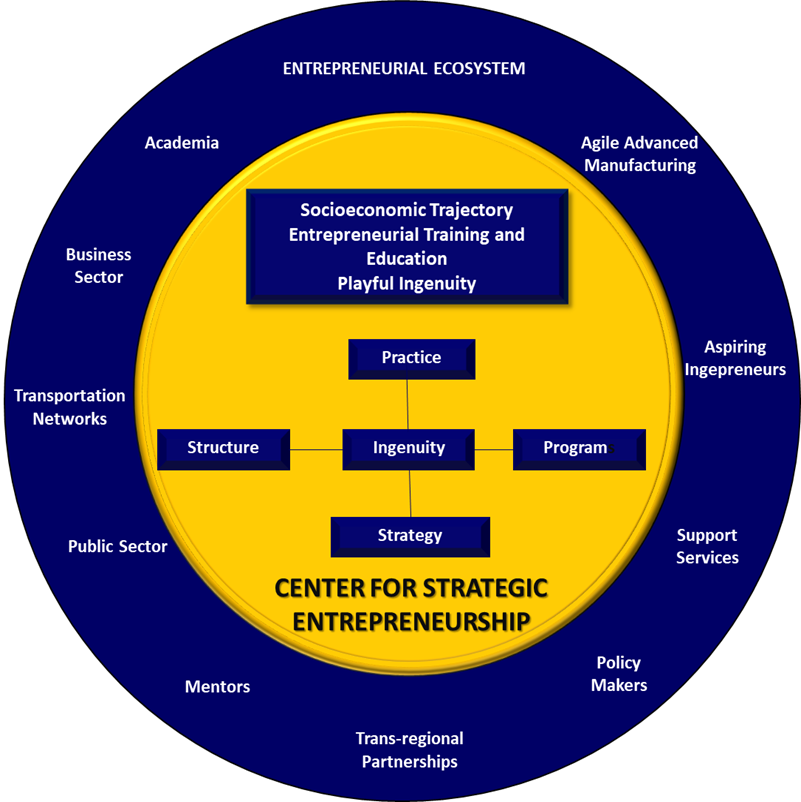
Gold circle within a blue circle explaining the entire ecosystem of entrepreneurship
The Entrepreneurial Ecosystem: This framework guides our approach to develop and share knowledge and skills related to entrepreneurial efforts within Coppin State University, the greater Baltimore community, and the world.

A blend of the words ingenuity and entrepreneurship, ingepreneurship is a method to build and nurture socioeconomic growth, specifically within urban communities. In his white paper entitled Strategic "Ingepreneurship", Ronald Williams defines ingepreneurship as “the act of infusing ingenuity into an entrepreneurship and business development process.” Simply, ingepreneurship is the process of thinking of unique ways to solve complex societal problems, while also creating opportunities for education and jobs.

Ingepreneurship looks like community building. It also looks like entrepreneurship, business development, and strategic industry, private, and public sector partnerships. Ingepreneurs are entrepreneurs, but not all entrepreneurs are ingepreneurs. As Williams points out in his white paper, entrepreneurs focus on the development, growth, and expansion of a business opportunity. Ingenpreneurs focus more on business opportunities within the context of quality of life social issues. Specially, an ingepreneur is someone who:

  • Engages in entrepreneurial activity focused on innovation in enterprise development

  • Infusing creativity into every phase of the entrepreneurial, business development process

  • Demonstrates concern for influencing socioeconomic growth for an identified geographic or demographic community

Especially in a city like Baltimore, the concept of ingepreneurship can be a powerful tool to address some of the most impactful challenges facing our communities today.

Contact Us

Dr. Tammira Lucas
Interim Director of the Center for Strategic Entrepreneurship

faculty

Student Complaints and Concerns

Student Complaints and Concerns

Division of Academic Affairs

Our Commitment to You

At Coppin, we work every day to make your time as a Coppin student positive, memorable, productive, and career-driven. While no college experience is perfect, it should feel safe and supportive. We commit to listen to you—our students—and quickly address complaints and concerns as they happen.  

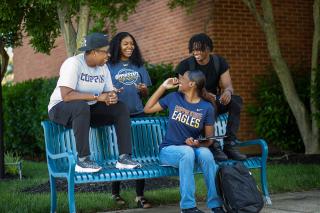
A group of four students chatting on a blue bench on Coppin's campus

Eagle Guide Student Handbook

You expect a lot from your University, and we expect a lot from our Eagles. The Student Handbook is a comprehensive resource for student and university standards.

Our Legal Obligation for Student Concerns and Complaints

Title 34 CFR §600.9 requires states to have a "process to review and appropriately act on complaints concerning the institution including enforcing applicable State laws." Title 34 CFR §668.43(b) requires that institutions: "make available for review to any enrolled or prospective student upon request, a copy of the documents describing the institution's accreditation and its State, Federal, or tribal approval or licensing. The institution must also provide its students or prospective students with contact information for filing complaints with its accreditor and with its State approval or licensing entity and any other relevant State official or agency that would appropriately handle a student's complaint." 

Legal language can be confusing. Simply put, each state must have a process where they review and follow up on complaints made about a school in that state. Sometimes this means states must enforce the law. 

This law also makes schools and institutions give any prospective or enrolled student the following information when requested: 

  • Any and all documentation about the institution’s accreditation and/or licensing 

  • All contact information to file a complaint with any accreditor, licensing agency, or state office that would appropriately deal with student complaints. 

How to Report a Student Concern

In this list, we include some of the most common student concerns as well as where to go to get more detailed information. If you don’t see your concern listed, talk with a trusted Coppin member of staff, faculty, or administration.

Submit a concern

This process is for when students believe a grade should change. First, request your professor complete a change-of-grade form on your behalf. If your professor agrees, s/he/they will update the grade with the revised grade and circulate it to the department chair, dean, and provost.  

If your professor disagrees about a grade change, you may take your complaint to your department chair, then your academic dean. Most of the time the dean is able to resolve these conflicts. If you don’t get a resolution from the dean, you may reach out to the Office of the Provost and Vice President for Academic Affairs. 

These violations focus on issues around plagiarism. Consult your department chair, and then, if necessary, your academic dean.  

Related concerns include incidents of unprofessional behavior, and other issues not related to grade changes or academic integrity. 

These types of concerns relate to being treated unfairly because of your race, gender, age, religion, sexual orientation, or other characteristic. Refer to Coppin’s Equal Employment Opportunity (EEO) and Non-Discrimination Statement for more detailed information. You can also connect with your department chair, then your academic dean, if necessary. 

If you or someone else is in imminent danger, reach out to Campus Police at (410) 951-3900. If you are looking to file a non-emergency report about hazing behavior, complete the online Behavioral Assessment Team Referral Form.

If you or someone else has been a victim of a hate crime, use the campus crime form to file an official report. As always, if you or someone else is in imminent danger, reach out to Campus Police at (410) 951-3900. 

Coppin commits to stay in compliance with the Americans with Disabilities Act of 1990 and the Americans with Disabilities Act Amendments Act (ADAAA). Visit our ADA page to file a report regarding potential noncompliance. 

Visit our resource section on Title IX compliance and fair practice to learn more about reporting sexual misconduct, which includes sexual and gender-based harassment, sexual violence, sexual exploitation, sexual intimidation, as well as sex- and gender-based stalking and retaliation. 

Coppin has an affirmative action program committed to ensuring equal employment opportunity. Visit our affirmative action resource page to file a report or concern about related unlawful practices. 

Our student, faculty, and staff resources outline Coppin’s commitment to Title IX, and maintaining a safe academic and professional work environment. 

Visit our resource section on Title IX compliance to learn more about reporting sexual misconduct, which includes sexual and gender-based harassment, sexual violence, sexual exploitation, sexual intimidation, as well as sex- and gender-based stalking and retaliation. 

If you or someone else has been a victim of a campus crime, use the campus crime form to file an official report. Report complaints about criminal activity to Campus Police. Criminal actions include, but are not limited to assault, battery, and theft. As always, if you or someone else in imminent danger, reach out to Campus Police at (410) 951-3900. 

As a Coppin student you have certain rights and responsibilities.  

The Office of Community Standards is responsible for determining whether the student code of conduct or grievances have been violated. 

In 2018, Governor Larry Hogan signed the Financial Consumer Protection Act of 2018. This law creates a Student Loan Ombudsman who serves as a go-between for student loan borrowers and their loan providers. Any student who wants to file a complaint against a loan provider can find valuable resources on the Helpful Resources - Student Loan Ombudsman - Financial Regulation page on the Maryland Department of Labor’s website. 

COB Accreditation and Assessment

Accreditation and Assessment

College of Business

Accreditor

The College of Business holds specialized accreditation from the Accreditation Council for Business Schools and Programs (ACBSP).

Academic & Operational Excellence

The Accreditation Council for Business Schools and Programs (ACBSP) granted the College of Business specialized business accreditation, November 2015. To maintain our goal of high standards for teaching and learning, we stay focused on continuous improvement and our academic quality. Learn more about the importance of specialized business accreditation, student achievement and more.

Download 2024 Quick Facts

What is Accreditation?

Accreditation is a process led by governmental and non-governmental organizations to set standards for acceptable levels of quality education. These organizations create evaluation criteria, lead interviews, review student assessment data, and conduct peer evaluations to determine if a program or institution meets established criteria. Accreditation can be at the university-level, school-level, and also program-level.

When an institution, school or program seeks accreditation, it often has to officially request an evaluation from a particular accrediting agency.

Why is Accreditation Important? 

Accreditation ensures the education provided by a specific institution, school, or program meets a certain quality standard. It’s important to note the U.S. Department of Education does not accredit higher education institutions or programs. However, the Department of Education does keep an official record of nationally-recognized accreditation agencies proven to be authorities on the quality of education or training. The Department of Education may also consider the accreditation of a higher education institution when determining federal financial aid.  

The Accreditation Council for Business Schools and Programs (ACBSP)

The ACBSP is a national organization founded in 1988 to address the need for more specialized accreditation for higher education business schools and programs. At the time, there was only one accrediting body that focused accreditation standards largely on research. Many schools didn’t primarily focus on research, instead their primary objectives were around student success and teaching excellence. The ACBSP was founded to serve as an accrediting body for schools seeking accreditation based on quality in teaching and learning outcomes. 

Assessment Data Standards

The COB has continuously assessed our academic programs since 2013, using course assessments, as well as student, faculty, and stakeholder feedback. We remain committed to meet and exceed the assessment measures set by both regional and specialized accreditors.

The College prepares numerous assessment reports as a part of the accreditation process. Specifically, we provide information on learning outcomes performance and other data related to academic and business practices. We share these reports with the University, the University System of Maryland (USM), and the Maryland Higher Education Commission (MHEC). 

The College of Business learning outcomes are: 

  • SLO 1  Written Communication

  • SLO 2  Oral Communication

  • SLO 3  Critical Thinking

  • SLO 4  Quantitative Literacy

  • SLO 5  Informational Literacy

  • SLO 6  Global Awareness 

  • SLO 7  Leadership 

  • SLO 8  Team Building 

  • SLO 9  Ethics

  • SLO 10  Reflective Practice 

Student Body

Fall 2024 by the numbers...

356 enrolled students
  37 transfer students


COB:

356

Full-time:

310 (87%)

Part-time:

  46 (13%)

Male:

166 (47%)

Female:

188 (53%)

FTFT:

   93 (26%)

Living on campus:

119 (41%)

Mean Student Age:

  24

Success Rates

Retention (1st to 2nd year):78%
Graduation (within 6th year):24%

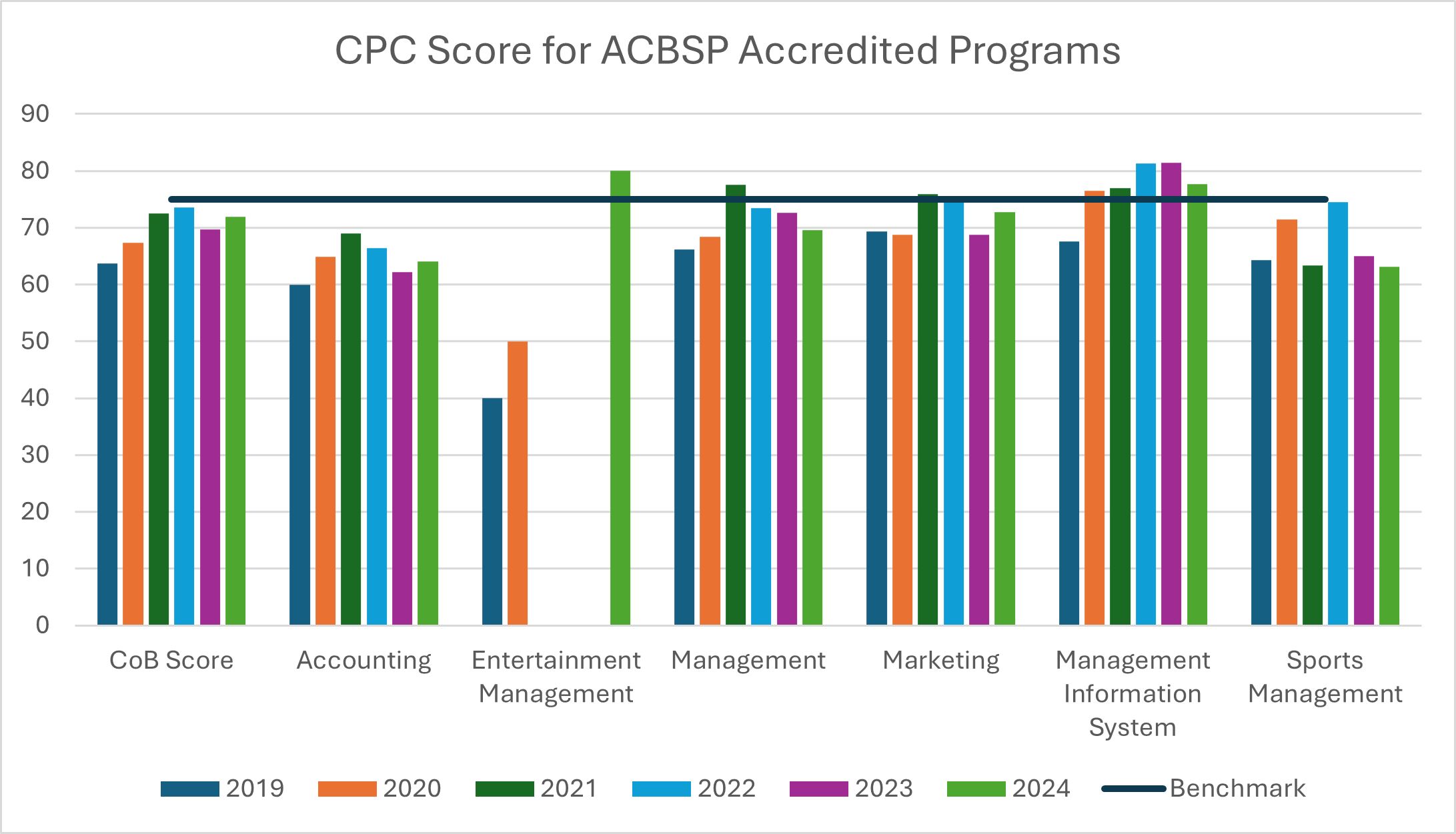
Student Achievement: Undergraduate Exit Examination

(Benchmark 75% or above.) 

2025 ACBSP TABLES CPC COMPARISONS


Contact Us

Are you a prospective or current student with a question about the College of Business or one of our programs? Reach out to us! 

Business Specialist

staff

Can Help With
Advising
Questions about academic programs
Dean, Professor

faculty

College of Business

College of Business

Division of Academic Affairs

Programs Designed with You in Mind

The biggest investment you’ll ever make is on yourself. Whether you are advancing your career or making your business dream a reality, we can help you get there. 

Top 50

Most innovative small business schools in the U.S.

100
%

Online Management, Management Information Systems (MIS), and Marketing programs

#
1

Most affordable 4-year USM institution

Programs Designed With You in Mind

Welcome to the College of Business (COB)! We’re excited you’ve stopped by to learn more about our programs. Our unique approach to wealth-building, entrepreneurship, and business education helps propel our students to limitless career opportunities in a changing market. Our location in the Baltimore area and our legacy of entrepreneurial and generational experience position us—and our students—to make a meaningful impact in this opportunity-rich economy.

Our programs cover multiple aspects of running a successful organization. From learning about financial management in accounting, to getting your brand messaging to audiences through marketing, to problem-solving organizational challenges through data-driven and database thinking learned in management information systems, we have courses that teach you to start a business, run an organization, and think critically to solve organizational problems on a global scale.

We’ve designed our programs with you—and your career goals in mind.

Our Mission 

CSU College of Business provides quality business education, inspires learners, and launches business careers as a path to lifelong success. 

(Reviewed March 7, 2025)

Why choose a College of Business program?

We’re smarter by design. We created the COB and its programs through the lens of a few guiding questions:  

  • What do today’s business students need?

  • What do today’s business students want?

  • How can we deliver to students’ needs and wants in a powerful and engaging way?  

Our answer was to design programs, courses, and out-of-the-classroom learning experiences that give you an edge toward pursuing a fulfilling career. Regardless of the COB academic program you choose, we prioritize:  

  • Cutting-edge courses

  • Extraordinary faculty

  • Hands-on learning for real-world experiences

  • Daily interactions with seasoned industry professionals

  • Innovative technology

  • Internships, industry partnerships, and co-op opportunities 

  • Exclusive access to the Baltimore-area’s leading businesses 

Our Programs

We offer all of our programs across 2 departments:  

Department of Accounting, Data Science, and Management Information Systems

Accounting

Data Science

Management Information Systems (MIS)

Department of Management and Marketing

Sport Management

Marketing

Entrepreneurship and Innovation

Esports Management

Entertainment Management

Entertainment Management: Music

Entertainment Management: Casino and Gaming

students image for career services page

Earn Your BS in Management—Online

Our Bachelor of Science in Management is the only 100% online accredited business management degree offered at an HBCU.

What will you learn as a College of Business student?

In addition to learning objectives specific for each program, the COB strives to create a holistic academic experience for each of our students. We commit to graduating professionals who can: 

  • Demonstrate fundamental knowledge of functional business areas 

  • Embody professionalism through strong communication and interpersonal skills 

  • Think ethically with a commitment to values and social responsibility 

  • Apply theory to practice, using technical skills to solve business problems 

Business education at Coppin is designed for you, designed for success, and designed to make a transformative impact in your life and career. 

Current student? Report a complaint or concern.

Report a concern or complaint

Contact Us

Are you a prospective or current student with a question about the College of Business or one of our programs? Reach out to us! 

Dean, Professor

faculty

Chairperson and Professor

faculty

Business Specialist

staff

Can Help With
Advising
Questions about academic programs
Executive Administrative Assistant II

staff

General Assistant

staff

Chairperson and Professor

faculty

School of Graduate Studies and Research (SGSR) History

School of Graduate Studies and Research History

Division of Academic Affairs

Mon - Thu: 8:30 am - 6:00 pm
Fri: 8:30 am - 5:00 pm
College of Business 3rd Fl. Suites 320-323
(410) 951-3022

Our History

The Coppin State University School of Graduate Studies and Research (SGSR) has a rich legacy. We stay committed to excellence and make a continuous effort to keep our programs relevant to the changing needs of students, to the professional communities they serve, and to society.  

Our 50+ Year Legacy

Summer 1968

The School of Graduate Studies and Research started as one graduate program in Special Education. This program was created to meet the growing demand for special educators who were qualified to work with emotionally disturbed and intellectually challenged students in Baltimore and surrounding areas.

1969

We added a master's program in Correctional Education to address the need for programming development and education for incarcerated persons. The need was so great at that time, the program expanded into a Correctional Education Department designed to serve the needs of correctional teachers. Seeing an even greater need to prepare practitioners across the criminal justice profession, Coppin expanded graduate studies and created the Department of Criminal Justice.  

1972

Coppin added a graduate program in Rehabilitation Counseling. This program led to our  Master of Education (M.Ed.) in Rehabilitation Counseling, which focuses on training students to deliver rehabilitation services, particularly to individuals with the most severe disabilities. 

July 1973

The Maryland Higher Education Commission (MHEC) approved a consortium in Criminal Justice between University of Baltimore (UB) and Coppin State College. This consortium has transformed with time, resulting in Coppin getting authorization to offer a Master of Science in Criminal Justice on May 26, 1976. Later that year, Coppin also received authorization to offer the Master of Science in Adult and Continuing Education.  

1975

In conjunction with the state rehabilitation agencies of Maryland, Delaware, Virginia and Washington D.C., Coppin created an innovative and experimental rehabilitation counseling program called "Rehabilitation Counseling Program: a Behavioral Approach". Students who successfully completed this program earned the M.Ed. in Rehabilitation Counseling. The project period expired in 1978, but some of its essential components live on in the current master’s program. 

1992

The Board of Regents of the University System of Maryland (USM) and MHEC approved the Master of Arts in Teaching (MAT) program.  

1999

USM and MHEC approved the Master of Education in Curriculum and Instruction (Distance Learning), Master of Science in Family Nurse Practitioner, and Master of Science in Human Services Administration.  

January 2000

USM and MHEC approved the Master of Science in Addiction Counseling. Upon successful completion of the program, persons are prepared for professional careers in Addiction Counseling. 

2010

USM and MHEC approved the Master of Education in Contemporary Educational Leadership.

2011

USM and MHEC approved Doctor of Nursing Practice (DNP).

2020

USM and MHEC approved Master of Science in Applied Molecular Biology and Biochemistry as well as the Master of Science in Polymer and Material Science. 

2021

Approved Doctor of Nursing Practice (BSN to DNP).

Contact Us

Our professors don't live in ivory towers. They're out actively applying research to practice, keeping up with the latest advances in their fields and leading cutting-edge research. Fully accessible, our faculty and staff keep their doors open, and stay committed to preparing our students to be a vital part of today's workforce. 

Director of Graduate Standards and Policy

staff

Director of Integrated Advancement

staff

Executive Administrative Assistant

staff

Can Help With
Graduate admissions status
General information about graduate school
Interim Dean of Graduate Studies and Research

faculty

School of Graduate Studies and Research

School of Graduate Studies and Research

Division of Academic Affairs

Mission

The Coppin State University School of Graduate Studies and Research offers professional and clinical programs that prepare each student for advanced careers. We provide a learning environment conducive to the development of skills, attitudes, and competencies, which are applicable to growth and development in an urban setting and global environment.

Invest in Yourself—and Your Career

The School of Graduate Studies and Research (SGSR) is built for busy working professionals. Our conveniently located urban campus offers graduate degrees and certificates, many you can complete in about two years, in high-demand fields.

We combine small classes, hands-on experience, and personal support across education, criminal justice, natural sciences, nursing, and human services. You’ll build the leadership and management skills to advance your career without putting your life on hold.

Learn how to apply

Why choose a Coppin graduate program?

Our goal is simple: help you thrive. Coppin graduate programs prepare you for leadership and management roles, especially in urban and professional settings. You’ll develop the skills and confidence to make an impact in your field and your community.

For Spring 2026 admission, upload all required materials, including transcripts, résumé, letters of recommendation, and supporting documents, by December 15, 2025. F-1 applicants are encouraged to submit materials early.

Convenience

Our campus is easy to reach by car or public transit, and we offer many graduate and doctoral classes in the evenings and on weekends. Small class sizes mean you’ll get to know your professors and classmates. You can move your career forward while still balancing work, family, and other responsibilities at Coppin.

Paying for Graduate School

Graduate school is a major investment, and we’re committed to keeping it affordable.

You may be eligible for federal financial aid when you enroll in a graduate degree or certificate program. To get started:

  1. Complete the Free Application for Federal Student Aid (FAFSA).

  2. Email the Office of Financial Aid from your Coppin email to request federal funding for your current or next semester.

You can also explore scholarship opportunities through the Division of Institutional Advancement. Still have questions? Email us, visit our office, or call (410) 951-3090.

Innovative Graduate Research

We prepare graduate students to lead in a global, knowledge-driven world. Faculty research keeps our programs current, strengthens the curriculum, and brings real examples into the classroom.

Who's leading graduate research at Coppin?

Our faculty stay connected to the communities they serve and work to solve pressing challenges in areas like criminology, nursing, rehabilitation counseling, polymer and materials science, and molecular biology. As a graduate student, you’ll learn from experts who are actively shaping their fields. Current faculty conducting graduate-level research include: 

  • Michael Berlin, criminology
  • Joan Tilghman, nursing
  • Janet Spry, rehabilitation counseling
  • Fred Nesbitt, polymer and material science
  • Thavamani Rajapandi, molecular biology

Partnerships that Promote Success

Education doesn’t happen in isolation. We partner with key Baltimore agencies, school systems, and employers so your graduate experience connects directly to real-world needs.

These partnerships keep our curriculum current and aligned with today’s workforce. Internships, fieldwork, and research opportunities help you build your network, gain experience, and bridge theory and practice so you’re ready for what comes next.

Fast Track Program

If you’re a current Coppin undergraduate, you may be able to start graduate study early through our Fast Track program. You can complete up to 6 graduate credits, the equivalent of one semester, if you:

Are entering your final semester of undergraduate study

Have a cumulative GPA of at least 2.70

Have at least a 2.80 GPA in your major

This option helps you save time and move smoothly into a Coppin graduate program.
Apply

Contact Us

Our professors don't live in ivory towers. They're out actively applying research to practice, keeping up with the latest advances in their fields and leading cutting-edge research. Fully accessible, our faculty and staff keep their doors open, and stay committed to preparing our students to be a vital part of today's workforce. 

Interim Dean of Graduate Studies and Research

faculty

Director of Graduate Standards and Policy

staff

Executive Administrative Assistant

staff

Can Help With
Graduate admissions status
General information about graduate school

Adjunct Faculty

Adjunct Faculty

Mon - Fri:
8:30 am - 5:00 pm
Health and Human Services Building, 2nd Floor, Room 218
(410) 951-3009

A Community of Expertise 

Welcome Adjunct Faculty! We're so glad you've decided to bring your talent, passion, and special skills to Coppin. Bookmark this page for quick access to policies, procedures, and resources designed to help you adjust to our campus community.

Adjunct Faculty Handbook

The Adjunct Faculty Handbook is a helpful resource for learning all things Coppin. It has descriptive information on classroom and institutional responsibilities, as well as University policy and procedure. 

It also includes a section specifically for adjunct faculty, including adjunct faculty employment resources. 

Meet and Confer Association

We invite all adjunct faculty to join the Adjunct Faculty Meet and Confer Association! It is a professional association of part-time faculty designed to help implement policies that ensure opportunities to meet with administration, through shared governance, or as distinct groups.

Coppin State University Adjunct Faculty “Meet & Confer” Association is organized in compliance with

As a professional association of part-time faculty, the group helps to implement policies that ensure opportunities to meet with administration, through shared governance, or as distinct groups.

This association stays committed to serving the educational needs of students, while also building and strengthening healthy relationships with campus leadership, full-time faculty, and the University System of Maryland (USM) Board of Regents.

In accordance with Article I Section I of the Coppin Adjunct Faculty Association Constitution, a key purpose of the group is to "engage in any and all activities that promote the educational process and welfare of its members." Additionally, this group complies with University System of Maryland Policy on the Employment of Adjunct Faculty in the University System of Maryland (December 3, 2010).

Advisory Council Members

  • President: Dr. Mirma A. Johnson-Majors
  • Vice President: Professor Joyce A. Camper
  • Secretary: Professor Asia Maxton
  • Treasurer: Open
  • Parliamentarians: Professor Paul Evans and Professor Brenda Zanders
  • Senator for College of Behavioral and Social Sciences: Professor Danielle Parker
  • Senators for College of Arts & Sciences, and Education: Professor Vanessa Russell and Professor Sayed Hassan
  • Senators for College of Business: Open
  • Senators for College of Health Professions: Open

Student Support

Student Support

Help for What Life and Coursework Throw Your Way

Student support at Coppin looks like many different things. It looks like peer and professional tutors ready to help students in the Math Center. It looks like trained mental health professionals prepared with resources to help you through the worst of what you’re going through. It looks like accommodations and improved access through the Accessibility Services. It’s emergency funds for students with urgent home, and life challenges. It’s professional guidance on how to take that next career step. Student support looks like all this, and so much more.

At Coppin, we aren’t only concerned about your academic success, we’re concerned about the whole you. We’ve worked hard to make sure our students have a variety of resources to allow you to bring your whole self to school. Because when you can bring your whole self to school, you can be ready to work toward all the opportunities you’ve dreamed of.

How We're Here for You

We've made Coppin for you. When you become part of the Coppin family, you have access to a wealth of resources designed to motivate, uplift, guide, and provide everything you need to make your journey through Coppin a successful one. Everyone needs a little—or a lot of—help sometimes. And that's ok! We're here to make sure nothing stands in the way of helping you bring all your dreams into reality.

Current student? Report a concern.

Report a concern