Destination Page
Executive Assistant to the Provost

staff

Dr. Chanta Haywood
Provost and Vice President for Academic Affairs

staff

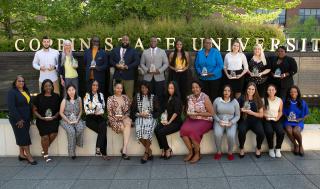
2022 Distinguished Eagle Awardees
May 12 2022

Coppin State University Celebrates the 2022 Distinguished Eagle Recipients

Coppin State University celebrates the recipients of its academic excellence...
2022 Distinguished Eagle Awardees
May 12 2022

Coppin State University Celebrates the 2022 Distinguished Eagle Recipients

Coppin State University celebrates the recipients of its academic excellence...

General Education Requirements - FAQ

General Education Requirements - FAQ

Mon - Fri:
8:30 am - 5:00 pm
Health and Human Services Building, 2nd Floor, Room 218
(410) 951-3009

Academic Advisement in the General Education Requirements

Am I required to complete general education requirements (GERs)?

All newly admitted Freshmen and Transfer students without an Associate of Arts (A.A.) or Associates of Sciences (A.S.) degree are required to complete 40 credit hours of General Education courses.

In accordance with USM and CSU policies, General Education Requirements (GERs) are satisfied for newly admitted transfer students with an Associate of Arts (A.A.) or an Associate of Science (A.S.) degree. GERs are considered met and newly admitted students with an A.A. or A.S. degree do not have to take any additional General Education courses.


Is there a Plan of Study for the General Education Requirements?

Yes.  General education requirements are taken during the first and second years of matriculation.


How much time does it take to complete my GERs?

The general education requirements are designed for completion in three semesters and a summer OR four full-time semesters.


Are general education requirements included in my degree plan?

Yes. All of the general education requirements are included in degree plans and, in some cases, such as Nursing, Social Work, and Education must be completed before the degree core of courses can be attempted.


Suppose I know that I cannot take courses together as recommended by my adviser, what can I do?

Course selections are based on several factors such as employment, family responsibilities, hours needed for study and research, as well as mode of instruction. Therefore, students have the flexibility of choosing the right combination of courses to meet their needs; however, students must complete general education requirements by the end of the second year of matriculation.


If I need to repeat a course should I repeat that course at Coppin?

Absolutely! When courses are repeated at Coppin students receive the benefit of the new grade and its quality points. Quality points are used to compute the grade point average.


I am working to complete courses ahead of schedule, how do I obtain permission to attend another college?

If the desire is to attend a community college or other local university that is not a member of the University System of Maryland students are required to obtain the permission form in the department at Coppin where the course is taught.  For example, Philosophy is taught in the Department of Humanities, therefore, students should go to the Department of Humanities which is located in the Grace Hill Jacobs Building in room 530.


Can any Academic Adviser help me with my course selections?

Absolutely! Although each student is assigned to an adviser to support efficient delivery of services, students will be offered the opportunity to consult with another adviser if their assigned adviser is not available when they visit the office.


If I need a permission code for a general education requirement can I obtain it from any adviser?

Absolutely! Advisers are able to request permission codes for courses that are filled and do not have waiting lists and will issue the permission code through Coppin email as soon as it is obtained.


Should I wait until I complete all general education requirements before I get involved with the department where I major?

Absolutely not! General education requirements come out of academic departments, they are students' first exposure to a degree program. Academic department faculty and staff welcome questions and inquiries about their degree programs.


When is the EAC Academic Advisement office open?

The Eagle Achievement Center and all of its resources are available to students Monday through Friday beginning at 8:30am. For more information on advisement services visit https://www.coppin.edu/eac-advising. For scheduling information related to the Math and Writing Centers check out their web pages for the latest updates, https://www.coppin.edu/math-center and https://www.coppin.edu/writing-center. For additional services and office hours provided by the Eagle Achievement Center, visit https://www.coppin.edu/eagle-achievement-center

General Education Requirements

General Education Requirements

Mon - Fri:
8:30 am - 5:00 pm
Henrietta Lacks Health & Human Services Building, 2nd Floor, Room 218
(410) 951-3009

The General Education Requirements (GER) serve as the core of the undergraduate curriculum. The program consists of a sequence of required courses in communications, the arts and humanities, the natural and physical sciences, mathematics, the behavioral and social sciences, health and information technology, designed to expose every undergraduate to the broad range of disciplines essential to the development of a liberally educated person. The General Education Requirements help students to develop the skills necessary for advanced study and for lifelong learning: to effectively communicate in oral and written formats; to acquire the ability to think analytically, critically, and creatively and to use the scientific method in problem solving; to proficiently use technology when conducting research; to obtain a deeper understanding of themselves, of others, and of our social and physical environment; to develop the capability to integrate their learning with past and present experiences; and to strengthen their potential for contributing to society. The Institutional Student Learning Outcomes (ISLOs) are intended to support, to inform, to provoke, to shape, and to model for students the dynamics of the eternal bond which exists between the right to an education and the responsibility to teach. Please keep reading for more information on ISLOs.

Institutional Student Learning Outcomes (ISLOs)

Coppin students' experiences and instruction over the next three to five years will be anchored within an academic framework of three universal Student Learning Outcomes (SLOs): Oral and Written Communication and Analytical Reasoning. These Student Learning Outcomes (SLOs), by definition, represent the university’s commitment to provide students with academic experiences that support their ability to write clear expository and persuasive prose; to use valid research-based arguments as support for their written or oral positions; to express their ideas in language that is both appropriate to the topic and for the target audience, and to write and speak proficiently for those various audiences. Moreover, students will be trained to apply applications of classical and/or current theories and principles from specific content areas; to use critical judgments from a combination of evidences and assumptions to reach viable conclusions; and to collect, analyze, and interpret data via computational literacy and scientific reasoning.

Oral Communication, Written Communication, and Analytical Reasoning also provide impetus for the Writing Across the Curriculum (WAC) initiative as an appropriate and timely response to the importance and functionality of media as a mainstay of human experience. Though inclusive by nature Writing Across the Curriculum is purposed to recognize that while students' 21st century modes of communication are filtered through Facebook, MySpace, blogs, email and among other modes of communication the ability to convey a clear idea and to signal that the clear idea has been received and understood is irrevocably foundational to building lives and relationships. Indeed, it is through the ability to communicate and to respond to clear ideas that students will continue to find their 'voice' as significant communicators, and as undergraduates who have been transformed into life-long learners who learn to maintain their standing among local, national, and international communities.

The remaining Student Learning Outcomes: Informational Literacy, Social Awareness, Reflective Practice, and Responsive Citizenship are strategically infused in General Education Requirements and figure prominently across the spectrum of this core curriculum. Students will become proficient in the use of technology and its appropriate applicability and will learn, for example, to use multiple information sources such as online databases, videotapes, government documents, and journals in conducting research and/or in problem solving (e.g., electronic and print periodicals, chapters in books, government documents, archival material, and microfilm) through Informational Literacy. At the same time, students will learn thru Social Awareness: the importance of understanding self and to embrace their responsibilities as engaged citizens and informed leaders in service within the community; the importance of becoming aware of and understanding economic, political, and organizational systems, and the importance of gaining an appreciation of diverse cultural heritages and global societies. These Student Learning Outcomes, Information Literacy and Social Awareness along with Reflective Practice and Responsive Citizenship further characterize the collective learning experiences found in the General Education Requirements.

In sum, Student Learning Outcomes (SLOs) are intended to support, to inform, to provoke, to shape, and to model for students the dynamics of the eternal bond which exists between the right to an education and the responsibility to teach.

Frequently Asked Questions

Everything from are your general education credits required to what happens if you need to repeat a course, you will find your answers here!
Read more

General Education Requirements (40 Credit Hours)

The General Education Requirements apply to all newly admitted Freshmen and Transfer students without an Associate of Arts or Associates of Sciences degree. The newly admitted Freshmen and Transfer students without an Associates of Arts or Associates of Science degree shall be required to complete 40 credit hours of General Education courses in the following Categories:

Please note: English Composition I ENG 101 and English Composition II ENG 102 must be completed with a grade of C or better. The passing grade for the other General Education courses is determined by the guidelines of the program faculty and documented on the program major plan of study.

In accordance with CSU policy, all newly admitted Freshmen and Transfer students without an Associate of Arts (A.A.) or Associates of Sciences (A.S.) degree are required to complete 40 credit hours of General Education courses.

Transfer Students with Associate of Arts and Associate of Science Degrees

In accordance with USM and CSU policies, General Education Requirements (GERs) are satisfied for newly admitted transfer students with an Associate of Arts (A.A.) or an Associate of Science (A.S.) degree. GERs are considered met and newly admitted students with an A.A. or A.S. degree do not have to take any additional General Education courses.

Transfer Courses

Transfer courses ending with 100T and 200T shall be used to satisfy 100 level or 200 level General Education courses within the same discipline area applicable for the relevant GER category. (ex. For a transfer student, GEOG 100T can be used to satisfy GER Category VI). Students are advised to select GER courses according to the program major plan of study.


Category 1 English Composition (6 credits)

Select two (2) courses total, which must be completed with a grade of C or better.

ENG 101 and ENG 102 or equivalent course

Category 2 Arts and Humanities (15 credits)

Select five (5) courses from below to be completed according to the program major plan of study. At least one (1) course must reflect content in African American heritage such as ENG 235 or ENG 236 or HIST 205 or HIST 206

WLIT 207 or WLIT 208 or any 200-Level English or Literature course; or PHIL 102 or PHIL 103 or PHIL 104; or HIST 201 or HIST 202 or HIST 203 or HIST 204 or HIST 205 or HIST 206; or any Foreign Language including SPAN 101, 102, 201, 202; or FRENCH 101, 102, 103, 104; or ART 100 or ART 103 or ART 105 or MUSC 201 or DANC 226 or THEA 100 or THEA 211 or SPCH 105 or SPCH 204 or an equivalent course

NOTE: These courses are no longer offered: IDIS 102 and IDIS 103

Category 3 Social and Behavioral Sciences (6 credits)

Select two (2) courses to be completed according to the program major plan of study.

ANTH 207 or ECON 103 or ECON 201 or POSC 201 or POSC 202 or PSYC 201 or SOCI 201 or SOSC 200 or equivalent course

Category 4 Mathematics (3 credits)

Select one (1) course to be completed at or above college algebra level according to the program major plan of study.

MATH 131 or MATH 203 or equivalent course

Category 5 Natural Sciences (7 credits)

Select any two (2) courses of which at least one must have a lab.

BIOL 100 (non-lab course) or BIOL 101 or BIOL 106 or BIOL 107 or BIOL 201 or BIOL 203 or CHEM 100 (non-lab course) or CHEM 101 or CHEM 103 or PHSC 101 or PHSC 102 or PHSC 103 (non-lab course) or equivalent course

Category 6 Interdisciplinary and Emerging Issues-Local to Global (3 credits)

Select one (1) course to be completed according to the program major plan of study.

GEOG 102 or HSC 102 or HSC 103 or HSC 105 or HSC110 or MISY 150 or URST 201* or equivalent course

NOTE: HEED Changed to HSC Effective Fall 2025

HSC 102 (formerly HEED 102)

HSC 103 (formerly HEED 101)

HSC 105 (formerly HEED 105)

HSC 110 (formerly HEED 110)

These courses are no longer offered: HEED 201, 203, 205

*URST 201 was approved by CSPC GER Subcommittee February 2026

General Education Program Assessment

The General Education (GE) curriculum at Coppin State University serves as the foundational academic experience through which all undergraduate students engage the University’s Institutional Student Learning Outcomes (ISLOs): Oral Communication, Written Communication, Analytical Reasoning, Information Literacy, Social Awareness, Reflective Practice, and Responsive Citizenship. General Education assessment is therefore intentionally integrated into the University’s broader institutional effectiveness framework and annual program assessment cycle.

Oversight of the General Education assessment process is coordinated through the General Education Subcommittee, operating under the University Curriculum Standards and Policies Committee and in collaboration with the Office of Planning and Assessment. The Subcommittee ensures that all approved General Education courses are explicitly mapped to one or more ISLOs and that each course includes clearly articulated student learning outcomes aligned with the University’s institutional outcomes.

Assessment of General Education is conducted through a structured annual cycle that incorporates the following elements:

First, faculty teaching General Education courses identify signature assignments or embedded assessment measures that directly evaluate the designated ISLO(s). These assignments are evaluated using institutionally developed or standardized rubrics aligned to ISLO performance indicators. The rubrics provide common criteria and performance levels, enabling consistent evaluation across sections and disciplines.

Second, departments submit annual Program Assessment Reports documenting:

  • the ISLO(s) assessed in General Education courses,
  • the assessment measures utilized (direct and indirect),
  • aggregated student performance results,
  • analysis of findings, and
  • action steps for improvement.

These reports are reviewed by department chairs, deans, and the Office of Planning and Assessment to ensure methodological soundness, appropriate data interpretation, and meaningful use of results.

Third, the General Education Subcommittee conducts periodic reviews of course alignment and assessment data to verify that:

  • course-level outcomes remain properly mapped to ISLOs,
  • rubrics are applied consistently,
  • performance benchmarks are appropriate, and
  • improvement actions are implemented and revisited.

This process reinforces Coppin’s “closing-the-loop” culture, ensuring that assessment findings inform curricular refinement, assignment redesign, pedagogical adjustments, and, when necessary, course recertification within the General Education framework. These processes support the creation of a culture of assessment and continuous quality improvement. 

In addition, General Education course proposals and renewals require documentation of ISLO alignment, assessment plans, and rubric use. This alignment review ensures coherence between course design, instructional delivery, and institutional learning priorities. Transfer pathways and course cross-listings are also examined to confirm that ISLO integrity is maintained across modalities and student populations.

Collectively, this structured assessment process ensures that General Education coursework is systematically evaluated using shared rubrics, that student learning evidence is aggregated and analyzed at the institutional level, and that results meaningfully contribute to continuous improvement. Through this model, the General Education curriculum functions not only as a curricular requirement but as a measurable and mission-aligned foundation for student achievement and institutional effectiveness.

Academic Policies

Academic Policies

Mon - Fri:
8:30 am - 5:00 pm
Health and Human Services Building, 2nd Floor, Room 218
(410) 951-3009

Grading System

grade definition counted in gpa?
A Grade for superior quality work Yes
B Grade for good quality work Yes
C Grade for satisfactory quality work Yes
D Grade for less than satisfactory quality work, and allowable for credit Yes
F Grade for failing quality of work Yes
PT Credit awarded by exam N/A
PS

Grade for satisfactorily completing all course requirements for Math:

  • ENGL 101A
  • MATH 097
  • MATH 098
N/A
CS

Grade for not satisfactorily completing all course requirements for:

English:

  • ENGL 101A
  • ENGL 101
  • ENGL 102

or Math:

  • MATH 097
  • MATH 098

Students who earn a "CS" must register again to repeat the course during the next regular semester.

N/A
AU A no-value grade that represents when a student has registered to audit a course No
AW Grade issued to students who violate the Class Attendance Policy before the official withdrawal period No
FX Grade issued to students who violate the Class Attendance Policy after the official withdrawal period Yes

Declare a Major

Keep in mind, getting admitted to Coppin State University is not an automatic guarantee that you have also been admitted to a major or program. All degree seeking students must officially declare a major. Each major department or school screens and accepts its own students, (i.e., School of Arts and Sciences, School of Professional Studies, School of Nursing or School of Graduate Studies).

Two students on their laptops

Grievance

A student who believes they have a legitimate complaint or dissatisfaction about their academic studies may start the academic grievance process within 15 days of learning about the grievance.

Examples of grievances include, among others:

  • disputes regarding evaluation of scholarship
  • suspension or dismissal from an academic major or from the University.

We encourage students to refer to the Student Handbook for next the steps to file a grievance.

Division of Academic Affairs

Division of Academic Affairs

Our Mission

The Academic Affairs Division includes faculty, staff, and administrators whose primary responsibility is to ensure that students receive an excellent education.

More than a degree. An education

Welcome to Coppin State University. Since 1900, we've been inspiring students to pursue the education of their dreams. We continue our legacy of academic excellence with diverse fields of study, a diverse student body and world-class faculty committed to student success.

Whatever your passion, whatever your interest, we have something to offer - all within the supportive and nurturing environment of an HBCU. Our home is in Baltimore, but our impact is worldwide. Explore what CSU can offer you, as a student or faculty member, today.

The Academic Affairs Division:

  • Fosters an effective and engaging educational environment that promotes outstanding teaching, improved student learning, on-going assessment of student learning outcomes, research, scholarship, service, and other creative endeavors.
  • Provides leadership for its members to grow and to discover potential talents through change shaped by knowledge embedded in historical perspectives.
  • Offers premier academic programs reflective of community needs and workforce trends.
  • Is accountable for teaching and learning consistent with Coppin State University’s mission, goals, and values.
  • Supports student lifelong learning, critical thinking, and engaged citizenship.

Our Vision:

The Academic Affairs Division is striving to become a vibrant scholarly community that values:

  • Academic quality and academic freedom
  • Principles of justice and integrity
  • Faculty participation in shared governance
  • Advancement of faculty interests as professionals
  • Educational approaches that enhance learning and serve as models in the education of diverse populations
  • Commitment to teaching and research that promotes faculty and student success
  • Collaboration among disciplines, programs, and external constituencies
  • Recruitment of highly qualified faculty and staff
  • A learning environment that promotes student persistence to graduation

Why Coppin? Let Coppin help propel you forward!

Forms and Policies

For the Division of Academic Affairs and college policies, visit Academic Affairs Policies.

Browse all forms and downloads

Contact & Organizational Chart

Dr. Chanta Haywood
Provost and Vice President for Academic Affairs

staff

Interim Associate Provost and Vice President for Academic Affairs

faculty

Executive Assistant to the Provost

staff

Administrative Assistant

staff

Current student? Report a concern.

Report a concern

COVID-19 disclaimer:

The University reserves the right to provide some or all instruction and related academic activities through alternative methods of delivery, including remote delivery. It also reserves the right to change the method of delivery before or during an academic term in the event of a health or safety emergency or other circumstance when it determines that such change is necessary or in the best interests of the campus community. Tuition and mandatory fees will not be reduced or refunded if the University changes the delivery method for any or all of an academic session.

Student Complaints and Concerns

Student Complaints and Concerns

Division of Academic Affairs

Our Commitment to You

At Coppin, we work every day to make your time as a Coppin student positive, memorable, productive, and career-driven. While no college experience is perfect, it should feel safe and supportive. We commit to listen to you—our students—and quickly address complaints and concerns as they happen.  

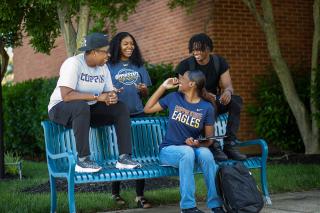
A group of four students chatting on a blue bench on Coppin's campus

Eagle Guide Student Handbook

You expect a lot from your University, and we expect a lot from our Eagles. The Student Handbook is a comprehensive resource for student and university standards.

Our Legal Obligation for Student Concerns and Complaints

Title 34 CFR §600.9 requires states to have a "process to review and appropriately act on complaints concerning the institution including enforcing applicable State laws." Title 34 CFR §668.43(b) requires that institutions: "make available for review to any enrolled or prospective student upon request, a copy of the documents describing the institution's accreditation and its State, Federal, or tribal approval or licensing. The institution must also provide its students or prospective students with contact information for filing complaints with its accreditor and with its State approval or licensing entity and any other relevant State official or agency that would appropriately handle a student's complaint." 

Legal language can be confusing. Simply put, each state must have a process where they review and follow up on complaints made about a school in that state. Sometimes this means states must enforce the law. 

This law also makes schools and institutions give any prospective or enrolled student the following information when requested: 

  • Any and all documentation about the institution’s accreditation and/or licensing 

  • All contact information to file a complaint with any accreditor, licensing agency, or state office that would appropriately deal with student complaints. 

How to Report a Student Concern

In this list, we include some of the most common student concerns as well as where to go to get more detailed information. If you don’t see your concern listed, talk with a trusted Coppin member of staff, faculty, or administration.

Submit a concern

This process is for when students believe a grade should change. First, request your professor complete a change-of-grade form on your behalf. If your professor agrees, s/he/they will update the grade with the revised grade and circulate it to the department chair, dean, and provost.  

If your professor disagrees about a grade change, you may take your complaint to your department chair, then your academic dean. Most of the time the dean is able to resolve these conflicts. If you don’t get a resolution from the dean, you may reach out to the Office of the Provost and Vice President for Academic Affairs. 

These violations focus on issues around plagiarism. Consult your department chair, and then, if necessary, your academic dean.  

Related concerns include incidents of unprofessional behavior, and other issues not related to grade changes or academic integrity. 

These types of concerns relate to being treated unfairly because of your race, gender, age, religion, sexual orientation, or other characteristic. Refer to Coppin’s Equal Employment Opportunity (EEO) and Non-Discrimination Statement for more detailed information. You can also connect with your department chair, then your academic dean, if necessary. 

If you or someone else is in imminent danger, reach out to Campus Police at (410) 951-3900. If you are looking to file a non-emergency report about hazing behavior, complete the online Behavioral Assessment Team Referral Form.

If you or someone else has been a victim of a hate crime, use the campus crime form to file an official report. As always, if you or someone else is in imminent danger, reach out to Campus Police at (410) 951-3900. 

Coppin commits to stay in compliance with the Americans with Disabilities Act of 1990 and the Americans with Disabilities Act Amendments Act (ADAAA). Visit our ADA page to file a report regarding potential noncompliance. 

Visit our resource section on Title IX compliance and fair practice to learn more about reporting sexual misconduct, which includes sexual and gender-based harassment, sexual violence, sexual exploitation, sexual intimidation, as well as sex- and gender-based stalking and retaliation. 

Coppin has an affirmative action program committed to ensuring equal employment opportunity. Visit our affirmative action resource page to file a report or concern about related unlawful practices. 

Our student, faculty, and staff resources outline Coppin’s commitment to Title IX, and maintaining a safe academic and professional work environment. 

Visit our resource section on Title IX compliance to learn more about reporting sexual misconduct, which includes sexual and gender-based harassment, sexual violence, sexual exploitation, sexual intimidation, as well as sex- and gender-based stalking and retaliation. 

If you or someone else has been a victim of a campus crime, use the campus crime form to file an official report. Report complaints about criminal activity to Campus Police. Criminal actions include, but are not limited to assault, battery, and theft. As always, if you or someone else in imminent danger, reach out to Campus Police at (410) 951-3900. 

As a Coppin student you have certain rights and responsibilities.  

The Office of Community Standards is responsible for determining whether the student code of conduct or grievances have been violated. 

In 2018, Governor Larry Hogan signed the Financial Consumer Protection Act of 2018. This law creates a Student Loan Ombudsman who serves as a go-between for student loan borrowers and their loan providers. Any student who wants to file a complaint against a loan provider can find valuable resources on the Helpful Resources - Student Loan Ombudsman - Financial Regulation page on the Maryland Department of Labor’s website.