
Satisfactory Academic Progress (SAP)

What is Satisfactory Academic Progress (SAP)?

Financial Aid Satisfactory Academic Progress (SAP) is an important policy because it affects your federal financial aid. It was created in 1965 as part of the Higher Education Amendment Act which requires schools to establish a minimum standard for SAP. Students who do not meet the criteria for SAP are not eligible for federal financial aid.

Mon-Thu: 8:00 am - 5:00 pm
Fri 8:00 am - 3:00 pm
Miles Connor Admin Bldg. First Floor

Students receiving federal financial aid must meet all 3 SAP requirements:

  • Qualitative grade point average (GPA): Undergraduate students must maintain a cumulative 2.0 GPA. Graduate students must maintain a cumulative 3.0 GPA
  • Quantitative analysis: All financial aid recipients must complete at least 67% of all attempted coursework.
  • Maximum timeframe: All financial aid recipients must complete their academic program within 150% of the maximum timeframe to complete

When is SAP evaluated?

SAP evaluation for all students happens at the end of spring semester, except for students on financial aid appeal. Students on appeal may be evaluated on a different timeline.
SAP Appeal Form

What are the different SAP statuses?

There are 3 different SAP statuses.

  • Meet SAP: A student receiving federal financial aid is in good standing and meets all 3 minimum GPA, coursework, and timeline requirements.
  • Suspension: A student receiving federal financial aid has fallen below minimum GPA requirements and/or has met or exceeded the maximum 150% time frame to complete their academic program. Students on SAP suspension are not eligible for federal financial aid.
  • Probation: A student receiving federal financial aid who has submitted an appeal application which has been approved is placed on a one-term probation. Students who meet all SAP requirements while in probation return to good standing. Students who don’t meet all SAP requirements while on probation are no longer eligible for federal financial aid or to re-appeal, and are placed back on suspension.

How am I notified about changes in my SAP status?

OFA notifies all students placed on financial aid warning and suspension via the EagleLINKS student portal.

What every student should know about the SAP appeals process

What should I include in my SAP appeal?

You may submit an appeal when placed on suspension by completing a Financial Aid Satisfactory Academic Progress (SAP) Appeal. Please note, submitting an appeal does not guarantee approval. Your appeal must include:

  1. SAP appeal form
  2. Typed personal statement detailing why you failed to meet SAP, and how you will meet SAP the next semester
  3. Additional documentation that supports your personal statement
  4. Academic and success strategies plan outlining the coursework and any academic services you will use to ensure academic success

How do I appeal my SAP status?

Reach out to your Academic Outreach Coordinator to complete the SAP Process:

Make an appointment

Outreach Coordinator/CollegeContact Information
Mr. Brandon Herring - CBSS

410-951-3587

brherring@coppin.edu

EAC- 421

Mr. Jared Nichols - COB

410-951-3565

janichols@coppin.edu

EAC-414

Ms. Yolanda Goshay - CASE

410-951-3568

ygoshay@coppin.edu

EAC-412

Ms. Hillary Bain - CHP

410-951-3912

hbain@coppin.edu

EAC-416

Please note: SAP status is separate from academic dismissal or suspension.

What’s next if my appeal is approved?

You will be on a one-term financial aid probation, and allowed one semester/enrollment period of federal financial aid to improve your status to meet SAP. Students cannot receive incompletes, fail, or withdraw while on one-term probation.

Students who don’t meet all SAP requirements while on probation are no longer eligible for federal financial aid or to re-appeal, and are placed back on suspension.

What’s next if my appeal is denied?

You are no longer eligible for federal financial aid at Coppin. You can regain eligibility at your own expense by:

  • Completing 67% of total coursework
  • Achieving the minimum cumulative undergraduate 2.0 GPA or cumulative graduate 3.0 GPA requirements

After meeting these SAP requirements at your own expense, you must complete a new appeal application if you want to be reconsidered for federal financial aid.

However, you cannot regain eligibility if you were denied an appeal for a maximum timeline extension. Also, eligibility cannot be established for being out of school for an extended time or paying for courses with your own funds.

How to Apply for Federal Financial Aid

How to Apply for Federal Financial Aid

Get Started on Your Financial Aid Process

Applying for federal financial aid begins with completing the Free Application for Federal Student Aid (FAFSA). Coppin uses the FAFSA to determine which students get federal financial aid, and how much they receive. Remember, completing the FAFSA is the first step for any student to be considered for federal financial aid, including grants, loans, work study and some scholarships.

The FAFSA school code for Coppin State University is 002068.

Start Your FAFSA

Are you a dependent?

A dependent student relies on financial help from parents or legal guardians.
Check Your Dependency Status

What every student and family needs to know to complete your FAFSA:

Student and families often complete the Free Application for Federal Student Aid (FAFSA) online. 

Step 1. Get your Federal Student Aid (FSA) User ID

Your FSA User ID is a username and password that acts as your login information and legal signature for federal financial aid applications, and online forms, like the FAFSA. Parents must create an FSA User ID if completing a FAFSA for a dependent. Any student applying for federal financial aid in their own name must have an FSA User ID. Create or look up your FSA User ID online through the Office of Federal Student Aid.

The FAFSA school code for Coppin State University is 002068.

Step 2. Collect all documentation required to complete the FAFSA

Remember, the documentation you need for your FAFSA is based on your dependency status. If you are a dependent, you must submit the required income documentation for your parents or legal guardians. If you are married, you’ll also need to submit your spouse’s income information in addition to your own.

Prepare to have these documents ready when completing your FAFSA:

  • Social Security number (for you and your parents, depending on dependency status)
  • Driver’s license number
  • Alien registration or permanent resident card (if not a U.S. citizen)
  • W2 forms (if you earned income, and did not file taxes)
  • Federal Tax Transcript or Tax Return for the year you’re applying for aid. We encourage you to use the IRS Data Retrieval tool to automatically transfer your Federal Tax Return into your FAFSA.

Note: Some accepted tax forms include the IRS 1040, 1040A, 1040 EZ, or Tax Return for Puerto Rico, American Samoa, the U.S. Virgin Islands, Marshall Islands, Federated States of Micronesia, or Palau.

Step 3: Complete, sign, and submit your FAFSA

The FAFSA is free to complete and never requires you to pay. Enter your FSA User ID to electronically sign your FAFSA before you submit.

What happens after I complete the FAFSA?

  1. After submitting your FAFSA, you receive your Student Aid Report (SAR). This report comes via the email you put on your FAFSA or through the mail. Your SAR shows your eligibility for Pell and Subsidized federal loans. It may also say you’ve been selected to confirm your FAFSA information through Verification.
  2. Coppin receives your SAR electronically via an Institutional Student Information Report (ISIR) after it processes.
  3. Your SAR report might indicate you’ve been selected to verify your FAFSA information. If this happens, Coppin’s Office of Financial Aid (OFA) notifies you about next steps, which may include you (and/or your parents) submitting Federal Tax Transcripts, Verification Worksheets, or any other documentation needed to finish your financial aid process. Learn what your next steps are when selected for Verification.
  4. Coppin’s OFA determines your eligibility for financial aid and notifies you once your file is complete.
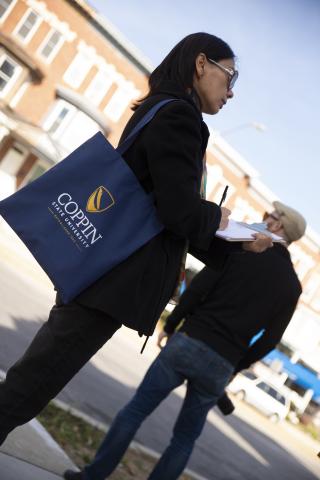
faculty with coppin tote

Important Tax Updates to the Federal Financial Aid Process

Students and families are now able to use Prior-Prior Year (PPY) tax information to complete the FAFSA. PPY is helpful because students and families can complete the FAFSA early, using accurate tax information from 2 years before. Before PPY, students and families had to estimate tax information on the FAFSA and then go back and update it once taxes were filed. This update means you can file your FAFSA faster, and possibly hear back about college financial aid packages sooner than before.

What is Verification?

FAFSA Verification

The Verification Process

The U.S. Department of Education requires universities to verify the accuracy of information provided on the Free Application for Federal Student Aid (FAFSA). Verification is the process of confirming that information reported by the student and parent(s) or spouse on the FAFSA is accurate. Each year, a percentage of student who complete the FAFSA applicants are randomly selected by the U.S. Department of Education for verification. A student may also be selected by the Coppin State University.

If selected for verification, students will initially be notified on their FAFSA submission summary. In addition, the Office of Financial Aid will notify the student via alerts on their Student Financial Planning (SFP) portal if additional documentation is needed.

Students who are selected for verification must provide all required documentation and verification must be complete before any financial aid will be released to students. Failure to provide all required documentation before the last day of classes for the semester may result in the cancellation of the student’s financial aid awards.

Please remember to write the student’s name and Campus ID on all verification documents prior to uploading to your SFP portal. To safeguard your personal information, please upload ALL verification documents to your student portal. Please do not email verification documents to the Office of Financial Aid.


Verification of Income Data

  • If you are selected for the verification process, our office will send you an email and post alerts on your SFP Portal specifying the documents required.
  • When all necessary documentation is received, our office will compare the submitted paperwork to the information provided on the FAFSA. If there are any discrepancies, our office will make the corrections, and you will receive notification if your financial aid has changed. The revised awards will be available on your SFP Portal.
  • Occasionally, our office must request additional documentation because the originally submitted documents do not provide all of the necessary information to complete the verification process. In these situations, you will be notified via e-mail that additional documentation needs to be submitted to our office.

Verification of Citizenship

If your citizenship status is not verified by the Department of Homeland Security when you initially complete your FAFSA, you will be required to submit documentation to the Office of Financial Aid verifying your citizenship status.


U.S. citizens flagged for verification of citizenship on the FAFSA should contact the Social Security Administration (SSA) to update their federal records to prevent repeated future requests. Use the link provided above and contact the SSA to find out how to update your record.


Acceptable Documentation for FAFSA Verification of Citizenship

For our office to verify citizenship, one of the following original documents must be submitted to the Office of Financial Aid in person:

If you are an U.S. citizen born in the United States, examples of acceptable documentation include:

  • Your birth certificate
  • Your U.S. passport

If you are a U.S. citizen born outside the United States, examples of acceptable documentation include:

  • Your Certificate of Citizenship
  • Your U.S. passport
  • Your Certificate of Naturalization

If you are an eligible non-citizen, examples of acceptable documentation include:

  • Your Alien Registration Receipt Card (Form I-551 or I-151)
  • Your passport stamped, “Processed for I-551 . . . valid until ___”
  • Your Departure Record (I-94)

General Verification FAQs

Verification is the process used to check the accuracy of information submitted by students on their Free Application for Federal Student Aid (FAFSA). If you are selected for verification, we must verify this information before you are offered financial aid.

If there are differences between your self-reported FAFSA information and the information you/your parent(s) provided as part of the verification process (including your federal tax return), we may update your FAFSA and recalculate your financial aid eligibility.

The U.S. Department of Education chooses student applications for verification and requires that universities check the accuracy of the information provided on the FAFSA or the renewal application.

Yes, you did already answer these questions or provide the information on the FAFSA. Verification is a process where we make sure that you have filled out the FAFSA correctly.

Yes, you must complete and submit the requested verification documents for your financial aid to be disbursed. Failure to complete the verification process could result in the delay or denial of your financial aid.

Please submit the requested verification document(s) by June 1 to be considered for all available financial aid programs. A financial aid offer cannot be created until all of the requested documents have been received and verification has been completed.

All required forms and documents for verification must be submitted before the conclusion of the semester to be considered for federal aid according to federal regulations.

For detailed information on how to complete the verification process through your Student Financial Planning Portal (SFP), please visit our SFP Verification Process page.

The Student Financial Planning portal is a web application provided to all enrolled to students to apply for, review/accept, and receive aid, with alert notifications for required actions, discrepancies and to expediate the verification process.

The length of time for verification can vary depending on the volume of students. Due to the high volume of students being verified in the spring and summer, it can take up to three to weeks for verification to be completed.

If additional information is needed during the verification process, you will be notified via email. If you need to update your contact information, please visit coppin.edu.

If the FAFSA has determined that you are a dependent student, yes, your parent information is needed to complete verification.

If you and your spouse did not file U.S. taxes, please submit both of the following documents:

  • The Student Non-Filer Status/Low Income Worksheet
    • This worksheet can be found on our (Forms) page.
  • The IRS Verification of Non-Filling Letter o You can request this letter on the IRS website or by completing IRS Form 4506-T.

If you worked in the U.S., we will also need all copies of the W-2 forms (if applicable). In the case that you or your spouse worked in a foreign country and earned foreign income, we will need a copy of the foreign taxes or a signed statement from the foreign employer, verifying the gross annual income earned. Please make sure all documents are translated to English and the currency is converted to U.S. dollars.

If your parents live in the U.S. and did not file taxes they will need to submit both of the following documents:

  • The Parent Non-Filer Status/Low Income Worksheet
    • This worksheet can be found on our page (Forms Page).
  • The IRS Verification of Non-Filling Letter o You can request this letter on the IRS website or by completing IRS Form 4506-T.

Please complete and upload the student’s SFP portal all copies of W-2 Forms (if applicable). If other documentation is needed, you will receive an email request.

Please provide copies of each parent’s foreign taxes or a signed statement from each parent’s foreign employer stating the annual gross income earned. Please submit a signed and dated statement that:

  • Certifies that your parent(s) does not have a Social Security Number, an Individual Taxpayer Identification Number, or an Employer Identification Number; and
  • Lists the sources and amounts of earnings, other income, and resources that supported your parent(s) for the associated tax year.

Please make sure all documents are translated to English and the foreign currency is converted to U.S. dollars.

The parent who lived in the U.S., needs to submit a copy of their U.S. federal tax information and the parent who lived abroad will need to submit a copy of the foreign taxes or a signed statement from their foreign employer, stating their annual gross income earned.

For the parent who lives abroad please submit a signed and dated statement that:

  • Certifies that the parent does not have a Social Security Number, an Individual Taxpayer Identification Number, or an Employer Identification Number, and
  • Lists the sources and amounts of earnings, other income, and resources that supported the parent for the associated tax year.

Please make sure all foreign documents are translated to English and the currency is converted to U.S. dollars.

For any parent that works for an international organization and is not required to file U.S. taxes or is not required to pay U.S. taxes, the parent should submit a letter from the employer stating the parent’s gross annual income earned. Also please visit the IRS website to request Verification of Non-filing Letter from the IRS for each parent in the household.

For any student or parent that files a federal tax extension, the student/parent must submit:

  • A copy of the IRS Form 4868, and
  • All copies of W-2 form(s) from employers; and/or
  • If one or both of your parents own a business or is self-employed, submit a signed statement listing the adjusted gross income (AGI) and taxes paid.

Individuals who filed an amended tax return must submit the following documents to the institution:

  • A transcript obtained from the IRS that lists tax account information of the tax filer for tax year; and
  • A signed copy of the IRS Form 1040X that was filed with the IRS.

Individuals who are victims of IRS tax-related identity theft must submit:

  • A Tax Return DataBase View (TRDBV) transcript obtained from the IRS; and
  • A statement signed and dated by the tax filer indicating that they were victims of IRS tax-related identity theft and that the IRS has been made aware of the tax-related identity theft.

Tax filers may obtain a TRDBV transcript and inform the IRS of the tax-related identity theft by calling the IRS’s Identity Protection Specialized Unit (IPSU) at 1-800-908-4490.

Types of Financial Aid

Types of Financial Aid

Find Your Financial Aid Fit

Coppin State University prides itself on being recognized nationally for transforming the lives of students from all socio-economic backgrounds through post-secondary education. We are committed to providing guidance on all forms of funding to finance your education and will take your request under review.

There are various types of financial aid. Financial aid is inclusive of grants (gift aid), scholarships (grant or payment awarded based on merit, athletic or other achievement) and educational loans (must be repaid).

Many Coppin students have a combination of grants, scholarships, loans and other funding sources to pay for their college education. Check out some of the available options to help make your Coppin education a reality.

Grants

A grant is gifted aid that you do not need to pay back. There are several types of grants:

  • First source of federal financial aid if eligible.
  • Awards range from $740 (minimum) - $7,395 (maximum).
  • Available to financial aid eligible degree-seeking students and students who have not earned a bachelor’s degree.
  • Based on student financial need determined by a completed and valid Free Application for Federal Student Aid (FAFSA) application.
  • Amount determined by the student’s Student Aid Index (SAI), cost of attendance, and number of enrolled credit hours. 

  • Awarded to students with exceptional financial need according to a federal eligibility formula.
  • Available to Pell Grant-eligible students.
  • Funds are limited and awarded to students first come first serve until funds are depleted.
  • Amount determined by your Student Aid Index (SAI), cost of attendance, and number of enrolled credit hours
  • Award amounts range from $100 - $4,000.00 depending on financial need and available funds. 

Direct Student Loans

Subsidized and Unsubsidized Loans

Federal Direct Student Loans are a type of federal financial aid you must repay. Direct Loans enter repayment after a one-time 6-month grace period when you either graduate, withdraw, or are enrolled less than half-time (6 credit hours). Coppin provides these types of Title IV and Campus Aid.

  • Federal Subsidized Direct Loan
  • Federal Unsubsidized Direct Loan
  • Federal Direct Parent Loan for Undergraduate Students (PLUS)
  • Federal Direct Graduate PLUS Loan

To be eligible for a Federal Direct Student Loan, a student must:

  • Complete the Free Application for Federal Student Aid (FAFSA), and submit all requested documents.
  • Enroll in at least 6 credit hours in a financial aid-eligible degree seeking and/or certificate program.
  • Meet Satisfactory Academic Progress (SAP) requirements.

It’s important to remember all first-time borrowers must complete the Direct Loan Entrance Counseling and sign Direct Loan Master Promissory Note (MPN).

  • Need based low-interest funds borrowed directly from the U.S. Department of Education Interest-free while you are enrolled at least half-time (6 credits) in an undergraduate degree seeking and/or certificate program.
  • Can be used for education-related expenses such as tuition, fees, books, living costs, transportation, and childcare.
  • Repayment begins 6 months after a recognized change in enrollment status.
  • Repayment terms vary according to a chosen repayment plan. If you don’t pick a repayment plan, your loan servicer will place you on the Standard Repayment Plan (a 10-year fixed payment repayment plan).
  • First time Coppin borrowers are subject to a 30 day hold on the first loan disbursement.

  • Funds borrowed directly from the U.S. Department of Education
  • Accrue interest during enrollment and repayment periods.
  • Can be used for education-related expenses such as tuition, fees, books, living costs, transportation, and childcare.
  • Repayment begins 6 months after a recognized change in enrollment status
  • Repayment terms can be a maximum of 10 years, or consolidated for a longer payment period
  • First time Coppin borrowers are subject to a 30 day hold on the first loan disbursement

PLUS Loans

In addition to Stafford Loans, Coppin also provides the Parent Loan for Undergraduate Students (PLUS) and a Grad-PLUS loan for graduate students. Parents of dependent undergraduate students and graduate students can borrow PLUS/Grad-PLUS monies to help pay for school. PLUS Loans are often less expensive than private loans because of their regulated borrower terms through the U.S. Department of Education.

  • Regulated by the U.S. Department of Education
  • Offered one academic year at a time
  • Processed, approved and/or denied by the U.S. Department of Education based on borrower’s credit history
  • Parents and legal guardians: Apply for a PLUS Loan through the Office of Federal Student Aid

When the U.S. Department of Education denies a PLUS loan application, the dependent student may become eligible to borrow up to $4,000 in additional Direct Unsubsidized loan funds. This additional Direct Unsubsidized Loan still earns interest during the student’s enrollment and cannot exceed the student’s cost of attendance minus all other aid (including other loans). 

Exit Counseling

Federal Direct Loan student borrowers are required to complete an Direct Loan Exit Counseling session. This Exit Counseling session has been created by the U.S. Department of Education to make sure that you understand your rights and responsibilities as a federal student loan borrower.


Federal Work-Study Program (FWS)

Federal Work-Study (FWS) is a need-based financial aid program that provides undergraduate and graduate students part-time employment opportunities, allowing students to earn money to help pay for educational expenses. FWS jobs are regular paid positions emphasizing employment in civic education and work related to your course of study whenever possible. Job opportunities can be on campus or off campus. Off campus positions will usually be a private nonprofit organization or a public agency, and the work performed must be in the public interest.

To become eligible for an FWS or SEP award, students must:

  • Complete the FAFSA
  • Be eligible to receive federal financial aid and have unmet need
  • Stay enrolled in 6 or more credit hours

To maintain FWS eligibility, students must:

  • Complete all personnel paperwork (e.g., I-9, W-4, Form 52, etc.) before starting employment
  • Work no more than 20 hours per week during fall and spring semesters
  • Stay enrolled in 6 or more credit hours in a degree-seeking program during FWS or Student Employment Program (SEP) opportunities
  • Submit timely accurate timesheets
  • Not exceed the FWS or SEP award

Private Loans

Private student loans (also known as alternative loans) are non-federal loans, made by a lender such as a bank, credit union or state agency. Federal student loans include many benefits (such as fixed rates, income-based repayment plans, and loan forgiveness plans) not typically offered by private loans. In many cases, private loans may be more expensive than Federal student loans. A student should NEVER consider borrowing from a private loan program until they have exhausted all their Federal Direct Loan options first.

  • Dependent Undergraduate students applying for private loan financing with a parental cosigner are advised to first investigate the options offered by the Federal PLUS program before applying. A detailed comparison between the Direct PLUS and Private loan programs can be viewed in our Direct Loan Comparison Worksheet.
  • Through our partnership with Fast Choice, you can now search for private lenders and loans that meet your needs.

Scholarships and Scholars Programs

Our Coppin Financial Aid Office provides a wealth of information on different scholarship programs. We encourage students to check the website often as new scholarships are added regularly. See our complete list of scholarship opportunities.


Student Loan Code of Conduct

The guiding principles for ensuring the integrity of the student aid process and the ethical conduct of employees in regard to student loan practices at Coppin State University.

Student Loan Code of Conduct


For Employers

For Employers

Career and Professional Services

We offer a variety of opportunities for employers to connect with our Coppin students and alumni. We welcome organizations to participate in career fairs and to schedule on-campus interviews, seminars, information sessions and tables. 

Recruitment is one of the Center's primary services—and we do the heavy lifting to schedule, arrange, and inform students and faculty of your campus visit.

Fall Career Fair

Career and Professional Services will sponsor the Fall Career Fair on Wednesday, September 23, 2026, at 1:00 p.m. - 4:00 p.m. in the Physical Education Center (PEC). You are invited to participate in this event.

The primary objective of the Career Fair is to acquaint our students and alumni with the various options available for their consideration. You are encouraged to discuss employment opportunities (jobs and internships) and graduate school programs. This event is open to all majors.

Free on campus parking will be provided on parking Lot H.

Registration

To secure your table, you must register. The registration fee for this event is $600 for for-profit/general employers and $250.00 for non-profit/501c employers.

Employer Registration

Employer Payment Portal

Questions? Contact: Mr. John McCray at 410-951-3581 or jmccray@coppin.edu.


On-Campus Interviews

Our campus is always open for employer interviews, and we work with you to make sure interviews are made available to all interested students. Please keep these dates in mind:

  • Fall semester: between the first week of October and first week of December
  • Spring semester: between the second week in February and second week in May
  • Need a specific date? Contact us—we're happy to help.

Information and Recruitment Tables

We can set up tables for recruiters in the Tawes College Center, Talon Center, or The Health and Human Services Building lobby. Are you actively recruiting for current openings? Bring information to share with students!


Information Sessions and Workshops

We invite you to partner with us for sessions and workshops. Employers can schedule information sessions before campus visits to promote your organization and answer specific student questions. We also run Resume Writing, Interviewing Skills, Networking, and Major-Specific Job Search workshops, and are always looking for industry partners to collaborate.

Career and Professional Services

Take your skills from classroom to career.

Career and Professional Services

Coppin State student in a suit in front of the Fanny Coppin statue
Our Mission

Career and Professional Services helps students and alumni build professional connections and develop the skills you need to transform your studies to the career you want. We offer programs and services that help you identify interests and career goals, learn industry trends, and also connect employers, students, and alumni for professional opportunities.

We are the go-to career and employment resource for students, alumni, and employers. It's never too early to start preparing for your next career or professional move. Not sure the help you need? Check out what we do and talk with us about how we can help you:

  • Identify and refine your values, personality traits, interests, and career goals
  • Prepare for your job search with career coaching, mock interviews, resume writing, and other services
  • Find resources for graduate and professional school opportunities
  • Connect students and employers for career opportunities

See where your major can take you

Programs

We know how important it is for learning to also happen outside of the classroom. We work to connect employers and students with career-related opportunities that allow students to gain hands-on experience in an occupation or industry before graduating.

This program connects employers and students through recruitment activities and initiatives. We help employers schedule individual interviews, information sessions and tables, as well as classroom presentations.

Learn more

Woo hoo, you graduated! Now what? As an alumni, you still have access to Career and Professional Services. Reach out to us for career coaching, mock interviews, and other job search support.

Plan your next career move

For Employers

Learn about our various opportunities for employers to connect with our Coppin students and alumni.

Information for Employers

Staff

Career Services Coordinator

staff

Employer Relations Coordinator

staff

From Classroom to Career

student story cropped image node 101

I have found PPEs to be useful in life—patience, perspective and empathy; and not letting other peoples’ judgment and opinion affect the way we live our lives.

Sunil Yadav B.A. Biology and Minor in Chemistry

Read Story
Ashley Queen

I call myself “The Unboxed Scientist.” And that's because people often try to fit you into a box based on your career.

Ashley Queen Microbiology

Read Story