Adult and Continuing Education

Adult and Continuing Education

Degree Type

Master of Science

About

How we learn changes as we age, so how we teach should change too. Learn how to teach and design learning opportunities for adult and aging learners.

Introduction

Adult education focuses on creating learning opportunities for adult and aging populations. This growing field extends across instruction, curriculum development, counseling, government, and other industries. With a wide range of meaningful opportunities, adult education offers practitioners to pursue careers as instructors, counselors, and administrators and help others pursue lifelong learning.

Learn how to: 

  • Apply adult learning and development theory to instruction, counseling, and training
  • Assess diverse adult learner needs. Use numerous instructional strategies, tools, and practices to meet learner needs
  • Apply theory to practices through models and tools for adult education
  • Plan, implement, and evaluate adult education instruction, courses, and programs
  • Develop inclusive adult education curricula, courses, and programs
  • Prepare scholarly research and activities
  • Problem solve ethical challenges

Encourage Lifelong Learning

This program focuses on training professionals for both general and specialized careers within adult education, counseling, and training programs. Coursework helps you understand adult learners, along with their motivations and needs. You can also choose to enhance understanding through a specialty:

  • Administration and Supervision
  • Gerontology
  • Family Counseling

Program Requirements

All students admitted to the M.A.T. program become teacher candidates. The department assigns each candidate an advisor to help plan your course schedule throughout your program journey.

Credit hours in this program split between:

  • Core requirements
  • Specialization courses

Core Courses (18 credits)

CoursecreditsName
ADLT 5003Foundations of Adult Education
ADLT 5013The Adult Learner
EDUC 7053Strategies for Curriculum Development
ADLT 5033Counseling Adults
ADLT 5043Practicum

Specializations

Choose to specialize in a focused area.

Administration and Supervision

This specialty focuses on leadership development for leaders and administrators of adult education, counseling, and training programs. Our students prepare to become administrators, counselors, and educators.

Specialization Courses

coursecreditsname
EDUC 7073Administration of Education Programs
EDUC 6553Supervision of Instruction
ADLT 5123Planning, Programming and Budgeting For Education Programs
ADLT 5133Sociology of Community and Community Development
EDUC 582 Research Methods in Social and Behavioral Sciences (Prerequisite for ADLT 600)
ADLT 6003Seminar in Graduate Research (Taken after 21 credits)

Gerontology

In this specialty, you learn about the clinical and theoretical aspects as well as the effects of aging. You’ll also learn more about roles that support persons throughout the aging process, like home health providers, and family caregivers. Upon graduation, students will be able to analyze and design government responses to aging.

Specialization Courses

coursecreditsname
ADLT 5303Environment of Aging
ADLT 5313Nutrition Problems of the Aging
ADLT 5323Developmental Psychology of Adult Years and Aging
ADLT 5333Process of Aging
EDUC 5823Research Methods in Social and Behavioral Sciences
ADLT 6003Seminar in Graduate Research

Family Counseling 

This is the only specialty that requires a 6-credit practicum experience. Students learn theory and application of family intervention strategies. Additional focus areas include dynamics of family systems theory and marriage counseling, as well as related counseling techniques.

Students studying

750+ Course Options

The Coppin State University Academic Catalog has a wide variety of skill-building courses designed to inspire and prepare you to be in-demand professionals and transformational leaders.

Graduate Education Programs

School Administration

Graduate

Contemporary Educational Leadership

Graduate
College

Adult and Continuing Education lives in the Department of Instructional Leadership and Instructional Development in the School of Education within the College of Arts & Sciences, and Education.

Department of Instructional Leadership and Professional Development

Department of Instructional Leadership and Professional Development

School of Education

We prepare school leaders today to meet the instructional challenges of tomorrow. We Build Leaders.

Are people born leaders, or can people be taught to lead? The Department of Instructional Leadership and Professional Development (ILPD) believes even those with natural leadership abilities can still grow these skills, while others without a strong leadership foundation can build one through our programs.

Since 1982, we have graduated more than 400 practitioners. These practitioners have gone on to serve and lead institutional and instructional efforts to meet social, educational, and health needs of P-12 and adult learner populations. With programs designed to satisfy a variety of learner experiences, we have strategically positioned the department to meet critical nontraditional educational programming needs.

Our Programs

Adult and Continuing Education

Graduate

Contemporary Educational Leadership

Graduate

School Administration

Graduate
students at laptops

Writing Center

student doing math on chalkboard

Math Center

Get peer and professional help for all kinds of math problems.

Current student? Report a complaint or concern.

Report a concern or complaint

Forms and Downloads

Find it now

Contact Us

Our teaching legacy has built a firm foundation for us to welcome renowned faculty to our department. With celebrated skills and expertise, professors guide each of our future educational leaders through program requirements, serving as mentors, advocates, and change agents.

Chairperson and Assistant Professor

faculty

Can Help With
Program Requirements
Plan of Study
Graduation Information
Administrative Assistant II

staff

Assistant Professor

faculty

Professor

staff

College

The Department of Instructional Leadership and Professional Development lives within the School of Education in the College of Art & Sciences, and Education.

Teaching

Teaching

Degree Type

Master of Arts in Teaching

About

Master the art of teaching with a Master of Arts in Teaching.

Introduction

As elementary student enrollment trends continue to increase, make sure you have the skills ready to meet demand, and benefit your career growth. Our Master of Arts in Teaching is an initial licensure program that prepares you to work with elementary students in first through sixth grade. There are several reasons to consider an advanced teaching degree:

  • Elevate your teaching skills
  • Increase your salary
  • Add a respected degree for more advancement opportunities
  • Choose a specialization
  • Start a second career as a teacher

Accreditation

The M.A.T. in Elementary Education is approved by the Maryland State Department of Education (MSDE), recognized by the Association for Childhood Education International (ACEI), and accredited by the Council for the Accreditation of Educator Preparation (CAEP).

Qualified Teacher Education

In the Department of Teaching and Learning, we adhere to the high academic standards of our field, committing to prepare well-qualified elementary education professionals, who are ready to champion student success in diverse and urban environments. Our program equips graduates with capabilities to apply knowledge and theory to practice, using research-based practices to support individual needs of students in first through sixth grade classrooms.

What You'll Learn

Learn how to: 

  • Plan and engage children in exploration, experimentation, and discovery activities
  • Reflect appropriate professional attitudes and behaviors
  • Effectively teach and meet academic needs of all students in special programs
  • Deconstruct curricula, be familiar with curricula organization, objectives, and procedures; as well as the instructional resources of the school and community to effectively implement curricula
  • Apply theory to practice in order to effectively analyze teaching practices and experiences while engaging in the selection, planning, presentation, and evaluation of content knowledge
  • Motivate and support learners through applied theory and practice Collaborate with the broader community of education professionals and practice continuous professional growth
  • Apply knowledge and skills in the use of technology to support instruction, access and manipulate data, enhance professional growth and productivity; communicate; and conduct research

Program Requirements

The department assigns each candidate an advisor to help plan your course schedule throughout your program journey.

Credit hours in this program are split between:

  • Core requirements
  • Professional course requirements

Professional Courses

CoursecreditsName
CUIN 5603Theoretical Bases for Teaching and Learning
SPED 5873Teaching Learners with Exceptionalities in the Regular Classroom
CUIN 6073Managing the Teaching and Learning Environment
REED 5043Processes and Acquisition of Reading Skills
REED 5053Strategies and Materials for Reading Instruction
REED 5083Reading and Literacy Instruction in Early Childhood/Elementary Grades
REED 6033Diagnostic Teaching of Reading

Methods and Student Teaching

CoursecreditsName
CUIN 6003Internship Proseminar
CUIN 6063Instructional Strategies and Methods for Effective Teaching
CUIN 6086Internship in Curriculum and Teaching (Field-based with action research)
ELED 5901Practicum in Elementary Education (Internship Part I)
Students studying

750+ Course Options

The Coppin State University Academic Catalog has a wide variety of skill-building courses designed to inspire and prepare you to be in-demand professionals and transformational leaders.

More Teacher Education Programs

Teacher Leadership

Graduate

Early Childhood Education

Undergraduate

Early Childhood Human Development

Undergraduate

Elementary Education

Undergraduate

Special Education

Undergraduate
College

The Master of Arts in Teaching lives in the Department of Teaching and Learning in the School of Education within the College of Arts & Sciences, and Education.

Special Education

Special Education

Degree Type

Bachelor of Science

About

Students are like stars; be the teacher who helps them shine. 

Introduction

Each teacher must prepare to face a classroom of children with varying exceptional abilities and needs. It can feel like a big responsibility (because it is), but you don’t have to do it by yourself. Every semester, our special education program commits to teaching and supporting teacher candidates in learning the skills needed to address the academic needs of all students. Because when you help them shine, you shine too.

Accreditation

The Special Education Program is approved by the Maryland State Department of Education (MSDE), recognized by the Council for Exceptional Children (CEC), and accredited by the Council for the Accreditation of Educator Preparation (CAEP).

Program Standards

The Special Education program and related courses align with standards set by the Council of Exceptional Children (CEC), the Interstate New Teacher Assessment and Support Consortium (INTASC), and Maryland Teacher Technology Standards (MTTS).

Qualified Teacher Education

In the Department of Teaching and Learning, we adhere to the high academic standards of our field, committing to prepare well-qualified special education professionals, who are ready to champion student success in diverse and urban environments. Our program equips graduates with capabilities to apply knowledge and theory to practice, using research-based practices to support individual student needs. 

We also expose teacher candidates to real-world classroom environments through our Professional Development School (PDS) sites. These classroom experiences help our students:

  • Analyze teaching situations and challenges
  • Select organize, and present subject matter
  • Use evaluation techniques on teaching and learning results
  • Apply theories and principles of learning

What You'll Learn

Learn how to: 

  • Plan and engage children in exploration, experimentation, and discovery activities 
  • Effectively teach and meet academic needs of all students in special programs 
  • Create and use meaningful and challenging experiences to teach students with exceptional abilities 
  • Establish safe, inclusive, and culturally responsive learning to effectively teach students with exceptional abilities 
  • Engage students with exceptional abilities in a manner consistent with ethical principles and practices  
  • Deconstruct curricula, be familiar with curricula organization, objectives, and procedures; as well as the instructional resources of the school and community to effectively implement curricula 
  • Apply knowledge and skills acquired during practical experiences to effectively analyze teaching practices and experiences while engaging in the selection, planning, presentation, and evaluation of content knowledge 
  • Motivate and support learners through applied theory and practice 
  • Collaborate with the broader community of education professionals and practice continuous professional growth 
  • Engage with current research to plan and apply tenets of practitioner research that demonstrate effective assessment of student learning and use those data to support learners and improve practices 
  • Apply knowledge and skills in the use of technology to support instruction, access and manipulate data, enhance professional growth and productivity; communicate; and conduct research 
Students studying

750+ Course Options

The Coppin State University Academic Catalog has a wide variety of skill-building courses designed to inspire and prepare you to be in-demand professionals and transformational leaders.

Program Requirements

To graduate with a Bachelor of Science in Special Education, students must complete 122 credit hours. These credit hours are split among:

Review the course descriptions to learn more about different types of major requirements.

General Education Requirements (GERs)

All special education majors must take (or transfer in) 45 credits.

CoursecreditsName
ENGL 1013English Composition I
ENGL 1023English Composition II

WLIT 207

or

ENGL 2xx

3

World Literature

or

200 Level English

HIST 2053African American History I
HIST 2063African American History II
BIOL 1014Biological Science

MATH 131

or

MATH 203

3

College Algebra

or

Basic Statistics

PHSC 1014Physical Science 
PSYC 201 3Introduction to Psychology
PHIL 1023Introduction to Philosophy
HLTH 1013Personal Health
IDIS 1033Visual Arts and Theatre
SOCI 2013Introduction to Sociology
MISY 1503Technology Fluency
FRSEM 1011Freshman Seminar

Program Requirements (22 credits)

CourseName
MATH 103Math for Elementary Teachers I
MATH 207Technology-Based Math
MATH 104Math for Elementary Teachers II
PHSC 102Earth and Space Science 
GEOG 102World Geography
PSYC 335Developmental Psychology
ENGL 321Children's Literature

Core Courses (30 credits)

CourseName
SPED 201Introduction to Needs of Exceptional Individuals
SPED 303Techniques of Measurement and Evaluation of Learners with Mild and Moderate Disabilities
SPED 402Counseling Parents and Family Members of Learners with Mild and Moderate Disabilities
EDUC 201Introduction to Race and Inequality
EDUC 202Educational Psychology
EDUC 300Foundations of Reading
EDUC 330Culture and Cognition
EDUC 331Practice What You Teach
REED 401Diagnosis and Remediation of Reading Disorders
REED 405Strategies and Materials for Teaching Reading

Methods and Student Teaching (25 credits)

CourseName
SPED 301Classroom Organization and Management in the Education of Learners with Mild and Moderate Disabilities
SPED 304Curriculum for Teaching Literacy Skills to Mild and Moderate Disabled Learners in Elementary and Middle Grades
SPED 305Curriculum for Teaching Math, Social Studies, and Science to Mild and Moderate Disabled Learners in Elementary and Middle Grades
SPED 390Practicum in Special Education (Internship Part I)
SPED 403Developing Individualized Education Programs for Learners with Mild and Moderate Disabilities
SPED 404Directed Teaching with Learners
SPED 405Seminar
ELED 303Methods of Teaching Reading

Remember! You must complete all major and prerequisite courses with a grade of C or higher.

Sample Degree Plan

This plan is only for example purposes. Your academic journey may be slightly different from another student’s, so be sure to always communicate with your academic advisor before finalizing your course schedule. 

Fall Semester (16 credits)

Course credits name
ENGL 101 3 English Composition I
PSYC 201 3 General Psychology

MATH 131

or

MATH 203

3

College Algebra

or

Basic Statistics

IDIS 103 3 Visual Arts & Theatre
MISY 150 3 Technology Fluency
FRSEM 101 1 Freshman Seminar

Spring Semester (16 credits)

course credits name
ENGL 102 3 English Composition II
MATH 103 3 Math for Elementary Teachers II
BIOL 101 4 Biological Science
HIST 205 3 African American History I
HEED 101 3 Personal Health

Fall Semester (16 credits)

Course credits name
MATH 104 3 Math for Elementary Teachers I
PHSC 101 4 Physical Science
WLIT 207 3 World Literature
PHIL 102 3 Introduction to Philosophy
HIST 206 3 African American History II

Spring Semester (16 credits)

Course credits name
MATH 207 3 World Literature
SOCI 201 3 Introduction to Sociology
PHSC 102 3 Earth and Space Science
SPED 201 3 Introduction to Exceptional Individuals
EDUC 300 3 Foundations of Reading

Fall Semester (15 credits)

Course

credits

name

EDUC 201

3

Introduction to Race and Inequality

EDUC 202

3

Educational Psychology

GEOG 102

3

World Geography

ENGL 321

3

Children's Literature

REED 401

3

Diagnosis and Remediation of Reading Disorders

Spring Semester (18 credits)

course

credits

name

SPED 303

3

Technology of Measurement and Evaluation

EDUC 330

3

Culture and Cognition

PSYC 335

3

Developmental Psychology

SPED 402

3

Counseling Parents and Family

REED 405

3

Reading Materials and Strategies

EDUC 331

3

Practice What You Teach

Fall Semester (13 credits)

Course

credits

name

SPED 304

3

Methods and Materials of Literature and Social Studies

ELED 303

3

Methods of Teaching Reading

SPED 305

3

Methods of Teaching Math and Science

SPED 403

3

Developing Individualized Education Programs

SPED 4390

1

Practicum in Special Education (Internship Part I)

Spring Semester (12 credits)

Course

credits

Name

SPED 404

9

Internship

SPED 405

3

Seminar

More Teacher Education Programs

Early Childhood Education

Undergraduate

Early Childhood Human Development

Undergraduate

Elementary Education

Undergraduate

Teaching

Graduate
College

Special Education lives in the Department of Teaching and Learning in the School of Education within the College of Arts & Sciences, and Education.
Elementary Education

Elementary Education

Degree Type

Bachelor of Science

About

When you’re investing in young learners, you’re investing in their communities.

Introduction

Working with students can be the most fulfilling part of a career in education, but there’s definitely more to it. Learning skills in classroom management and curriculum development can help prepare you for real-world scenarios, propelling you and your career to the front of the class.

Accreditation

The Elementary Education Program is approved by the Maryland State Department of Education (MSDE), recognized by the Association for Childhood Education International (ACEI), and accredited by the Council for the Accreditation of Educator Preparation (CAEP).

Qualified Teacher Education

In the Department of Teaching and Learning, we adhere to the high academic standards of our field. We commit to prepare well-qualified elementary education professionals, who are ready to champion student success in diverse and urban environments. Our program equips graduates with capabilities to apply knowledge and theory to practice, using research-based practices to support individual student needs.

We also expose students to real-world classroom environments through our Professional Development School (PDS) sites. These classroom experiences help our students:

  • Analyze teaching situations and challenges
  • Select organize, and present subject matter
  • Use evaluation techniques on teaching and learning results
  • Apply theories and principles of learning

What You'll Learn

Learn how to:

  • Plan and engage children in exploration, experimentation, and discovery activities
  • Reflect appropriate professional attitudes and behaviors Deconstruct curricula, be familiar with curricula organization, objectives, and procedures; as well as the instructional resources of the school and community to effectively implement curricula
  • Apply theory to practice in order to effectively analyze teaching practices and experiences while engaging in the selection, planning, presentation, and evaluation of content knowledge
  • Apply and reflect on the practical application of theories and principles of learning to support and motivate learners
  • Collaborate with the broader community of education professionals and practice continuous professional growth
  • Engage with current research to plan and apply tenets of practitioner research that demonstrates an effective assessment of student learning and use those data to support learners and improve practices
  • Apply knowledge and skills in the use of technology to support instruction, access and manipulate data, enhance professional growth and productivity; communicate; and conduct research
Students studying

750+ Course Options

The Coppin State University Academic Catalog has a wide variety of skill-building courses designed to inspire and prepare you to be in-demand professionals and transformational leaders.

Program Requirements

To graduate with a Bachelor of Science in Elementary Education, students must complete 122 credit hours. These credit hours are split among:

  • General Education Requirements, or GERs (45 credits)
  • Program requirements (22 credits)
  • Core requirements (30 credits)
  • Methods and student teaching (25 credits)

Review the course descriptions to learn more about different types of major requirements.

General Education Requirements (GERs)

All elementary education majors must take (or transfer in) 45 credits. Choose from the following courses:

CoursecreditsName
ENGL 1013English Composition I
ENGL 1023English Composition II

WLIT 207

or

ENGL 2xx

3

World Literature

or

200 Level English

HIST 2053African American History I
HIST 2063African American History II
BIOL 1014Biological Science

MATH 131

or

MATH 203

3

College Algebra

or

Basic Statistics

PHSC 1014Physical Science 
PSYC 201 3Introduction to Psychology
PHIL 1023Introduction to Philosophy
HLTH 1013Personal Health
IDIS 1033Visual Arts and Theatre
SOCI 2013Introduction to Sociology
MISY 1503Technology Fluency
FRSEM 1011Freshman Seminar

Program Requirements (22 credits)

CoursecreditsName
MATH 1033Math for Elementary Teachers I
MATH 2073Technology-Based Math
MATH 1043Math for Elementary Teachers II
PHSC 1024Earth and Space Science 
GEOG 1023World Geography
PSYC 3043Child Psychology
ENGL 3213Children's Literature

Core Courses (30 credits)

CoursecreditsName
EDUC 2023Educational Psychology
EDUC 3003Foundations of Reading
EDUC 2013Introduction to Race and Inequality
EDUC 3303Culture and Cognition
ELED 3013Curriculum, Planning, and Management
EDUC 3313Practice What You Teach
EDUC 4083Measurement and Evaluation
REED 4013Diagnosis and Remediation of Reading Disorders
REED 4053Strategies and Materials for Teaching Reading
SPED 2013Introduction to Needs of Exceptional Individuals

Methods and Student Teaching (25 credits)

CoursecreditsName
ELED 3023Methods of Teaching Mathematics in Elementary
ELED 3033Methods of Teaching Reading in Elementary
ELED 3063Methods of Teaching Social Studies in Elementary
ELED 3053Methods of Teaching Science in Elementary
ELED 3901Practicum in Elementary Education (Internship Part I)
ELED 4123Directed Teaching
ELED 4133Seminar

Remember! You must complete all major and prerequisite courses with a grade of C or higher.

Sample Degree Plan

This plan is only for example purposes. Your academic journey may be slightly different from another student’s, so be sure to always communicate with your academic advisor before finalizing your course schedule.

Fall Semester (16 credits)

Course

credits

name

ENGL 101

3

English Composition I

PSYC 201

3

General Psychology 

MATH 131

or

MATH 203

3

College Algebra

or

Basic Statistics

IDIS 103

3

Visual Arts & Theatre

MISY 150

3

Technology Fluency

FRSEM 101

1

Freshman Seminar

Spring Semester (16 credits)

course

credits

name

ENGL 102

3

English Composition II

MATH 103

3

Math for Elementary Teachers II

BIOL 101

4

Biological Science 

HIST 205

3

African American History I

HEED 101

3

Personal Health

Fall Semester (16 credits)

Course

credits

name

MATH 104

3

Math for Elementary Teachers I

PHSC 101

4

Physical Science

WLIT 207

3

World Literature

PHIL 102

3

Introduction to Philosophy

SOCI 201

3

Introduction to Sociology

Spring Semester (16 credits)

Course

credits

name

MATH 207

3

World Literature

HIST 206

3

African American History II

PHSC 102

3

Earth and Space Science

GEOG 102

3

World Geography

EDUC 300

3

Foundations of Reading

Fall Semester (15 credits)

Course

credits

name

EDUC 201

3

Introduction to Race and Inequality

EDUC 202

3

Educational Psychology

ELED 301

3

Curriculum Planning and Management

ENGL 321

3

Children's Literature

REED 401

3

Diagnosis and Remediation of Reading Disorders

Spring Semester (18 credits)

course

credits

name

EDUC 408

3

Measurement and Evaluation

EDUC 330

3

Culture and Cognition

PSYC 304

3

Child Psychology

SPED 201

3

Introduction to Exceptional Individuals

REED 405

3

Reading Materials and Strategies

EDUC 331

1

Practice What You Teach

Fall Semester (13 credits)

Course

credits

name

ELED 302

3

Methods of Teaching Math

ELED 303

3

Methods of Teaching Reading

ELED 305

3

Methods of Teaching Science

ELED 306

3

Methods of Teaching Social Studies

ELED 390

1

Practicum in Elementary Education (Internship Part I)

Spring Semester (12 credits)

Course

credits

Name

ELED 412

9

Internship

ELED 413

3

Seminar

More Teacher Education Programs

Early Childhood Education

Undergraduate

Early Childhood Human Development

Undergraduate

Special Education

Undergraduate

Teaching

Graduate
College

Elementary Education lives in the Department of Teaching and Learning in the School of Education within the College of Arts & Sciences, and Education.
Early Childhood Human Development

Early Childhood Human Development

Degree Type

Bachelor of Science

About

Do more than just watch them grow—be part of their journey. 

Introduction

During a child’s first years, physical, emotional, and social growth happen at rapid speeds. Learning opportunities are everywhere as these young minds take in the world around them like sponges. Pre-school, Head Start, and other early learning professionals play such an important role in this development—and opportunities are on the rise.

Prospective early learning teachers and future directors of child care centers will have the opportunity to acquire the skills and understanding that will enable them to stimulate the sensory and cognitive abilities of the child through exploration, experimentation, and discovery.

Qualified Teacher Education

In the Department of Teaching and Learning, our goal is to prepare well-qualified early learning professionals, such as early learning center teachers and directors, as well as pre-school program and Head Start teachers, to champion support for the early learners’ broad range of needs. Our students graduate with the skills to manage daily operations, plan foundational academic lessons, as well as collect and analyze data to make informed decisions.

We also expose students to real-world classroom environments through on-site field experiences with our local childcare center and school partners. These classroom experiences help our students:

  • Analyze teaching situations and challenges

  • Select, organize, and present subject matter

  • Use evaluation techniques on teaching and learning results

  • Apply theories and principles of learning 

What You'll Learn

You'll learn how to encourage healthy childhood development through:

  • Planning and engaging children in exploration, experimentation, and discovery activities 

  • Nurturing self-awareness and identity of feelings and how to manage them

  • Teaching situational awareness and adaptability in practical and real-world contexts

  • Encouraging self-awareness and independence within the larger community

  • Building and maintaining positive relationships with peers, teachers, and within the community

  • Planning and implementing learning activities to develop effective communication skills

  • Planning and implementing culturally appropriate literacy lessons on topics including, the alphabet, new words, and story composition 

  • Planning and implementing culturally appropriate numeracy lessons on topics including, numbers, shapes, and problem-solving  

  • Fostering fine and gross motor skills 

Students studying

750+ Course Options

The Coppin State University Academic Catalog has a wide variety of skill-building courses designed to inspire and prepare you to be in-demand professionals and transformational leaders.

Program Requirements

To graduate with a Bachelor of Science in Early Childhood —Human Development, majors must complete 120 credit hours. These credit hours split among: 

  • General Education Requirements, or GERs (45 credits)
  • Program requirements (75 credits)

Review the course descriptions to learn more about different types of major requirements.

General Education Requirements (GERs)

All early childhood human development majors must take (or transfer in) 45 credits.

CoursecreditsName
ENGl 1013English Composition I
ENGL 1023English Composition II
WLIT 2073World Literature
HIST 2053African American History I
HIST 2063African American History II
BIOL 1014Biological Science

MATH 131

or

MATH 203

3

College Algebra

or

Basic Statistics

PHSC 1014Physical Science 
PSYC 201 3Introduction to Psychology
HLTH 1013Personal Health
IDIS 1033Visual Arts and Theatre
SOCI 2013Introduction to Sociology
MISY 1503Technology Fluency
FRSEM 1011Freshman Seminar

Program Requirements (75 credits)

CoursecreditsName
MATH 1033Math for Elementary Teachers I
MATH 1043Math for Elementary Teachers II
ECED 3503Family, Community Engagement, & Advocacy in Child Development
ENGL 3213Children's Literature
PSYC 3043Child Psychology
ECON 1033Introduction to Business and Entrepreneurial Economics
ECED 3013Child Growth and Physiological Development
ECED 3293Principles and Practicum in Early Childhood
ECED 3343Creative Expression
EDUC 2023Educational Psychology
EDUC 3003Foundations of Reading
EDUC 2013Introduction to Race and Inequity in American Education
EDUC 4083Measurement and Evaluation
EDUC 4543Classroom Management
REED 4013Diagnosis and Remediation of Reading Disorders
REED 4053Strategies and Materials for Teaching Reading
SPED 2013Introduction to Needs of Exceptional Individuals
ECED 3393Social Emotional Development
ECED 3443Nutrition, Health, Safety, and Childhood
ECED 3483School Age Programs
ECED 4203Seminar in Early Education and Care

Teacher Concentration

CoursecreditsName
ECED 3463Early Education and Care for Infants & Toddlers
PSYC 3353Developmental Psychology
ECED 4013Language and Literacy Development in the Early Years
REED 4053Strategies and Materials for Teaching Reading

Administration Concentration

CoursecreditsName
MKTG 310 or MGMT 4203Principles of Marketing or
Small Business Management
ENGL 305 or ENGL 4073Advanced Expository Writing or
The Theory of Composition
MGMT 3203Principles of Management
ECED 4023Supervision of Childcare Programs for Diverse Communities

Remember! You must complete all major and prerequisite courses with a grade of C or higher.

Sample Degree Plan

This plan is only for example purposes. Your academic journey may be slightly different from another student’s, so be sure to always communicate with your academic advisor before finalizing your course schedule.

Fall Semester (16 credits)

Course credits name
ENGL 101 3 English Composition I
PSYC 201 3 General Psychology 

MATH 131

or

MATH 203

3

College Algebra

or

Basic Statistics

IDIS 103 3 Visual Arts & Theatre
MISY 150 3 Technology Fluency
FRSEM 101 1 Freshman Seminar

Spring Semester (16 credits)

course credits name
ENGL 102 3 English Composition II
MATH 103 3 Math for Elementary Teachers II
BIOL 101 4 Biological Science 
HIST 205 3 African American History I
HEED 101 3 Personal Health

Fall Semester (16 credits)

Course credits name
MATH 104 3 Math for Elementary Teachers I
PHSC 101 4 Physical Science
WLIT 207 3 World Literature
PHIL 102 3 Introduction to Philosophy
HIST 206 3 African American History II

Spring Semester (15 credits)

Course credits name
ECON 103 3 Introduction to Business Interpretation
EDUC 202 3 Educational Psychology
SPED 201 3 Introduction to Exceptional Individuals
EDUC 201 3 Introduction to Race and Inequality
SOCI 201 3 Introduction to Sociology

Fall Semester (18 credits)

Course credits name
ECED 201 3 Learning Lab
EDUC 300 3 Foundations of Reading
ECED 301 3 Child Growth and Physical Development
ENGL 321 3 Children's Literature
ENGL 329 3 Principles and Practices in EC

Spring Semester (15 credits)

course credits name
EDUC 330 3 Culture and Cognition
ECED 339 3 Social Emotional Development
PSYC 304 3 Child Psychology

ECED 340

3

Introduction to Childcare

EDUC 331 3 Practice What You Teach

Fall Semester (15 credits)

Course credits name
ENGL 305 3 Advanced Expository Writing
MGMT 320 3 Principles of Management
PSYC 335 3 Developmental Psychology
ECED 344 3 Nutrition, Health, and Safety
ECED 347 3 Before and After Care

Spring Semester (12 credits)

Course credits Name
REED 401 3 Diagnosis and Remediation of Reading Disorders
REED 405 3 Reading Materials and Strategies
EDUC 408 3 Measurement and Evaluation

MGMT 420

or

MKTG 310

3

Small Business Management 


Marketing for Managers

More Teacher Education Programs

Early Childhood Education

Undergraduate

Elementary Education

Undergraduate

Special Education

Undergraduate

Teaching

Graduate
College

Early Childhood Human Development lives in the Department of Teaching and Learning in the School of Education within the College of Arts & Sciences, and Education.

Center for Nanotechnology

Center for Nanotechnology

Research

Mon - Fri: 9:00 a.m. to 5:00 p.m.
Katherine Johnson Science & Technology Building, Room 360

STEM Day 2026

https://www.coppin.edu/stemday

The Center for Nanotechnology at Coppin State University presents STEM DAY 2026 on Monday, September 21, 2026, at 9 am. Click on the link to register.

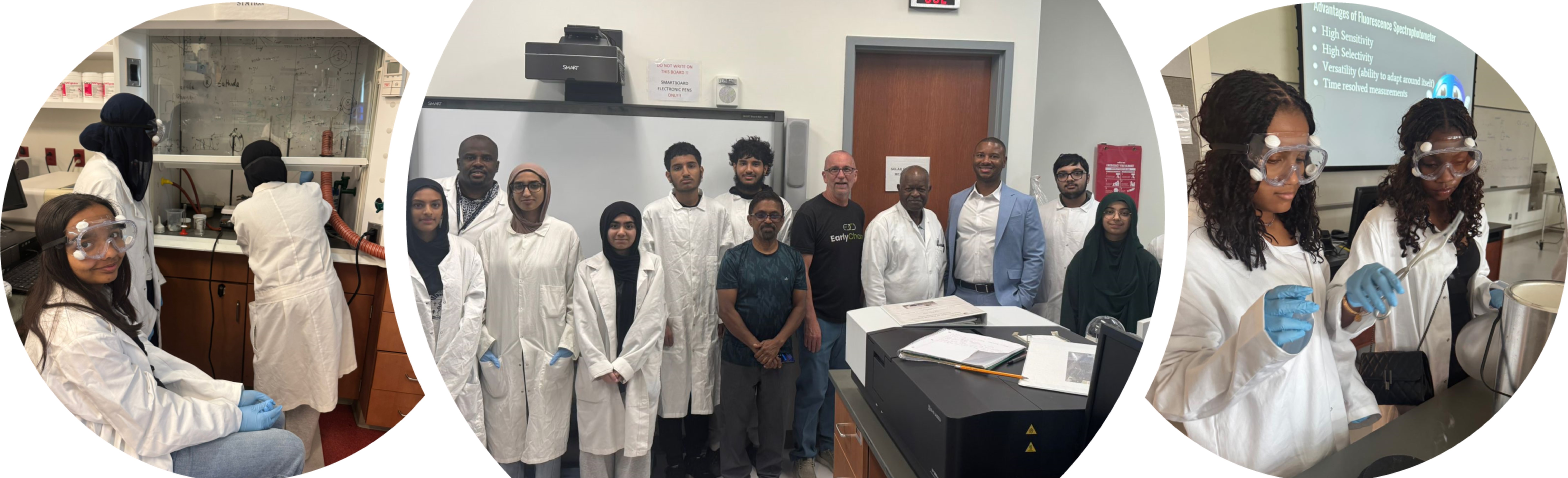
PICTURE OF STEM INTERNSHIP STUDENTS

Summer Internship Opportunities at the Center for Nanotechnology

The Center for Nanotechnology at Coppin State University is offering summer internship opportunities for high school students interested in hands-on research and STEM exploration.

The internship will run from June 24 to August 21, providing students with valuable experience in a research laboratory environment.

Interested students should email their resume to Dr. Jamal Uddin (juddin@coppin.edu) or Dr. William Ghann (wghann@coppin.edu) to apply.


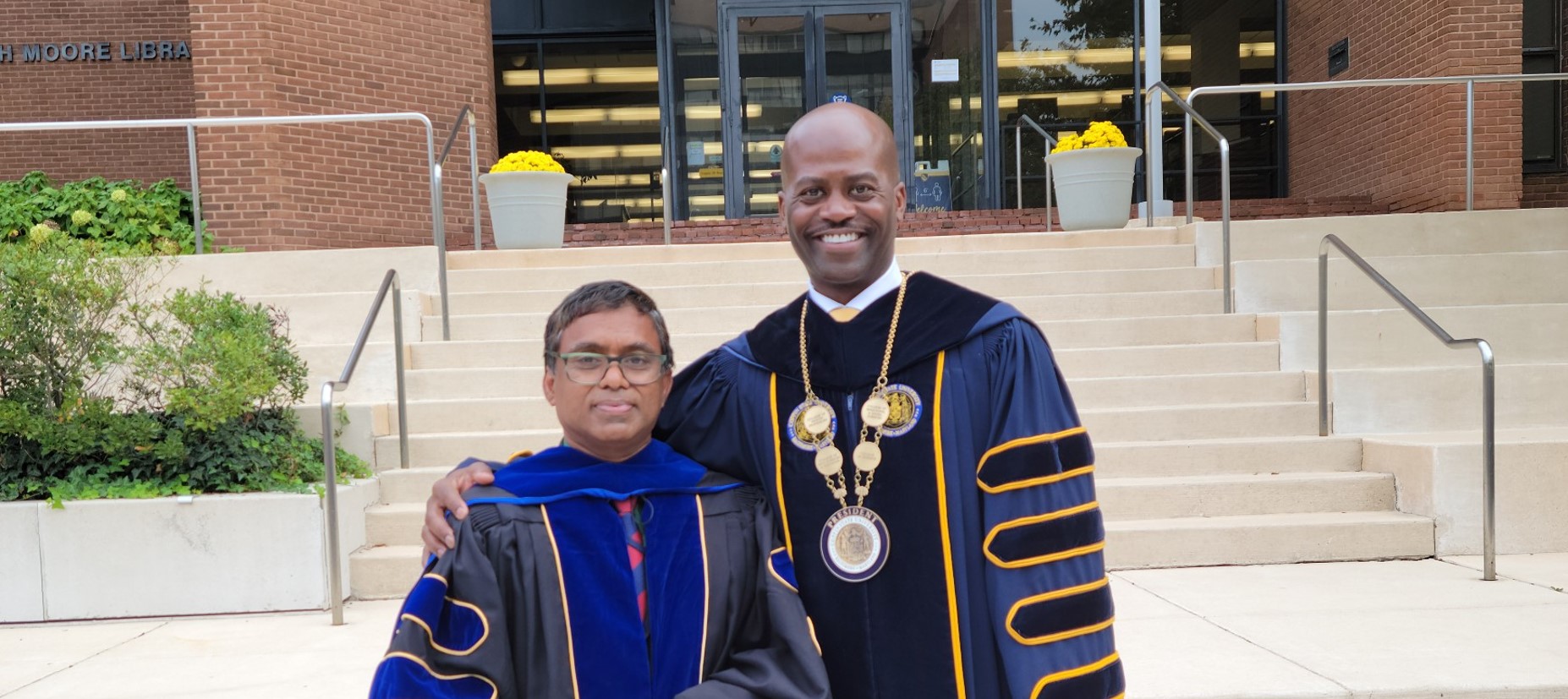
Investiture of President Jenkins

The Center for Nanotechnology is home to an array of impressive state-of-the-art equipment. Founded in 2007 by Dr. Jamal Uddin, the center is currently located on the third floor of the Science and Technology Center on the Coppin State University campus. A talented team of faculty, staff, and students conduct research at the center. Research efforts, funded by several organizations, encompass dye sensitized solar cells, terahertz technology, and biomedical application of gold nanoparticles. Funding organizations include Constellation—an Exelon company, Department of Education (Safra Title III Grant) TEDCO, Department of Defense, and the University System of Maryland. The center has received recognition and awards for research findings, which have also been published in several highly regarded peer-reviewed journals such as Nature Scientific Reports and Inorganic Chimica Acta. The research team periodically undertakes field trips, attends, and organizes conferences and workshops annually.

Constellation_Logo

E2 Energy to Educate

For thirteen consecutive years (2011-2024), the Center for Nanotechnology has been awarded the Constellation’s E2 Energy to Educate grant, receiving a total of approximately $500,000. The 2024 project, titled “Engaging STEM Youth in Baltimore City and the Greater Baltimore Area to Explore the Biosynthesis and Characterization of Fluorescent Carbon Nanoparticles for Energy Conversion and Storage at Coppin State University," has been the latest to be funded.

Check Out Our Past Events

2011 Daily Record Innovator of the Year Award

Innovator of the Year Award (2016)

2nd International Symposium

Contact Us

Thank you for your interest in the Center for Nanotechnology at Coppin State University. We welcome any questions and feedback you have. If you would like more information on anything you have read about on this website you can, please contact the various means provided below:

Professor of Chemistry

faculty

Can Help With
Solar Cell Fabrication and Characterization
Nanomaterial Synthesis, Characterization and Application
Electrospinning and its applications
William Emmanuel Ghann, PhD.
Research Associate

faculty

Instrumentation Technician

faculty

Coppin Center for Nanotechnology - where science is done at the nano level

Early Childhood Education

Early Childhood Education

Degree Type

Bachelor of Science

About

Discover the wonder in helping a child experience and master something new.

Introduction

Seeing the world through a child’s eyes can be awe-inspiring. Helping a child learn new ways to see and interact with the world can feel fulfilling and life-changing. With a Maryland State Department of Education (MSDE) approved early childhood education degree, you’ll have the academic, professional, and hands-on experience to make an impact on children during some of the most developmentally important times in their lives.  

Accreditation

The Early Childhood Education Program is approved by the Maryland State Department of Education (MSDE), recognized by the National Association for the Education of Young Children (NAEYC), and accredited by the Council for the Accreditation of Educator Preparation (CAEP).

What You'll Learn

Qualified Teacher Education

In the Department of Teaching and Learning, our goal is to prepare well-qualified teachers for instruction in preschool through third grade classrooms. We provide prospective teachers with the experiences you need to create learning objectives, organize curricula, and understand school procedures and instructional resources.

We also expose students to real-world classroom environments through our Professional Development School (PDS) sites. These classroom experiences help our students:

  • Analyze teaching situations and challenges

  • Select, organize, and present subject matter

  • Use evaluation techniques on teaching and learning results

  • Apply theories and principles of learning

Students studying

750+ Course Options

The Coppin State University Academic Catalog has a wide variety of skill-building courses designed to inspire and prepare you to be in-demand professionals and transformational leaders.

Program Requirements

To graduate with a Bachelor of Science in Early Childhood Education, students must complete 125 credit hours. These credit hours are split among:

  • General Education Requirements, or GERs (45 credits)

  • Program requirements (22 credits)

  • Core requirements (33 credits)

  • Methods and student teaching (25 credits)

General Education Requirements (GERs)

All early childhood education majors must take (or transfer in) 45 credits.

CoursecreditsName
ENGl 1013English Composition I
ENGL 1023English Composition II

WLIT 207

or

ENGL 2xx

3

World Literature

or

200 Level English

HIST 2053African American History I
HIST 2063African American History II
BIOL 1014Biological Science

MATH 131

or

MATH 203

3

College Algebra

or

Basic Statistics

PHSC 1014Physical Science
PSYC 201 3Introduction to Psychology
PHIL 1023Introduction to Philosophy
HLTH 1013Personal Health
IDIS 1033Visual Arts and Theatre
SOCI 2013Introduction to Sociology
MISY 1503Technology Fluency
FRSEM 1011Freshman Seminar

Program Requirements (22 credits)

CoursecreditsName
MATH 1033Math for Elementary Teachers I
MATH 1043Math for Elementary Teachers II
MATH 2073Technology-Based Math
PHSC 1024Earth and Space Science
GEOG 1023World Geography
PSYC 3043Child Psychology
ENGL 3213Children's Literature

Core Courses (33 credits)

CourseName
ECED 301Child Growth and Physiological Development
ECED 329Principles and Practicum in Early Childhood
EDUC 330Culture and Cognition
EDUC 331Practice What You Teach
EDUC 201Introduction to Race and Inequality
EDUC 202Educational Psychology
EDUC 300Foundations of Reading
EDUC 408Measurement and Evaluation
REED 401Diagnosis and Remediation of Reading Disorders
REED 405Strategies and Materials for Teaching Reading
SPED 201Introduction to Needs of Exceptional Individuals

Methods and Student Teaching (25 credits)

CourseName
ECED 331Methods of Teaching Social Studies in Early Childhood
ECED 333Methods of Teaching Reading in Early Childhood
ECED 337Methods of Teaching Science in Early Childhood
ECED 338Methods of Teaching Math in Early Childhood
ECED 390Practicum in Early Childhood Education (Internship Part I)
ECED 411Directed Teaching
ECED 412Seminar

Remember! You must complete all major and prerequisite courses with a grade of C or higher.

Sample Degree Plan

This plan is only for example purposes. Your academic journey may be slightly different from another student’s, so be sure to always communicate with your academic advisor before finalizing your course schedule.

Fall Semester (16 credits)

Course

credits

name

ENGL 101

3

English Composition I

PSYC 201

3

General Psychology

MATH 131

or

MATH 205

3

College Algebra

or

Basic Statistics

IDIS 103

3

Visual Arts & Theatre

MIST 150

3

Technology Fluency

FRSEM 101

1

Freshman Seminar

Spring Semester (16 credits)

course

credits

name

ENGL 102

3

English Composition II

MATH 103

3

Math for Elementary Teachers II

BIOL 101

4

Biological Science 

HIST 205

3

African American History I

HEED 101

3

Personal Health

Fall Semester (16 credits)

Course

credits

name

MATH 104

3

Math for Elementary Teachers I

PHSC 101

4

Physical Science

WLIT 207

3

World Literature

PHIL 102

3

Introduction to Philosophy

SOCI 201

3

Introduction to Sociology

Spring Semester (16 credits)

Course

credits

name

PHSC 102

4

Earth and Space Science

MATH 207

3

Technology-Based Math

GEOG 102

3

World Geography

EDUC 300

3

Foundations of Reading

HIST 206

3

African American History II

Fall Semester (18 credits)

Course

credits

name

EDUC 201

3

Introduction to Race and Inequality

EDUC 202

3

Educational Psychology

ECED 301

3

Child Growth and Development

ECED 329

3

Principles and Practices in EC

ENGL 321

3

Children's Literature

REED 401

3

Diagnosis and Remediation of Reading Disorders

Spring Semester (18 credits)

course

credits

name

EDUC 330

3

Culture and Cognition

EDUC 408

3

Measurement and Evaluation

PSYC 304

3

Child Psychology

SPED 201

3

Introduction to Exceptional Individuals

REED 405

3

Reading Materials and Strategies

EDUC 331

3

Practice What You Teach

Fall Semester (13 credits)

Course

credits

name

ECED 330

3

Reading Methods

ECED 331

3

Social Studies Methods

ECED 337

3

Science Methods

ECED 338

3

Math Methods

ECED 390

1

Practicum in Early Childhood Education (Internship Part I) 

Spring Semester (12 credits)

Course

credits

Name

ECED 411

9

Internship

ECED 412

3

Seminar

More Teacher Education Programs

Early Childhood Human Development

Undergraduate

Elementary Education

Undergraduate

Special Education

Undergraduate

Teaching

Graduate
College

Early Childhood Education lives in the Department of Teaching and Learning in the School of Education within the College of Arts & Sciences, and Education.

Department of Teaching and Learning

Department of Teaching and Learning

School of Education

We graduate teacher candidates who are excited to open doors to new worlds for young learners. 

Preparing the Next Generation of Educators

The Department of Teaching and Learning continues our historic legacy of preparing future teachers to make a difference in the lives of students in Baltimore and beyond. When Coppin was founded in 1900, it had one program designed to prepare African-American elementary school teachers.

In 1950, when Coppin joined the Maryland higher education system (now called University System of Maryland, USM) we became Coppin Teachers College. Still later, our name changed again, this time to Coppin State Teachers College. Teaching is in the fabric of who we are as a University and a department; it colors everything we do and our dedication to our students.

We set rigorous standards for our undergraduate and graduate programs in early childhood education, elementary education, and special education, which are reflected in each program’s accreditation by the Council for the Accreditation of Educator Preparation (CAEP), and approval from the Maryland State Department of Education (MSDE).

We stay committed to graduating teacher candidates who seek to be positive change agents in the lives of the students they serve. To align with MSDE’s redesign of Teacher Education, we equip our students to be data-driven decision makers and competent professionals with strong:

  • Academic background,

  • Hands-on professional experience and

  • Pedagogical and theoretical knowledge.

Our Programs

Early Childhood Education

Undergraduate

Early Childhood Human Development

Undergraduate

Elementary Education

Undergraduate

Special Education

Undergraduate

Teacher Leadership

Graduate

Teaching

Graduate
A smiling male student types on a computer

Writing Center

Current student? Report a complaint or concern.

Report a concern or complaint
students walking upstairs

Math Center

Get peer and professional help for all kinds of math problems.

Contact Us

Our teaching legacy has built a firm foundation for us to welcome renowned faculty to our department. With celebrated skills and expertise, professors guide each of our teacher candidates through program requirements, serving as mentors, advocates, and change agents themselves. 

Interim Chairperson and Assistant Professor

faculty

Can Help With
Elementary Education
Urban Education
Curriculum and Instruction
Interim Associate Dean and Associate Professor

faculty

Associate Professor

faculty

Assistant Professor

faculty

Assistant Professor

faculty

Administrative Assistant II

staff

Executive Director and Research Professor

faculty

Assistant Professor

faculty

Assistant Professor

faculty

Forms and Downloads

Find it now
College

The Department of Teaching and Learning lives within the School of Education in the College of Art & Sciences, and Education.
EPP Accreditation

EPP Accreditation

School of Education

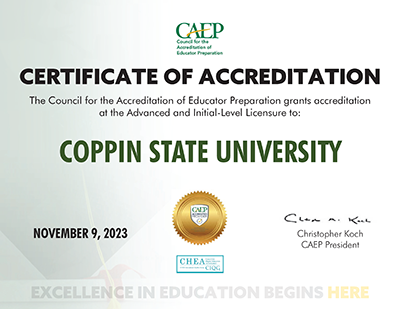
CERTIFICATE OF ACCREDITATION The Council for the Accreditation of Educator Preparation grants accreditation at the Advanced and Initial-Level Licensure to: COPPIN STATE UNIVERSITY NOVEMBER 9, 2023
Council for the Accreditation of Educator Preparation Certificate of Accreditation

CAEP Accountability Measures

(Formerly known as CAEP Annual Reporting Measures)

CAEP has identified four (4) reporting measures that educator preparation providers (EPP) are required to track and document on an annual basis. CAEP Accountability Measures focus on two (2) areas: Impact Measures and Outcome Measures. Below is a summary of those measures.

Impact MeasuresOutcome Measures
Measure 1: Completer Effectiveness and Impact on P-12 learning and developmentMeasure 3: Candidate Competency and program completion
Measure 2: Satisfaction of employers and stakeholder involvementMeasure 4: Ability of completers to be hired in education positions for which they have been prepared

Impact Measures

The data on completer effectiveness and impact on P-12 learning and development is aligned to CAEP Component R4.1.

The Employer Satisfaction Surveys as well as the Completer Satisfaction Surveys are administered through the University’s Office of Institutional Research for each completer and employer for up to three years following program completion to ensure consistency and triangulate data. This action will afford the EPP clear insights into the satisfaction of employers.

Outcome Measures

The EPP demonstrates that completers can effectively apply professional knowledge, skills, and dispositions through the collection of several key assessments. The EPP determines candidate competency at the completion of the program using the summative student teaching evaluation instrument and a cumulative electronic portfolio. In addition, a team of faculty and mentor teachers conduct exit interviews, which includes measures related to non-academic factors, specifically dispositions, to serve as another measure to triangulate data and assess candidates’ readiness to exit the program.

The EPP defines program completers as candidates who have met all program requirements, which include the state required Praxis II certification assessments. Praxis II reflects completers’ ability to meet state certification requirements and competencies at program completion. As a result, all candidates who are deemed a program completer have met all Praxis II requirements as reflected in the table below.

In addition to the ability of completers to meet state certification requirements, they must also meet EPP-created benchmarks. The measures designed by the EPP to assess candidate readiness for the field include:

  • Student teaching evaluation
  • Phase III electronic portfolio, with artifacts reflecting short- and long-term plans, impact on P-12 learning and development, and measures specific to the State of Maryland
  • Candidate exit interview, which also assess dispositional measures

Candidates enrolled in the Administrative I Certificate program are required to meet capstone requirements, which include assessments on seven key assessments, which include an ePortfolio.

The data to document initial and advanced candidates’ competencies at completion are available at the link below.

The State of Maryland does not track employment of the state’s EPP completers. As a result, the institution monitors employment in the field in which the candidate is prepared through direct outreach to completers. Outreach to program completers reflects that at the initial program level all completers are employed in a position for which they were prepared. The employment data are available at the link below. following employment numbers in the field for which the completers were prepared.

Additional Accreditation Details

The Coppin State University’s Education Preparation Provider (EPP) is accredited by the Council for the Accreditation of Educator Preparation (CAEP). During CAEP’s most recent 2023 visit, they reviewed the following certification programs:

program Academic level certification level 
Elementary Education Bachelor'sInitial
Elementary Education Master'sInitial 
Early Childhood EducationBachelor'sInitial
Special EducationBachelor's Initial
School AdministratorCertificateAdvanced


Maryland State Department of Education (MSDE) Approval

In addition to accreditation, the programs offered by the EPP are also approved by the Maryland State Department of Education (MSDE). This approval extends to all degree and certificate programs that lead to educator preparation, including: