Destination Page

Graduate Tuition and Aid

Graduate Tuition and Aid

Office of Financial Aid

Mon-Thu: 8:00 am - 5:00 pm
Fri: 8:00 am - 3:00 pm
Miles Connor Admin Bldg. 1st Floor
(410) 951-2551

Get Financial Aid for Graduate School

Graduate school is often more expensive than your undergraduate college experience, so it's important to research all available types funding to finance your education. There are federal financial aid options to pay for graduate school. Many graduate students seek scholarships, internships, assistantships, as well as federal financial aid options like grants, loans, and Federal Work-Study (FWS).

Apply for Graduate Federal Financial Aid

You must complete the Free Application for Federal Student Aid (FAFSA) to be eligible for any federal financial aid, including grants, loans, and Federal Work-Study (FWS). Go to our How to apply for financial aid page and follow the steps to complete your FAFSA before the priority March 1st deadline.

Can I get federal or state financial aid as an international student?

You must be a U.S. citizen or permanent resident of the United States to be eligible for federal and state financial aid. If you have your permanent residency card, you must be prepared to submit it as part of any financial aid application.

Additional Graduate Student Funding Opportunities

Federal financial aid isn't the only type of funding available to graduate students. Coppin offers several ways to help graduate students pay for books and materials, as well as cover certain life emergencies.

Student Emergency Loan Fund (SELF)

SELF is a loan available to cover urgent and emergent needs, including rent evictions, utilities turn off notices, transportation fare, childcare, and food. To be eligible, you must have an expected financial aid refund.

Check Your Eligibility

Coppin Bookstore Charge Authorization

Any student receiving financial aid, can charge up to $500.00 per semester at the Campus Bookstore for books and supplies. To be eligible, you must have an expected financial aid refund after semester charges have been applied.

Visit our Types of Financial Aid page to learn more about federal loans, grants, and Federal Work-Study (FWS) opportunities

Cost of Attendance

Cost to Attend

Invest in Yourself, Your Career, and Your Future


College is a big investment, so it is important to know the costs. Financial aid offers are based on a cost of attendance that is constructed using components designated by federal regulations. The cost of attendance is made up of:
 

  • Direct Costs: These are expenses that are paid directly to Coppin State University (CSU). They typically include tuition, fees, on-campus housing and meal plans.
  • Indirect Costs: These are expenses that are NOT paid directly to Coppin State University (CSU) but are anticipated costs for living and other personal expenses while you are enrolled. Examples of indirect costs include off-campus housing, transportation, and supplies.

The cost of attendance represents the maximum amount of financial aid that students may receive from all sources, including student loans. Actual cost may vary, and some programs may involve additional costs. 

2025-2026 Undergraduate Costs

All costs below are for the 2025-2026 academic school year.

Maryland Resident Living On Campus12 Semester Hours24 Semester Hours
Direct Costs (estimated) 
Tuition  $2,565.00 $5,130.00 
Mandatory Fees$1,144.00 $2,288.00 
Housing (Double Occupancy)$3,464.00 $6,928.00 
Indirect Costs (estimated) 
Food (Average)$2,786.00 $5,572.00 
Books and Supplies$950.00 $1,900.00 
Transportation $1,000.00  $2,000.00 
Personal$1,758.00 $3,516.00 
Loan Fees$38.00 $76.00 
Total Costs (estimated)$13,705.00 $27,410.00 


Undergraduate Maryland Resident Living Off Campus.png

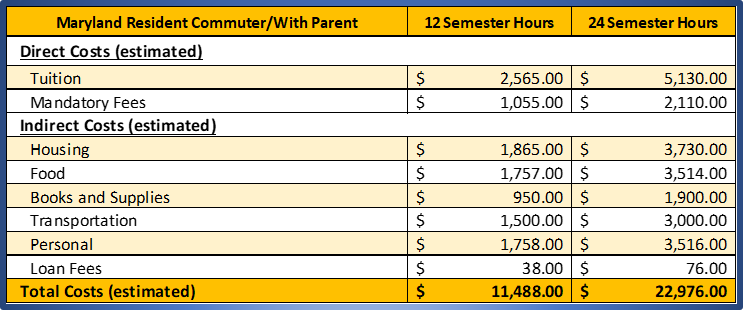
Undergraduate Maryland Resident Commuter With Parent.png

Undergraduate Maryland Non-Resident Living On Campus.png

Undergraduate Maryland Non-Resident Living Off Campus.png

Undergraduate Maryland Non-Resident Commuter With Parent.png

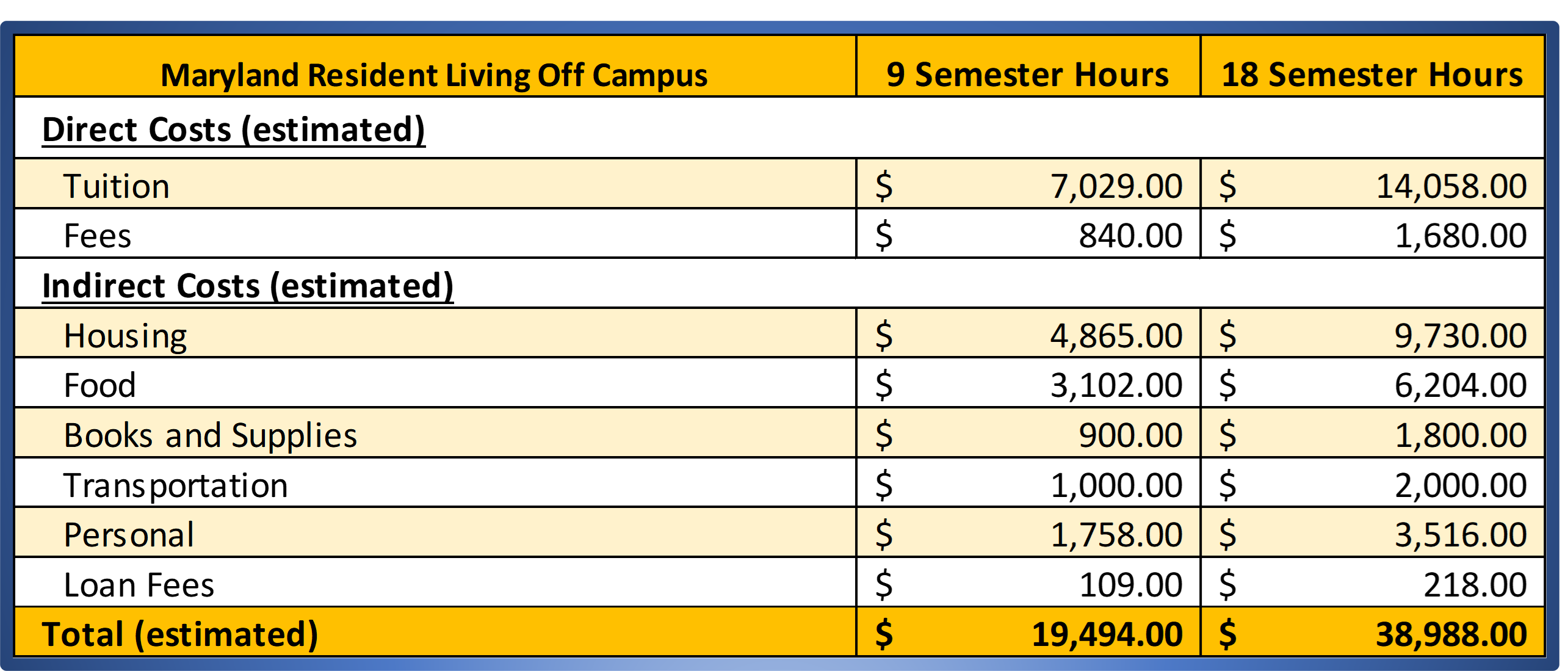
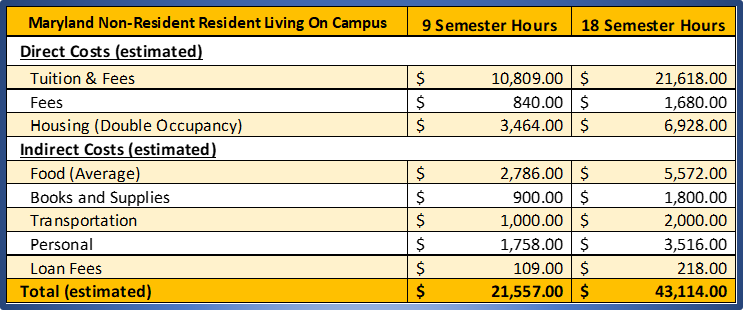
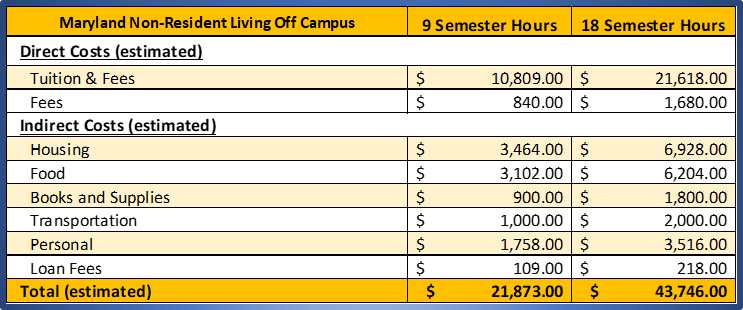
2025-2026 Graduate Costs

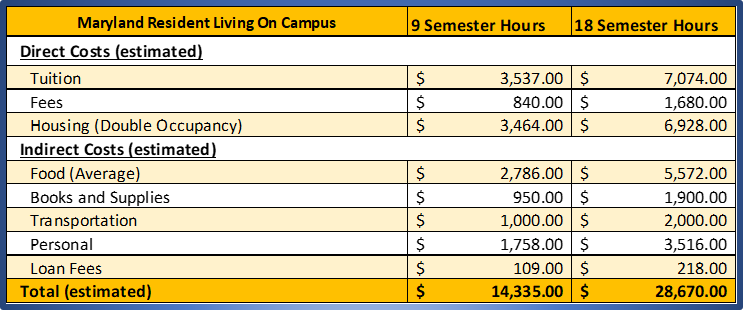
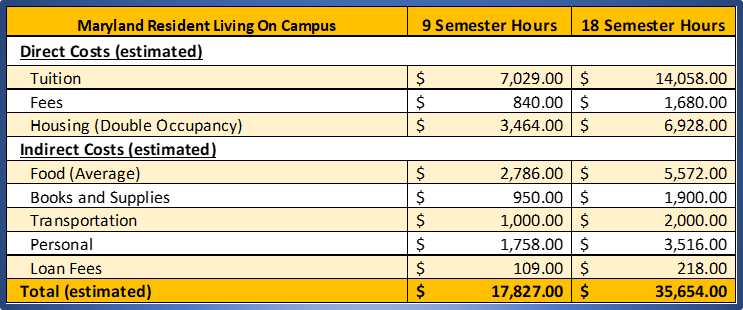
Graduate Maryland Resident Living On Campus.png

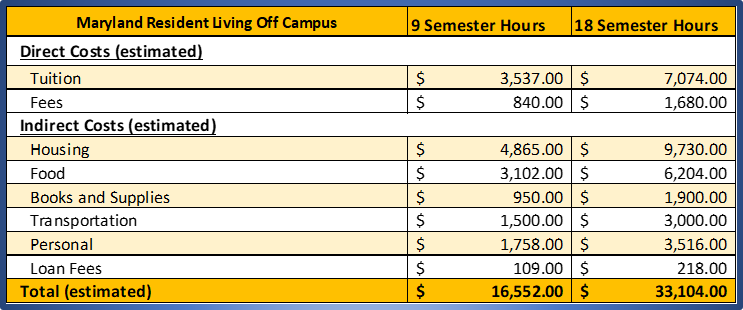
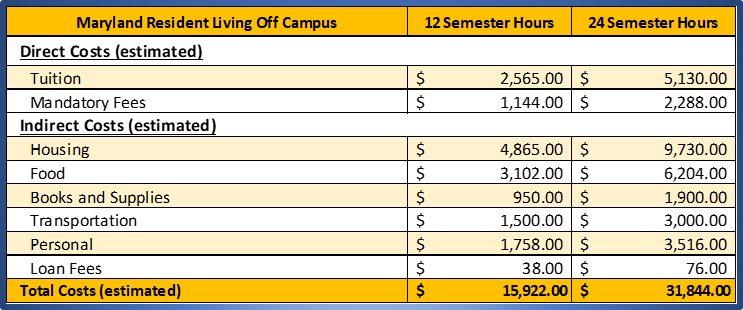
Graduate Maryland Resident Living Off Campus.png

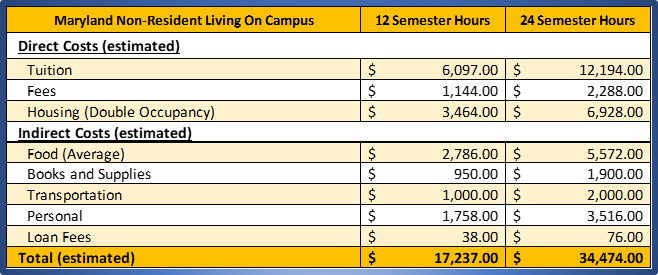
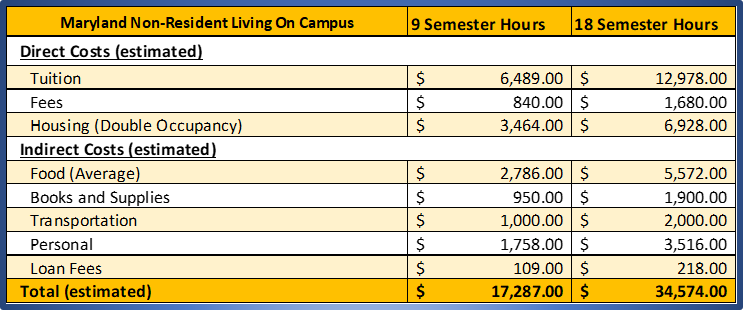
Graduate Maryland Non-Resident Living On Campus.png

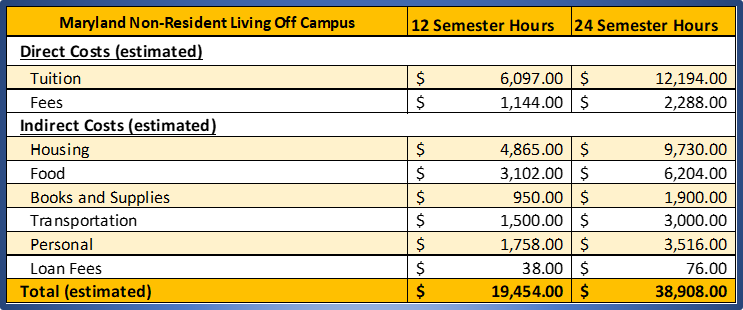
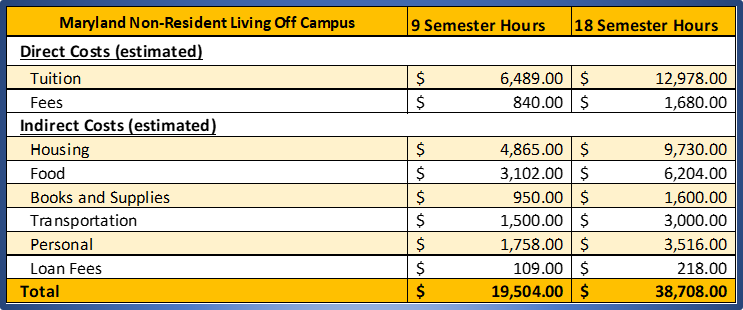
Graduate Maryland Non-Resident Living Off Campus.png

2025-2026 Doctoral Costs

Graduate Maryland Non-Resident Living Off Campus.png

Doctorate Maryland Resident Living Off Campus.png

Doctorate Maryland Non-Resident Resident Living On Campus.png

Doctorate Maryland Non-Resident Living Off Campus.png

2024-2025 Undergraduate Costs

All costs below are for the 2024-2025 academic school year.


12 Semester Hours

24 Semester Hours

Tuition

$ 2,516

$ 5,032

Mandatory Fees

$ 1,034

$ 2,068

Housing (Double Occupancy)

$ 3,299

$ 6,598

Food (Average)

$ 2,704

$ 5,408

Books and supplies (2)

$ 950

$1,900

Transportation (2)

$ 900.00

$ 1,800

Personal

$ 1,700

$ 3,400

Loan Fees

$ 200.00

$ 400

Total

$13,303

$26,406


12 Semester Hours

24 Semester Hours

Tuition

$ 2,516

$ 5,032

Mandatory Fees

$ 1,034

$ 2,068

Housing (Double Occupancy)

$ 4,705

$ 9,410

Food (Average)

$ 3,000

$ 6,000

Books and supplies (2)

$ 950.00

$ 1,900

Transportation (2)

$ 1,500

$ 3,000

Personal

$ 1,700

$ 3,400

Loan Fees

$ 200

$ 400

Total

$ 15,605

$ 31,210


12 Semester Hours

24 Semester Hours

Tuition

$ 2,516

$ 5,032

Mandatory Fees

$ 1,034

$ 2,068

Housing (Double Occupancy)

$ 1,804

$ 3,608

Food (Average)

$ 1,757

$ 3,514

Books and supplies (2)

$ 950

$ 1,900

Transportation (2)

$ 1,500

$ 3,000

Personal

$ 1,700

$ 3,400

Loan Fees

$ 200

$ 400

Total

$ 11,461

$ 22,922


12 Semester Hours

24 Semester Hours

Tuition

$ 5,978

$ 11,956

Mandatory Fees

$ 1,034

$ 2,068

Housing (Double Occupancy)

$ 3,299

$ 6,598

Food (Average)

$ 2,704

$ 5,408

Books and supplies (2)

$ 950

$ 1,900

Transportation (2)

$ 900

$ 1,800

Personal

$ 1,700

$ 3,400

Loan Fees

$ 200

$ 400

Total

$ 16,765

$ 33,530


12 Semester Hours

24 Semester Hours

Tuition

$ 5,978

$ 11,956

Mandatory Fees

$ 1,034

$ 2,068

Housing (Double Occupancy)

$ 4,705

$ 9,410

Food (Average)

$ 3,000

$ 6,000

Books and supplies (2)

$ 950

$ 1,900

Transportation (2)

$ 1,500

$ 3,000

Personal

$ 1,700

$ 3,400

Loan Fees

$ 200

$ 400

Total

$ 19,067

$ 38,134


12 Semester Hours

24 Semester Hours

Tuition

$ 5,978

$ 11,956

Mandatory Fees

$ 1,034

$ 2,068

Housing (Double Occupancy)

$ 1,804

$ 3,608

Food (Average)

$ 1,757

$ 3,514

Books and supplies (2)

$ 900

$ 1,800

Transportation (2)

$ 1,500

$ 3,000

Personal

$ 1,700

$ 3,400

Loan Fees

$ 200

$ 400

Total

$ 14,873

$ 29,746

2024-2025 Graduate Costs


9 Semester Hours

(per semester

18 Semester Hours

Tuition

$ 3,465

$ 6,930

Mandatory Fees

$ 808

$ 1,616

Housing (Double Occupancy)

$ 3,299

$ 6,598

Food (Average)

$ 2,704

$ 5,408

Books and supplies (2)

$ 950

$ 1,900

Transportation (2)

$ 900

$ 1,800

Personal

$ 1,700

$ 3,400

Loan Fees

$ 109

$ 218

Total

$ 13,826

$ 27,652


9 Semester Hours

18 Semester Hours

Tuition

$ 3,465

$ 6,930

Mandatory Fees

$ 808

$ 1,616

Housing (Double Occupancy)

$ 4,705

$ 9,410

Food (Average)

$ 3,000

$ 6,000

Books and supplies (2)

$ 950

$ 1,900

Transportation (2)

$ 1,500

$ 3,000

Personal

$ 1,700

$ 3,400

Loan Fees

$109

$ 218

Total

$ 16,128

$ 32,256


9 Semester Hours

18 Semester Hours

Tuition

$ 6,363

$ 12,726

Mandatory Fees

$ 808

$ 1,616

Housing (Double Occupancy)

$ 3,299

$ 6,598

Food (Average)

$ 2,704

$ 5,408

Books and supplies (2)

$ 950

$ 1,900

Transportation (2)

$ 900

$ 1,800

Personal

$ 1,700

$ 3,400

Loan Fees

$ 109

$ 218

Total

$ 16,724

$ 33,448


9 Semester Hours

18 Semester Hours

Tuition

$ 6,363

$ 12,726

Mandatory Fees

$ 808

$ 1,616

Housing (Double Occupancy)

$ 4,705

$ 9,410

Food (Average)

$ 3,000

$ 6,000

Books and supplies (2)

$ 950

$ 1,900

Transportation (2)

$ 1,500

$ 3,000

Personal

$ 1,700

$ 3,400

Loan Fees

$ 109

$ 218

Total

$19,026

$37,752

2024-2025 Doctoral Costs


9 Semester Hours

18 Semester Hours

Tuition

$ 6,894

$ 13,788

Mandatory Fees

$ 808

$ 1,616

Housing (Double Occupancy)

$ 3,299

$ 6,598

Food (Average)

$ 2,704

$ 5,408

Books and supplies (2)

$ 950

$ 1,900

Transportation (2)

$ 900

$ 1,800

Personal

$ 1,700

$ 3,400

Loan Fees

$109

$ 218

Total

$ 17,255

$ 34,510


9 Semester Hours

18 Semester Hours

Tuition

$ 6,894

$ 13,788

Mandatory Fees

$ 808

$ 1,616

Housing 

$ 4,705

$ 9,410

Food (Average)

$ 3,000

$ 6,000

Books and supplies (2)

$ 950

$ 1,900

Transportation (2)

$ 1,000

$ 2,000

Personal

$ 1,700

$ 3,400

Loan Fees

$109

$ 218

Total

$ 19,007

$ 38,014


9 Semester Hours

18 Semester Hours

Tuition

$ 10,593

$ 21,186

Mandatory Fees

$ 808

$ 1,616

Housing (Double Occupancy)

$ 3,299

$ 6,598

Food (Average)

$ 2,704

$ 5,408

Books and supplies (2)

$ 950

$ 1,900

Transportation (2)

$ 900

$ 1,800

Personal

$ 1,700

$ 3,400

Loan Fees

$ 109

$ 218

Total

$ 21,063

$ 42,126


9 Semester Hours

18 Semester Hours

Tuition

$ 10,593

$ 21,186

Mandatory Fees

$ 808

$ 1,616

Housing 

$ 4,705

$ 9,410

Food (Average)

$ 3,000

$ 6,000

Books and supplies (2)

$ 950

$ 1,900

Transportation (2)

$ 1,000

$ 2,000

Personal

$ 1,700

$ 3,400

Loan Fees

$ 109

$ 218

Total

$ 22,865

$ 45,730

Net Price Calculator

Use Coppin State University’s Net Price Calculator to estimate your cost to attend for one academic year. Net price reflects what you may pay after grants and scholarships are applied.

The estimate includes tuition and required fees, books and supplies, room and meal plans, and other related educational expenses.

To get started, select the button below and follow the prompts to enter your personal and financial information. The calculator uses data from students with similar profiles from the previous academic year.

Open Coppin State Net Price Calculator 


Office of Financial Aid

Office of Financial Aid

Coppin students and Eagle

Important Notice! Review Your Financial Aid Award for Fall 2025/Spring 2026

Log in to EagleLinks to review your financial aid package and complete any outstanding requirements.
Access EagleLinks Now

Welcome to the Office of Financial Aid

At Coppin State University, we understand the importance of making higher education affordable and accessible. Our dedicated team is here to guide you through the financial aid process, helping you explore options to fund your education and achieve your goals.


Application Deadlines

Staying aware of important financial aid deadlines is crucial to maximizing your funding opportunities:

  • FAFSA Availability: The Free Application for Federal Student Aid (FAFSA) for the 2025–2026 academic year will be available starting December 1, 2024.
  • FAFSA Priority Deadline: Submit your FAFSA by March 1, 2025, to ensure consideration for the maximum amount of financial aid.
  • Maryland State Financial Aid Deadline: The deadline for state financial aid applications is March 1, 2025.
  • Scholarship Application Deadlines: Deadlines vary by program; please refer to individual scholarship listings below for specific dates.


Note: Submit your FAFSA early using Coppin State University’s school code: 002068.


Financial Aid Opportunities

Explore the financial aid options available to Coppin State University students:

  • Scholarships

 Explore Scholarship

  • Grants

Explore Grants  

  • Loans

Explore Loans 


Important Updates for 2025


FAFSA Simplification Act

  • The FAFSA form has been simplified for a faster, user-friendly application process.
  • Expanded Pell Grant eligibility based on adjusted income guidelines.
     

State-Specific Programs

  • Guaranteed Access Grant: For low-income Maryland residents.
  • Delegate and Senatorial Scholarships: Contact your Maryland state representatives to apply

Estimate Your Costs

Coppin State University’s Net Price Calculator helps you estimate your cost of attendance and potential financial aid based on your individual circumstances.

Your estimate may include tuition and required fees, books and supplies, room and meal plans, and other educational expenses.

Estimate Your Cost with the Net Price Calculator 


Frequently Asked Questions

Complete the FAFSA at fafsa.gov using Coppin’s school code: 002068.

  • Tax returns (student and/or parent, if dependent)
  • W-2 forms or income records
  • Documentation of untaxed income

Log in to your EagleLinks account to view your application and award status.

Withdrawal and Dismissal Refund Policy

Withdrawal and Dismissal Refund Policy

The federal government provides federal financial aid to students to pay for school. There are circumstances when a student leaves school that may require you to repay some or all of the federal financial aid funds paid on your behalf.

These federal financial aid funds, known as Federal Title IV and Campus-Based Aid, include Federal Pell Grants, Federal Supplemental Educational Opportunity Grants (SEOG), Federal Direct Stafford Student Loans, and Federal Graduate Student or Parent PLUS Loans. Every school and institution that awards federal financial aid must have a refund policy for federal Title IV funds.

Mon-Thu: 8:00 am - 5:00 pm
Fri: 8:00 am - 3:00 pm
Miles Connor Admin Bldg. 1st Floor
(410) 951-2551

When am I responsible for repaying my federal loans?

Here are some common situations where you may be required to pay back your Federal Title IV and Campus-Based funds:

  • Withdraw from all classes either officially or unofficially
  • Are dismissed from the University
  • Leave the University before finishing 60% of the current semester

How does Coppin determine what I owe?

Federal law requires Coppin State University’s Office of Financial Aid (OFA) to use this formula to calculate what you owe.

(100% of total funds - percent (%) earned) x funds dispersed = $$ of aid you must repay

One of the numbers in the recalculation formula is percent earned. Here’s what it means and how we calculate it:

Percent earned = number of calendar days completed up to and including the withdrawal date ÷ total number of days in the semester/quarter

Per federal law, we have to consider scheduled semester breaks in recalculation. This means OFA excludes all breaks longer than 5 days, like Thanksgiving Recess, Christmas, or Spring Break, in our recalculation formula. Those scheduled breaks do not affect the amount of federal student aid earned.

What should I know about returning Title IV funds?

The U.S. Department of Education requires the return of Title IV funds paid to the school for “unearned” institutional charges. And you do not have to repay aid from federal programs you did not accept. OFA tells your loan service provider of your enrollment change within 30 days.

You have 45 days from the date OFA notifies your loan service provider of your withdrawal or dismissal to repay your funds. Refer back to your legally binding Master Promissory Note (MPN) for the terms and conditions of your repayment. Title IV funds must be repaid in the order they are dispersed at Coppin:

  1. Unsubsidized Direct Stafford Loan
  2. Subsidized Direct Stafford Loan
  3. Direct Graduate Student or Parent PLUS Loan

If part of your unearned Title IV funds includes a federal grant, you don’t need to repay more than 50% of the initial amount you’re responsible for repaying.

What happens if I don’t repay Title IV funds I owe?

OFA may report to the National Student Loan Data System (NSLDS) that you received an overpayment—which may affect your eligibility to receive additional Title IV aid for any school until resolved.

Sometimes OFA returning federal financial aid funds to the U.S. Department of Education creates a bill in the Office of Student Accounts. Remember this bill must be paid, or Student Accounts may send it to collections.

What is a post-withdrawal disbursement?

At times, you may be eligible for Title IV funds that have not been disbursed. Any student eligible for federal financial aid will automatically have these funds credited to their outstanding charges. If you are eligible for any grant funds, you will receive these funds first.

OFA notifies you about your loan eligibility if you don’t have any outstanding charges or you have a balance on your student account after disbursement. You have 14 days to respond to OFA’s notification about wanting all, part, or none of the loan(s). If you don’t respond, you will not receive the loan disbursement.

OFA considers several factors before calculating when a loan gets cancelled. A loan gets automatically cancelled if any of the following occur:

If you are a student selected for verification, and have not completed it, you are not eligible for federal financial aid, and therefore not included in this policy. Learn more about verification.

What is exit counseling—and do I need it?

Everyone who receives federal financial aid must complete exit counseling. The purpose is to help you prepare for loan repayment and personal money management.

Exit counseling covers important information on your rights and responsibilities regarding your student loan(s). Topics covered include:

Depending on your loan(s), exit counseling may be completed online or in person. Regardless, come prepared knowing the types of loans you have from your time at Coppin. Use your FSA User ID to login into the National Student Loan Data System (NSLDS) to access all of your loan information.

You are required to repay your student loans, so if you are having difficulty with payments, please reach out to your loan service provider.


  • A Stafford Loan promissory note has not been signed and submitted by the student before date of withdrawal
  • A student has not completed the Stafford Loan entrance loan interview before date of withdrawal
  • A first-time Coppin student withdraws from the University during the first 30 days of the semester
    • Your rights and responsibilities as a recipient of federal financial aid
    • Consequences of loan nonpayment
    • Repayment options
    • Debt management possibilities
    • Loan consolidation

Depending on your loan(s), exit counseling may be completed online or in person. Regardless, come prepared knowing the types of loans you have from your time at Coppin. Use your FSA User ID to login into the National Student Loan Data System (NSLDS) to access all of your loan information.

You are required to repay your student loans, so if you are having difficulty with payments, please reach out to your loan service provider.
How to Keep Your Student Loans in Good Standing

How to Keep Your Student Loans in Good Standing

You’re not alone if you need to borrow money to pay for your education. Many students at Coppin and other universities decide to apply for federal financial aid, scholarships, and other funding opportunities.

The Office of Financial Aid encourages all students to research other funding sources, including federal, state, local, private, and public grants, scholarships, student employment, as well as employer tuition assistance. We keep a database of scholarships and other funding, but it’s just as important for you to do your own research.

What all student borrowers should know

Working with student borrowers, our office has a lot of experience understanding what every student borrower needs to know. The biggest point to remember is that you must repay federal student loans. When you don’t repay a loan in repayment, it can put your loan in default.

The federal government does any and everything to get federal monies loaned to borrowers, and are well within their rights to seize your tax refund, garnish wages, and place liens on your property—all of which can damage your credit. Read on to learn how you can make smart decisions about your federal financial aid.

Borrowing and managing student and parent loans

Students and families who take out federal school loans are borrowing money to pay for school. Remember, any money you borrow must be repaid—even if you do not finish school. It is also important to remember that when you borrow money, you are agreeing to a contract for how you get the money, what it can be used for, how you repay it, and what your options are if you cannot or do not pay your loans back.

School can get expensive, so it may be tempting to borrow more than you need. We get it—but strongly encourage you to only accept loans based on actual need.

When your loans enter repayment, you will have to pay back everything you borrowed plus interest. Borrowing more than you need may lead to higher monthly payments for a longer time. Remember, you must repay your loans even if you do not finish your program and/or degree.

View and manage your loans through the National Student Loan Data System (NSLDS). Be ready with your FSA User ID because you can use it to login to NSLDS too. You can also contact the Federal Student Aid Information Center (FSAIC) via live chat, phone, or email.

When you have multiple loans, each loan may be with a different loan service provider. A loan servicer is a company the federal government assigns to handle the billing and repayment of your loans. Some well-known providers are FedLoan Servicing, Mohela, Nelnet, and ECSI, along with several others. Be sure you know who your providers are and how to contact them. The NSLDS is a good place to start.

Loan consolidation means to combine multiple loans into one loan so you have one bill and repayment plan. Borrowers must have at least one Direct Loan or Federal Family Education Loan (FFEL) to qualify for consolidation through a Direct Consolidation Loan. You may also qualify if you have Federal Stafford Subsidized, Unsubsidized, Perkins loans, or loans from another school attended in addition to Coppin.

Loans must be in grace, repayment, deferment, or default status to qualify for consolidation. They cannot be in in-school status. Consider learning more about loan consolidation and if it’s right for you.

Repaying student and parent loans

Repayment is the period of time where you must pay your school loans back. There are often several different options for repayment. Be sure to work with your loan providers for a repayment option that fits your employment status and other needs.

First, your loan service provider contacts you with the date your loan repayment starts and how much you owe. They usually contact you when one of the following events happens:

  • Graduation
  • Withdrawal from school
  • Drop below half-time enrollment

These events start the 6-month grace period before you must start repaying your loans. During the grace period, your subsidized loans don’t earn interest. Unsubsidized loans do earn interest, which is then added to your loan balance when it enters repayment. Repayment begins the day after your grace period ends, and your first payment is due within 60 days. Talk with your loan service provider about extending your grace period, if needed.

Each loan only has one grace period. You may be eligible for loan deferment if you re-enroll in school, but you will immediately return to repayment after you leave school. There are also options to pay your loans while you are enrolled in school. Contact your loan service provider to learn more.

Loan service providers commonly offer different types of repayment plans. Let’s look at the most common ones.

Standard repayment

With this plan, you’ll pay a fixed amount each month until your loans are paid in full. These plans often have a 10-year limit, so your monthly payments may be higher than other repayment plans, but you may pay less interest overall.

Graduated repayment

With this plan, you’ll start with a low payment that gradually increases every two years. These plans last for 10 years and can be a good choice if you expect steady salary increases.

This plan still earns interest that is part of your monthly payment. However, even with interest and graduated payments, you will not have any single payment be 3x more than any other payment.

Extended repayment

With this plan, you’ll pay an annual fixed amount or graduated amount over 25 years. This plan allows you to make smaller monthly payments over a longer period. Remember, even though your monthly payments may be smaller, you will pay more than the total amount of your loan because it will earn interest during the entire repayment period.

To be eligible for an extended repayment plan, borrowers must have certain types of loans:

  • $30,000 or more in outstanding Federal Family Education Loan (FFEL) loans and/or
  • $30,000 or more in outstanding Direct Loans

Getting help for loan default

Everyone can fall on hard times, so it’s important to know what can happen if you are unable to pay your loans as agreed. Your loan service provider may be able to help, so do not wait to contact them if you are struggling to repay your bills.

When you accept your loans and sign your Master Promissory Note (MPN), you also agree to conditions for repaying your loan(s) on time. Failure to repay your loan(s) can result in loan default, and other consequences.

There are options to available to help you prevent default:

Deferment is a period of time that postpones your student loans payments. During deferment for subsidized loans, interest doesn’t accrue. Deferment is usually available for students enrolled in courses at least half-time.

Forbearance is a time period when your monthly loan payments are temporarily suspended or reduced due to financial hardships. Common hardships include medical expenses, financial difficulties, or loss of employment.

Repayment options are available. Changing your repayment plan can be helpful if your life circumstances change. There are no penalties for changing to a different repayment plan.

When you sign your Master Promissory Note (MPN) it becomes a binding legal document. This means, when you break the terms of the MPN, like repaying your loans on time, you are breaking the law. Any of the loan providers, managers or guarantors of your loans can take legal action against you to recover the money you owe.

Serious consequences of loan default include:

  • Negative impact to your credit rating
  • Wage garnishment
  • Ineligibility for additional federal student aid
  • Legal action
  • Federal tax return garnishment

The Federal Student Aid (FSA) Ombudsman is a resource available to help students resolve disputes and problems regarding federal student loans. We also encourage you to reach out to your loan service provider.
Student Loan Default Rate at Coppin State University

Cohort Default Rate

In 2019 the default rate for borrowers at Coppin State University was 7%. A total of 1,005 Coppin State University students entered loan repayment in 2019. After three years, 7% of these students (71 out of 1,005) defaulted on their loans. 

A cohort default rate (CDR) is the percentage of a school’s borrowers who enter repayment on certain Federal Family Education Loan (FFEL) Program or William D. Ford Federal Direct Loan (Direct Loan) Program loans during a particular federal fiscal year (FY), October 1 to September 30, and default or meet other specified conditions prior to the end of the second following fiscal year.

A student is considered to be in default on a student loan if they have not made a payment in more than 270 days. The official student loan default rate for a school is calculated by measuring how many students are in default three years after graduation. Note that the default rate only takes into account federal loans, not private.

Student Rights and Responsibilities

Student Rights and Responsibilities

Mon-Thu: 8:00 am - 5:00 pm
Fri: 8:00 am - 3:00 pm
Miles Connor Admin Bldg. 1st Floor
(410) 951-2551

Understanding your financial aid can feel overwhelming, but we are here to help! Any student who receives financial aid has rights and responsibilities that are important to know. We’re here to empower you to make the best financial decisions for your Coppin education.

As a student recipient of financial aid, you are entitled to know:

  • Details about available financial aid programs
  • Processes to apply for financial aid
  • Criteria used to determine student eligibility and financial need
  • Policies and procedures around refunds and repayments
  • Policies and procedures on Satisfactory Academic Progress (SAP)
  • Rights and responsibilities of Coppin’s academic programs

As a student recipient of financial aid, you are responsible for:

  • Reading your Master Promissory Note (MPN) and disclosure statement to understand the terms and conditions of your Federal Direct Student Loan(s)
  • Submitting accurate information and forms to the Office of Financial Aid (OFA) on time
  • Updating the OFA on changes to your personal information, that may include name, address, marital status, financial situation, etc.
  • Communicating any other funding assistance from outside sources to the OFA—this may include scholarships, private loans, and educational benefits
  • Informing the OFA of any changes in your enrollment status
  • Maintaining Satisfactory Academic Progress (SAP)
  • Re-applying for financial aid by March 1st of each year

SAP Maximum Timeframe

Satisfactory Academic Progress (SAP) Maximum Timeframe

Mon-Thu: 8:00 am - 5:00 pm
Fri: 8:00 am - 3:00 pm
Miles Connor Bldg. 1st Floor
(410) 951-2551

You are allowed to hit 150% of the timeframe required to complete your program of study. If you take more than the required maximum amount of time to complete your program, you become ineligible to receive any additional financial aid. What does this look like in your real world when planning your Coppin education?

Example in table based on a 120 credit program
Enrollment Status # of Credits to Graduate Maximum of Attempted Credits (150%) Maximum Years/Semesters to Complete Program
Full-time (at least 12 credits/semester) 120 credit hours (4 years/8 semesters) 180 credits 6 years/12 semesters
Half-time (6-8 credit hours/semester) 120 credit hours (8 years/16 semesters) 180 credits 12 years/24 semesters
Graduate Students 30 credit hours (2 semesters) 45 credits 3 semesters


Subsidized Loans and Pell Grants

  • Federal student aid regulations limit the maximum Subsidized Loan for new students to 150% of their program of students.
  • Federal Pell Grant may only be received up to a maximum of 12 full-time semesters. Students exceeding 12 full-time semesters to complete their undergraduate degree will not be eligible for Federal Pell Grant funding (this includes dual degrees and change of majors).

SAP Qualitative Requirements

Satisfactory Academic Progress (SAP) Qualitative Requirements

Mon-Thu: 8:00 am - 5:00 pm
Fri: 8:00 am - 3:00 pm
Miles Connor Admin Bldg. 1st Floor
(410) 951-2551

As an Undergraduate student financial aid recipient, you must maintain a cumulative grade point average (GPA) of 2.0 or higher (at least a C average).

The Office of Financial Aid reviews your GPA at the end of each semester:

  • If at the end of your first semester your GPA is less than 2.00, you will be notified and placed on Financial Aid Warning Status
  • If at the end of your second semester or end of the academic year your GPA falls below a 2.00, you will be placed on financial aid suspension

As a Graduate student financial aid recipient, you must maintain a cumulative GPA of 3.0 or higher (at least a B).

The Office of Financial Aid reviews your GPA at the end of each semester:

  • If at the end of your first semester, your GPA is less than 3.00, you will be notified and placed on Financial Aid Warning Status
  • If at the end of your second semester or end of the academic year your GPA falls below a 3.00, you will be placed on financial aid suspension

What does this mean at the coursework level for both undergraduate and graduate students?

  • Successful coursework completion: A, B, C, D, P
  • Unsuccessful coursework completion: F, W, I, X, AU

SAP Quantitative Requirements

Satisfactory Academic Progress (SAP) Quantitative Requirements

Mon-Thu: 8:00 am - 5:00 pm
Fri: 8:00 am - 3:00 pm
Miles Connor Admin Bldg. 1st Floor
(410) 951-2551

67% is the number to remember when it comes to meeting Satisfactory Academic Progress (SAP) requirements.

Students receiving federal financial aid must complete at least 67% of all attempted coursework

Failure to complete at least 67% of your coursework, means that you will face the following penalties:

  • If not by the end of the first semester, you’ll be placed on financial aid warning status
  • If not by the end of the second semester, you’ll be placed on academic suspension

The number of credits you must complete each semester depends on your enrollment status. Enrollment status is determined by the number of credits you are attempting in the semester.

Undergraduate credit completion requirements

These credit requirements apply across fall, spring, and summer semesters.

# of Attempted Credits Enrollment Status # of Credits Required to Complete
12 or more  Full-time 9
9 - 11.5 3/4 time 8
6 - 8.5 1/2 time 6
1 - 5.5 less than 1/2 time Must complete all credits attempted

Graduate student requirements

If you are a graduate student, your requirements are based on the 9 credit hour full-time enrollment measurement.

If you have transfer credits that apply toward your degree, including those from institutions outside the United States, they may be included in your completion rate calculation.

Satisfactory Academic Progress (SAP)

What is Satisfactory Academic Progress (SAP)?

Financial Aid Satisfactory Academic Progress (SAP) is an important policy because it affects your federal financial aid. It was created in 1965 as part of the Higher Education Amendment Act which requires schools to establish a minimum standard for SAP. Students who do not meet the criteria for SAP are not eligible for federal financial aid.

Mon-Thu: 8:00 am - 5:00 pm
Fri 8:00 am - 3:00 pm
Miles Connor Admin Bldg. First Floor

Students receiving federal financial aid must meet all 3 SAP requirements:

  • Qualitative grade point average (GPA): Undergraduate students must maintain a cumulative 2.0 GPA. Graduate students must maintain a cumulative 3.0 GPA
  • Quantitative analysis: All financial aid recipients must complete at least 67% of all attempted coursework.
  • Maximum timeframe: All financial aid recipients must complete their academic program within 150% of the maximum timeframe to complete

When is SAP evaluated?

SAP evaluation for all students happens at the end of spring semester, except for students on financial aid appeal. Students on appeal may be evaluated on a different timeline.
SAP Appeal Form

What are the different SAP statuses?

There are 3 different SAP statuses.

  • Meet SAP: A student receiving federal financial aid is in good standing and meets all 3 minimum GPA, coursework, and timeline requirements.
  • Suspension: A student receiving federal financial aid has fallen below minimum GPA requirements and/or has met or exceeded the maximum 150% time frame to complete their academic program. Students on SAP suspension are not eligible for federal financial aid.
  • Probation: A student receiving federal financial aid who has submitted an appeal application which has been approved is placed on a one-term probation. Students who meet all SAP requirements while in probation return to good standing. Students who don’t meet all SAP requirements while on probation are no longer eligible for federal financial aid or to re-appeal, and are placed back on suspension.

How am I notified about changes in my SAP status?

OFA notifies all students placed on financial aid warning and suspension via the EagleLINKS student portal.

What every student should know about the SAP appeals process

What should I include in my SAP appeal?

You may submit an appeal when placed on suspension by completing a Financial Aid Satisfactory Academic Progress (SAP) Appeal. Please note, submitting an appeal does not guarantee approval. Your appeal must include:

  1. SAP appeal form
  2. Typed personal statement detailing why you failed to meet SAP, and how you will meet SAP the next semester
  3. Additional documentation that supports your personal statement
  4. Academic and success strategies plan outlining the coursework and any academic services you will use to ensure academic success

How do I appeal my SAP status?

Reach out to your Academic Outreach Coordinator to complete the SAP Process:

Make an appointment

Outreach Coordinator/CollegeContact Information
Mr. Brandon Herring - CBSS

410-951-3587

brherring@coppin.edu

EAC- 421

Mr. Jared Nichols - COB

410-951-3565

janichols@coppin.edu

EAC-414

Ms. Yolanda Goshay - CASE

410-951-3568

ygoshay@coppin.edu

EAC-412

Ms. Hillary Bain - CHP

410-951-3912

hbain@coppin.edu

EAC-416

Please note: SAP status is separate from academic dismissal or suspension.

What’s next if my appeal is approved?

You will be on a one-term financial aid probation, and allowed one semester/enrollment period of federal financial aid to improve your status to meet SAP. Students cannot receive incompletes, fail, or withdraw while on one-term probation.

Students who don’t meet all SAP requirements while on probation are no longer eligible for federal financial aid or to re-appeal, and are placed back on suspension.

What’s next if my appeal is denied?

You are no longer eligible for federal financial aid at Coppin. You can regain eligibility at your own expense by:

  • Completing 67% of total coursework
  • Achieving the minimum cumulative undergraduate 2.0 GPA or cumulative graduate 3.0 GPA requirements

After meeting these SAP requirements at your own expense, you must complete a new appeal application if you want to be reconsidered for federal financial aid.

However, you cannot regain eligibility if you were denied an appeal for a maximum timeline extension. Also, eligibility cannot be established for being out of school for an extended time or paying for courses with your own funds.