Six Coppin Faculty Join USM Digital Accessibility Communities of Practice
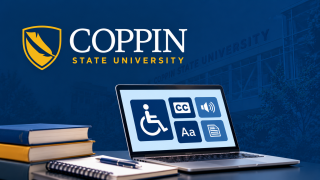
Faculty will collaborate with colleagues across Maryland to address accessibility challenges in STEM, music and the arts
BALTIMORE — Six Coppin State University faculty members have been selected to participate in the University System of Maryland’s Digital Accessibility Communities of Practice, an initiative focused on making college courses and instructional materials more accessible to all students.
The initiative, led by the William E. Kirwan Center for Academic Innovation, brings together more than 40 faculty members from USM and partner institutions to address discipline-specific accessibility challenges in STEM and Music & Arts.
“Accessible course design is essential to helping every student fully engage in learning,” said Dr. Chanta Haywood, provost of Coppin State University. “Our faculty bring valuable expertise to this collaboration, and the practices they develop will strengthen teaching at Coppin while supporting more inclusive learning experiences across Maryland.”
Representing Coppin in the Music & Arts Community of Practice are:
Morgan Banks, Visual Arts
Hasani Claxton, Visual Arts
Michael Klima, Theater
Representing Coppin in the STEM Community of Practice are:
Dondra Bailey, Biology
Hany Sobhi, Organic Chemistry
Mamadou Wade, Mathematics & Computer Science
Digital accessibility helps ensure that students with disabilities can effectively and independently access course materials and fully participate in their learning experiences. The Communities of Practice will give faculty an opportunity to work with colleagues across institutions to identify accessibility barriers, share effective practices and develop practical solutions.
The work will focus particularly on challenges found in STEM, music and arts courses, where instruction often relies on symbolic notation, multimedia, graphics, tables, images and other specialized content.
Participants will also help create resources that can be used across the University System of Maryland and throughout the state while building a network of faculty leaders focused on accessible and inclusive teaching.
Coppin’s participation expands the University’s ongoing work to strengthen digital accessibility and inclusive course design. It also follows the recent selection of three Coppin faculty members for USM’s 2026–2027 Boosting Course Accessibility Faculty Fellows program.
Together, these efforts reflect Coppin State University’s commitment to innovative teaching, academic excellence and creating learning environments where all students have the opportunity to succeed.