
Coppin State Undergraduate Researchers Examine Tree Canopy and Urban Heat in Baltimore
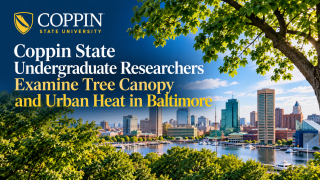
Student-faculty research published in Environmental Justice highlights the role of urban greening in creating healthier, more equitable communities.
BALTIMORE — Coppin State University undergraduate researchers Richard Fadipe and Breonna Taylor are contributing to important conversations about environmental justice and public health through a newly published study examining the relationship between tree canopy coverage and summer land surface temperatures across Baltimore neighborhoods.
The study, “Neighborhood Tree Canopy and Summer Land Surface Temperature in Baltimore, Maryland: A Descriptive Spatial Assessment with Implications for Environmental Justice Informed Planning,” was published online July 22, 2026, in the peer-reviewed journal Environmental Justice.
Fadipe and Taylor co-authored the article with faculty mentor Carlin D. Nelson, Ph.D., MPH, CPH, CHES, assistant professor and chairperson in Coppin State University’s Department of Health Sciences.
The researchers examined tree canopy coverage and summer land surface temperatures across 34 Community Statistical Areas in Baltimore. Their findings revealed a strong inverse relationship between tree coverage and summer surface temperatures. Neighborhoods with higher tree canopy coverage experienced average summer surface temperatures approximately 5 degrees Fahrenheit lower than neighborhoods with less tree coverage.
“Our findings show that tree canopy is more than an environmental feature; it is also a public health resource,” Nelson said. “By examining these patterns across Baltimore neighborhoods, we can better understand how urban planning decisions may help reduce heat exposure and support healthier, more equitable communities. It was especially meaningful to engage Coppin students in research connected so directly to the city we serve.”
The findings underscore the importance of urban greening as Baltimore and other cities consider strategies to reduce extreme heat, improve public health, and support more equitable community planning.
The study also demonstrates how undergraduate research at Coppin connects classroom learning with challenges affecting surrounding communities. Through faculty mentorship and hands-on research, students gain experience analyzing data, investigating health disparities and contributing to scholarship with implications beyond the campus.
“This experience showed me how data can be used to better understand challenges affecting our communities,” Fadipe said. “Contributing to published research strengthened my skills and allowed me to see how our work could help inform decisions that improve health and quality of life across Baltimore.”
“Being part of this research gave me the opportunity to apply what I have learned at Coppin to an issue affecting people in our own community,” Taylor said. “Seeing our work published is rewarding because it shows that undergraduate researchers can contribute meaningful insight to important public health and environmental justice conversations.”
Fadipe and Taylor’s achievement reflects the College of Health Professions’ commitment to preparing students to address real-world health and environmental challenges through research, service and community engagement.