Building What’s Next: Coppin’s Campus Transformation Takes Shape
More than $123 million in campus investments, along with new residence halls, classrooms, labs and dining options, are transforming the Coppin State University campus
BALTIMORE — Walk across Coppin State University’s campus today and you can see change taking shape.
Construction crews are at work. New spaces are emerging behind familiar walls. A new residence hall is rising. Classrooms and laboratories are being reimagined. New places to eat, study, live, and gather are on the way.
The work underway is the latest chapter in a significant investment in Coppin’s physical campus.
Over the last five years, Coppin State University has invested $108 million in major capital projects, including $44 million in the College of Business and $64 million in Thurgood Marshall Hall. In addition, the University has invested $15.5 million in approximately 60 smaller projects across campus.
Combined, those investments represent more than $123 million devoted to improving and expanding the places where Eagles learn, live, work and build community.
“This is about building the Coppin our students deserve and preparing our university for where we are going next,” said President Anthony L. Jenkins, Ph.D. “As our enrollment grows and our university continues to gain momentum, we must make sure our campus grows with us. We are investing in spaces that support learning, discovery, community and the overall student experience.”
A New Place to Call Home
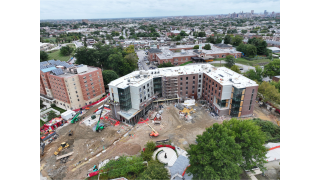
One of the biggest changes is also one of the hardest to miss: Coppin’s new 350-bed residence hall.
The building is quickly taking shape, with brickwork completed along the south side and the exterior curtain wall approximately 60% installed. Inside, drywall is going up on multiple floors, countertops are being installed, bedrooms and stairwells are being painted, and HVAC, electrical, and plumbing work continues.
Soon, those construction spaces will become bedrooms, suites and gathering places where hundreds of Eagles will make friends, study for exams, and create their own Coppin memories.
Arima Christopher, a freshman nursing major from Boston, is looking forward to being among the students who will call the new residence hall home.
“I’m really looking forward to living in the new residence hall and seeing what the experience is going to be like,” Christopher said. “I love that Coppin is making so many improvements for students.”
Coppin is already looking beyond the new building. Planning is underway for an additional 800-bed residence hall, including expanded dining capacity, to support the University’s future residential needs.
New Ways to Learn
The transformation extends into Coppin’s classrooms and laboratories.
In the Grace Jacobs Building, new School of Education model classrooms are nearing completion. The spaces are being designed to give future educators an environment that better reflects the classrooms and technology they will encounter in their careers.
Elsewhere in the Grace Jacobs Building, improvements are underway on a 3D Lab, while a new Office of Experiential Learning suite is being developed to support opportunities that connect classroom learning with professional experiences.
In the Henrietta Lacks Health and Human Services Building, construction is underway on a Mock Crime Scene Room, a specialized learning environment that will allow students to apply concepts and skills in a realistic setting.
Plans are also advancing for science laboratory improvements in the Miles Conner Building and Grace Jacobs Building, including new wet-lab spaces.
For Christopher, improvements to spaces students use every day can make a difference. She points to Coppin’s mindfulness rooms as an example of how campus spaces can support students academically and personally.
“I really love the mindfulness rooms because they give me a place where I can focus and study,” Christopher said. “It shows that the University is thinking about what students need.”
More Than Classrooms
Some of the most noticeable changes will happen outside the classroom.
New food and retail options are being developed across campus, including Talon, Coppin’s new C-Store; a planned Dunkin' location in the Henrietta Lacks Health and Human Services Building; and plans for Milk & Honey in Tawes.
The goal is to give students more options and more opportunities to stay connected to campus throughout the day.
“Every project starts with a question: How can this space better serve our students, faculty and staff?” said Stephen R. Danik, vice president for administration and finance. “Whether we are building a residence hall, renovating an academic space or adding new dining options, we are focused on creating a campus that is functional, welcoming and prepared to support Coppin’s continued growth.”
Refreshing the Places Eagles Already Know
The transformation is also reaching some of Coppin’s most familiar spaces.
Library construction is approximately 95% complete, with painting and lighting improvements nearing completion and new first-floor flooring moving forward. The work will provide students with refreshed spaces for studying, research, and collaboration.
The Physical Education Complex (PEC) is receiving attention as well. Renovations to the women’s volleyball locker room include new lighting, ceiling work, storage improvements, and relocated lockers. Additional improvements are being planned for other areas of the PEC.
Auditorium classroom renovations and new furniture have already been completed, providing students and faculty with another updated teaching and learning environment.
Campus signage is also being updated to reflect building name changes and make navigating Coppin easier for students, employees and visitors.
For Jesus Gonzales, a freshman nursing major from Baltimore, the improvements complement what has already stood out to him about his experience at Coppin.
“Coppin has such a warm, welcoming and friendly environment, and I love seeing all of the improvements happening around campus,” Gonzales said. “It shows that the University is continuing to make Coppin a better place for students.”
Building for Coppin’s Future
The scale of Coppin’s investment tells its own story. Over the past five years, the University has committed $108 million to major capital projects and another $15.5 million to approximately 60 smaller projects, touching academic, residential, athletic and student spaces throughout campus.
The transformation is about more than the dollars invested or the number of projects completed. It is about creating a campus that keeps pace with Coppin’s growth and provides students, faculty and staff with spaces that support how they learn, teach, work and connect.
Some projects will be completed soon. Others remain in design and planning. Together, they offer a glimpse of where Coppin is headed.
For President Jenkins, the transformation is another reflection of Coppin’s commitment to its students and to Baltimore.
“We are building for the students who are here today and for the generations of Eagles who will follow them,” Jenkins said. “There is tremendous energy at Coppin right now. You can see it in our students, you can feel it across our campus, and now you can literally watch our future being built around us.”
For students, faculty, staff and alumni who have watched Coppin evolve, the message across campus is becoming increasingly visible:
Something new is taking shape at Coppin. Eagle Nation is just getting started.